
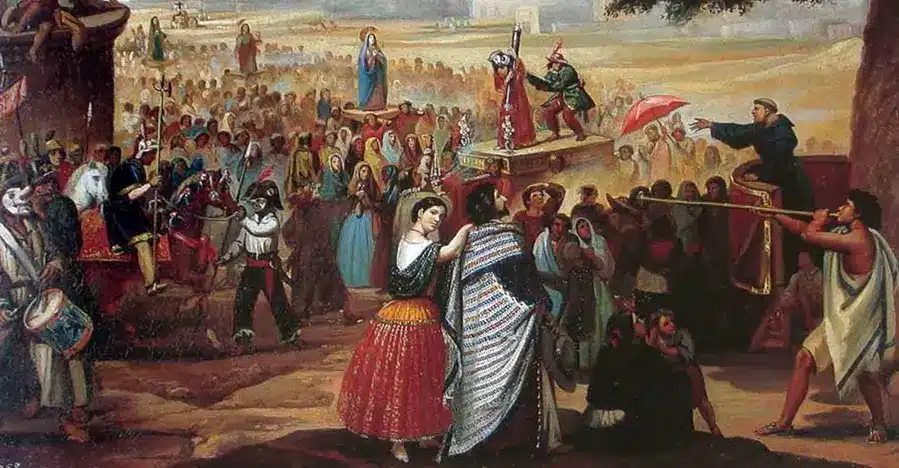
The Mesoamerican territories became part of the Catholic monarchy, under the viceregal administration organized by the Crown of Castile. During the 16th century, Novo-Hispanic life was reordered among new institutions, old adapted practices and constant tensions. At the center was the encomienda, tribute and the creation of indigenous cabildos that sought to give political form to the towns within the viceregal framework.
From Cortés’ military journey to the viceroyalty government
After the military journey led by Hernán Cortés and his indigenous allies against the power structure of the Mexica dominion, a political order subject to the Crown of Castile was established. The first peninsular actors sought to secure rights and rents, while the viceregal authorities asserted that all jurisdiction should be subordinated to the audiencias and the viceroy. This was the tone of the new arrangement: to take advantage of existing indigenous structures, but to subject them to viceregal government and taxation.
The encomienda: purpose, tensions and limits (1530-1555)
The encomienda distributed Indian villages to individuals to receive tribute and certain services. The Crown of Castile tolerated it with reservations, insisting on “good treatment” and evangelization as the main duty. Very soon curbs were imposed: taxation of tribute, judges with more interference and, from 1542, limitation of inheritance (first to one life and then to two in 1555). In practice, far from the cities, some encomenderos accumulated seigniorial power, which led to more vigilance and complaints from the towns.
Cabildos de indios and the “order of the republic”.
Since 1532, cabildos were introduced in indigenous towns, with authorities elected from among caciques and principals. The official objective was to conserve the communities and facilitate their indoctrination, but also to channel tribute and labor. This order more clearly separated the indigenous elites from the commons, exempting them from certain burdens, while the community base sustained increasing obligations. When the principals resisted, they could be replaced by figures more amenable to the interests of the authorities and businessmen.
From self-consumption to monetary economy
Indigenous peoples, accustomed to an economy of self-consumption with tribute in kind, were pushed toward monetary payments and deliveries of tradable goods. Spanish cities grew, centralizing markets and displacing local tianguis. The urban need for food and merchandise redirected trade flows, altering exchanges between towns and weakening previous balances.
Indigenous labor: from personal service to restrictions
Some encomenderos and businessmen forced their encomendados to work lands, estancias and mines. To contain abuses, personal service was gradually prohibited, favoring annual tribute. However, in urban works or regions with a shortage of labor, viceroys – from Antonio de Mendoza to Luis de Velasco – tried to regulate rotating services and “fair” payments. The practice went beyond the norm: long transfers, retentions and low salaries disorganized families and communities.

Indigenous slavery and undercover seats
Initially, the enslavement of Indians captured in “just war” or “ransomed” was allowed, but the royal decree of 1548 ordered their liberation. In mines and laundries, resistance persisted, disguised in “asientos”: contracts that nominally established free labor, but with de facto coercion. Their prohibition revealed the tension between viceregal legality and exploitation practices in productive zones.
Epidemics and demographic decline
Smallpox introduced during the war and other diseases -especially the cocoliztli of 1548- hit the indigenous populations hard. Estimates vary, but all agree on a severe decline throughout the 16th century. Less population meant a crisis for a system based on indigenous tribute and forced adjustments in labor and taxation.
New social groups: mestizos, blacks and “little people”.
The introduction of enslaved blacks for mines and sugar cane, the increase of mestizos and the mobility of mulattos and other groups added complexity to the legal order of “two republics” (Indians and Spaniards). Viceregal authorities looked askance at conspiracies and disorders, while the normative framework fell short of the social reality.
Conclusion
The 16th century in New Spain was a political and social laboratory. The Crown of Castile limited local powers through audiencias, appraisals and succession rules, but the facts of the land – urban markets, labor demand, epidemics and human diversity – continually reconfigured the balance. From the encomienda to the indigenous cabildo, from the local tianguis to the urban plaza, daily life was rearranged under the viceroyalty of New Spain, setting up the tensions that would mark the seventeenth century.
Frequently asked questions: economy and society in the first viceregal century (1520-1600)
What was the encomienda and how did it differ from a manor?
The encomienda was the assignment of indigenous towns to individuals to receive tribute and certain services, under viceregal supervision. Unlike a lordship, it did not grant full jurisdiction: the Royal Audiencia of Mexico and the viceroy could intervene and limit the encomenderos.
Why did the Crown of Castile limit the power of the encomenderos?
To avoid local autonomy and abuses. Tax assessments, judges with greater interference and succession restrictions (one life in 1542 and two lives in 1555) were imposed, reinforcing the viceregal administration.
What was the role of the cabildos de indios (from 1532)?
They ordered the local political life with elected authorities among chiefs and principals, exempted from some charges. They functioned as a cog in the republican order, channeling tribute and labor, although they also reinforced internal inequalities.
What does the “two republics” scheme mean?
It is the legal division between the republic of Indians and the republic of Spaniards to govern a diverse society. In practice, mestizos, blacks, mulattos and other castes overflowed this framework, generating tensions and controls.
How did we move from self-consumption to a cash economy?
Indigenous peoples, previously focused on self-consumption and in-kind tribute, were pushed into cash payments and tradable goods. Urban growth centralized markets and weakened local tianguis.
What was personal service and why was it restricted?
It was the obligation of direct labor of the indigenous people for works and enterprises. Due to abuses and community disorganization, it tended to be prohibited or strictly regulated, favoring the annual tribute.
What happened to indigenous slavery and the “seats”?
The royal decree of 1548 ordered the liberation of enslaved Indians. Attempts persisted to cover up coercion by means of asientos (nominally free contracts), which were prohibited for reproducing situations of servitude.
What was the influence of epidemics (smallpox, cocoliztli of 1548)?
They caused a severe demographic decline, affecting the system based on tribute and indigenous labor. This forced fiscal and labor adjustments in the second half of the 16th century.
What was the Marquesado del Valle de Oaxaca and why was it not a separate “State”?
A privilege granted to Hernán Cortés with vassals and private justice, but subject to the Royal Audiencia of Mexico. In practice it functioned as a large encomienda, without sovereignty over the viceroyalty.
How did the growth of Mexico and other cities impact the markets?
Cities demanded constant supply, attracting production and consumption to urban plazas. Tianguis in small towns were restricted in order to concentrate circulation in larger centers.
Who were the “little people” and why were the authorities concerned?
Mestizos, mulattos, blacks and other groups with high mobility and little fit within the legal framework. Their movement through towns, cities and mining estates was perceived as a focus of lawsuits and disorder.
What changed with the viceroys Antonio de Mendoza and Luis de Velasco (1550-1564)?
The containment of local powers was consolidated: appraisals, justice closer to the people and rules for personal service. The objective was to strengthen viceregal authority and reduce abuses against indigenous communities.
How do you formulate the general framework of the period without anachronisms?
“The Mesoamerican territories became part of the Catholic monarchy, under the viceregal administration organized by the Crown of Castile.” This sentence summarizes the political process without simplifications or inaccurate terms.
What was the role of the military journey of Cortés and his indigenous allies?
It opened the way to viceregal government, taking advantage of pre-existing indigenous political structures. From then on, authority was subordinated to audiences and viceroys, not to individual caudillos.
Was there continuity of the indigenous communities despite the changes?
Yes, but with reconfigurations: cabildos, tax burdens, changes in family and work, and loss of ecological and commercial balances. Indigenous agency persisted amidst adaptations, resistance and local negotiations.