
México independiente

Diego Rivera Murals
May 22, 2025

Diego Rivera’s murals

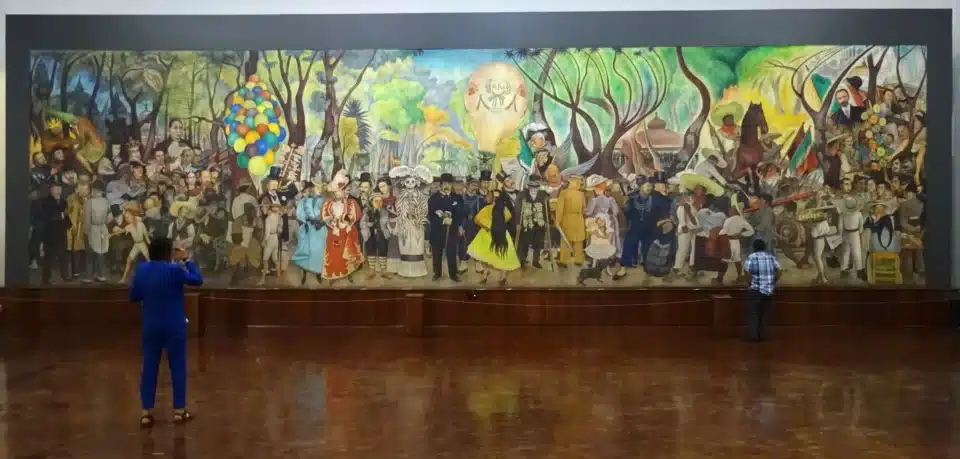
The Historic Center houses the most outstanding civil building, which is resplendent with a significant collection of works by the influential artist of the twentieth century, that is, the murals of Diego Rivera. His mastery of the fresco painting technique played a crucial role in the construction of the identity of a nation in full transformation after the Revolution.

History of Mexico
Read More Diego Rivera’s murals

Independent Mexico: nation under construction
The period of Independent Mexico began in 1821, after the entrance of the Trigante Army to Mexico City and the signing of the Treaties of Cordoba. With this, the viceroyalty of New Spain came to an end and a new country was born that had to face enormous challenges: to build its institutions, define its model of government and consolidate a national identity.
Far from being a linear process, Mexico’s 19th century was marked by political tensions, economic crises, external wars and internal struggles that shaped the course of the nation.

The first years of independence
Newly independent Mexico faced an economy weakened by years of conflict and a deeply divided society. Iturbide’s short-lived Empire showed the difficulties of maintaining a stable central power. Shortly thereafter, the country adopted the form of a Federal Republic, inspired by foreign models but adapted to a complex reality.
Political instability led to constant changes of government, coups d’état and struggles between centralist and federalist factions.

Conflicts and redefinition of the territory
During Mexico’s independence, the country lost a large part of its territory. The independence of Texas, the war with the United States and the subsequent cession of large regions to the north profoundly marked national history. These events showed the fragility of a state in formation in the face of foreign powers.
At the same time, internal wars -such as the struggles between liberals and conservatives- were decisive for the definition of institutions, especially in issues such as the relationship between Church and State, the role of the army and the organization of public powers.

Society and culture
Independence also transformed social and cultural life. A new nationalist discourse emerged that sought to rescue the indigenous and Mesoamerican past as the foundation of Mexican identity. Literature, painting and architecture reflected these concerns, giving shape to a patriotic imaginary.
Indigenous, peasant and urban communities actively participated in the processes of change, whether supporting political movements, resisting abuses or adapting to new economic dynamics.

Conclusion
Independent Mexico was a period of transition full of challenges, but also of creativity and a search for identity. Between wars, political divisions and economic crises, a nation was forged that, with all its setbacks, managed to consolidate the foundations of the Mexican republic. To understand this stage is to recognize the origins of many of the problems and aspirations that are still part of the life of the country.