
During the 16th century, the Spanish Monarchy sought to establish a political and social order that would allow it to govern a vast, diverse, and deeply unequal territory. In New Spain, this organization was expressed in the so-called division into two republics: the republic of Spaniards and the republic of indigenous peoples. Rather than a strict racial separation, it was a legal and administrative classification that sought to regulate coexistence, work, justice, and taxation within the new viceregal order.
This model reflected both the medieval heritage of Castilian political thought and the tensions inherent in an expanding world marked by evangelization, economic exploitation, and constant negotiation with indigenous societies.
El origen del modelo de las dos repúblicas
The idea of dividing society into distinct communities did not arise spontaneously. In Hispanic political tradition, the notion of a republic referred to an organized political body with its own rights and obligations. When this concept was transferred to New Spain, the Crown chose to recognize the existence of separate indigenous communities with their own authorities, while reserving control of the main institutions of power for the Spanish.
This scheme had several objectives: to facilitate evangelization, ensure tax collection, prevent excessive abuse by encomenderos, and, in theory, protect indigenous peoples as direct vassals of the king.
The indigenous republic
The indigenous republic was made up of native peoples recognized as political communities. They retained, at least legally, their indigenous councils, local authorities, and certain rules of their own, provided that these did not contradict Christian law or royal order.
Indigenous people were considered free vassals of the Crown, obliged to pay tribute and perform regulated work, such as repartimiento. Although this status legally differentiated them from slaves, in practice their living and working conditions could be extremely harsh, especially in mining regions, haciendas, and public works.
Legal separation also meant limiting contact with the Spanish population, with the stated aim of preventing abuse, land dispossession, and moral disorder. However, these barriers were constantly violated.
The Spanish Republic
The Spanish republic included peninsulars, creoles, and, over time, other non-indigenous groups. It exercised the political, economic, and military power of the viceroyalty. The Spanish controlled the urban councils, the administration of higher justice, trade, and most private land ownership.
This area was also home to the central institutions of the viceregal government, such as the viceroy, the Royal Audience of Mexico—based in Mexico City—and the main fiscal and ecclesiastical bodies.
Although in theory this republic was clearly defined, in practice it gradually became an increasingly complex social space, where Spaniards, mestizos, Africans, and people of diverse origins coexisted.
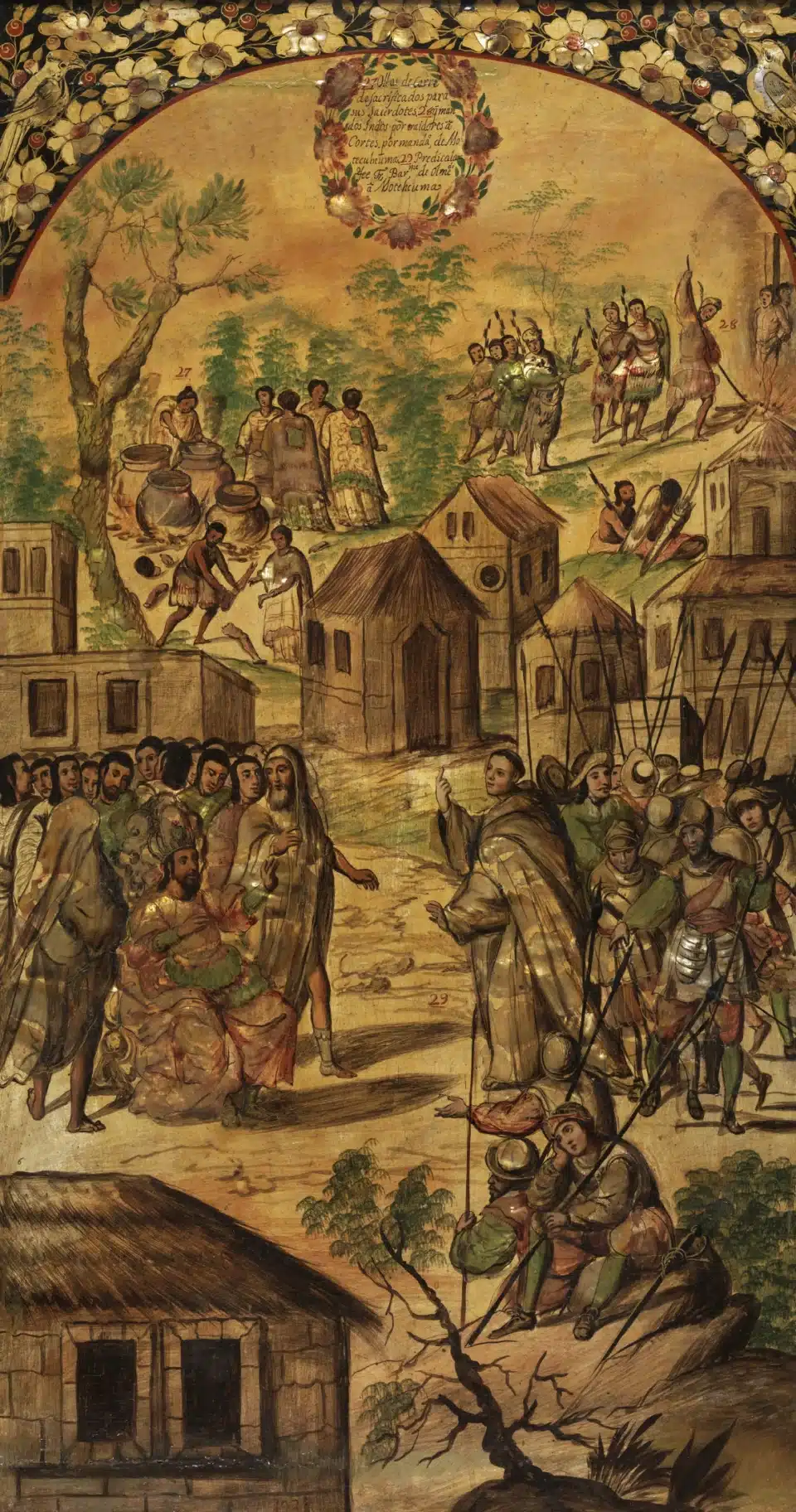
An ideal social order and a mixed-race reality
The division into two republics represented an administrative ideal rather than a rigid reality. From the early years of the viceroyalty, biological, cultural, and social intermingling overwhelmed any attempt at strict separation.
Markets, roads, workshops, mines, and cities became places of daily contact between indigenous peoples, Spaniards, and Africans. Despite the rules, daily life gave rise to labor, family, and cultural relationships that constantly challenged the official model.
This gap between law and practice forced the Crown to adapt its legislation, creating a flexible yet deeply hierarchical legal system.
Tensions, conflicts, and limits of the system
The two-republic model did not eliminate social conflicts. On the contrary, many abuses occurred precisely within this legal framework: dispossession of communal lands, labor exploitation, corruption of local authorities, and manipulation of indigenous councils.
At the same time, indigenous peoples used the system’s own legal language to defend their rights, filing lawsuits, appeals, and briefs before the viceregal authorities. This shows that the indigenous republic was not a passive space, but rather a terrain of constant negotiation.
Conclusion
The division of New Spain society into two republics was one of the pillars of the viceregal order during the 16th century. Designed to organize, control, and, in theory, protect the indigenous populations, this structure reflected both the aspirations of the Spanish monarchy and the profound contradictions of the colonial project.
Far from constituting an effective separation, the two republics coexisted in an environment marked by miscegenation, inequality, and conflict. Studying them provides a better understanding of the mechanisms of government in New Spain and the limits of imperial power in the face of the complexity of American society.
Frequently asked questions
What were the two republics in New Spain?
They were a form of social and legal organization promoted by the Crown of Castile that divided the population into two distinct groups: the republic of indigenous peoples and the republic of Spaniards, each with its own authorities and rules.
Why was the two-republic system created?
The goal was to facilitate the governance of the viceroyalty, legally protect indigenous communities, and maintain political, fiscal, and religious control over a deeply diverse society.
Were the two republics completely separate?
No. Although the model sought legal separation, in practice there were constant contacts through work, trade, evangelization, and the viceregal courts.
What were the functions of the indigenous republic?
It administered indigenous communities through their own councils, regulated taxes, community work, and local life, always under the supervision of viceregal and ecclesiastical authorities.
Who was part of the Spanish Republic?
It included peninsulars and creoles, as well as other non-indigenous groups, organized in cities, towns, and councils under Castilian law.
Did this system really protect indigenous peoples?
It offered certain legal protection mechanisms, but had clear limitations. Abuse, land dispossession, and labor exploitation persisted despite the legal framework.
What role did the Catholic Church play in the two republics?
The Church was a central player in both, especially in the indigenous republic, where evangelization, religious education, and moral control were part of the viceregal order.
When did the system of the two republics cease to function?
Although it emerged in the 16th century, its formal separation gradually faded over time, especially with the growth of castes and the social transformation of the viceroyalty in subsequent centuries.