
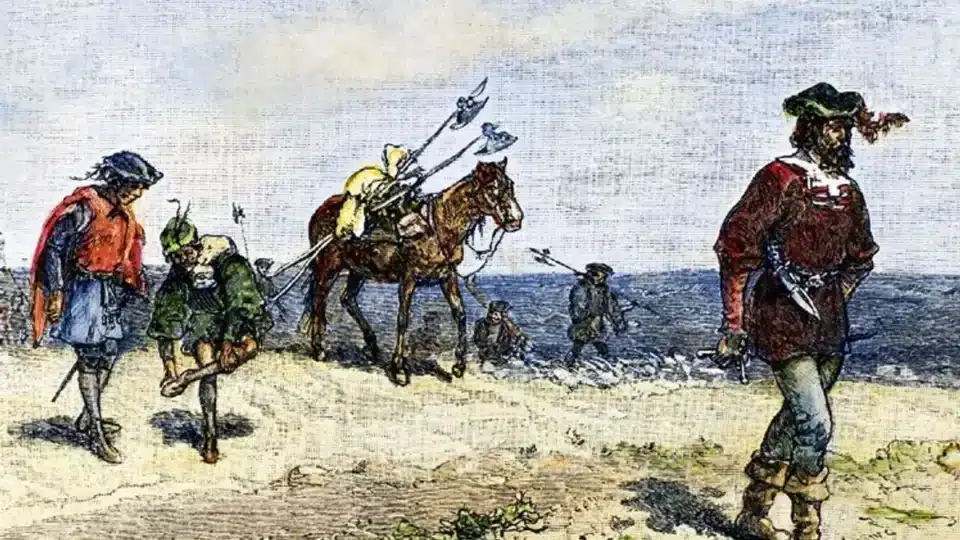
The history of expeditions to the north of New Spain did not always begin with maps or royal orders. Sometimes it arose from oral accounts, rumors, and the words of men returning from the unknown. One of them was Álvar Núñez Cabeza de Vaca, who reappeared in New Spain in 1536 after years of walking, trading, healing, and surviving among the indigenous peoples of the north.
His arrival caused astonishment. He was accompanied by three other men: Alonso del Castillo Maldonado, Andrés Dorantes, and the Moorish slave Estebanico. Together they had crossed enormous expanses of land. What they recounted seemed incredible, but their bodies and their experience spoke for themselves. Their words rekindled interest in exploring those regions. And the viceroy, Antonio de Mendoza, was quick to listen attentively to everything Cabeza de Vaca had to say.
Shipwrecked in unknown lands
It all began in 1527, when an expedition led by Pánfilo de Narváez set sail from Sanlúcar de Barrameda bound for the territories between Florida and the Las Palmas River, then considered the northern border of the province of Pánuco. Álvar Núñez Cabeza de Vaca was the expedition’s treasurer.
The expedition landed in Florida, but difficulties arose from the moment they set foot on land: hostile terrain, food shortages, and clashes with local peoples. When they decided to leave the mainland, they improvised five boats to continue by sea. The plan was to reach the port of Pánuco, which they believed to be nearby. But the sea was unforgiving: winds and currents scattered the boats. Cabeza de Vaca’s boat was washed up on an unknown beach, where it ended up alongside the remains of another shipwrecked boat.
There they were captured by indigenous people who were gathering food. They were not part of a common political structure, but rather groups that moved according to the seasons. Soon they dispersed, and Álvar Núñez was left alone, a prisoner of a different group. His life changed completely.
From prisoner to merchant
For the next six years, Cabeza de Vaca lived among various peoples. He was not always a slave. At one point, he achieved a special status thanks to an unexpected resource: trade. “I became a merchant,” he would later say, and that allowed him to move with some freedom among indigenous groups, exchanging objects, learning languages, and gaining the trust of many.
“Because I became a merchant, I tried to do my job as best I could, and for this they fed me and treated me well…”
This new role kept him free, at least for a while. He survived like this until one day he learned that he was not alone: in a nearby town there were three other enslaved Spaniards.
The reunion and the escape
Alonso del Castillo, Andrés Dorantes, and his slave Estebanico were in that village. Cabeza de Vaca decided to approach them and join them. Together they began to plan their escape, waiting for the right moment. That opportunity came when their captors, forced by the weather and hunger, neglected their vigilance as they moved out of the territory.
During their escape, an unexpected skill paved the way for them: they began to practice ritual healing, mixing Christian elements with gestures that the local people recognized. They crossed themselves, blew on people, and recited prayers.
“The way we cured them was by blessing them and blowing on them, and praying a Pater noster and an Ave Maria…”
For the people who welcomed them, these men had a gift. Their fame grew, and so they were able to cross entire regions without being rejected. They moved from one community to another, treated with respect, guided by their reputation as “foreign healers.”

Meeting with the colonial authorities
After years of walking, they finally arrived in the region of Sinaloa, where they encountered an expedition led by Diego de Alcaraz, a captain in the service of Nuño de Guzmán, who was then raiding the north in search of indigenous people to capture and enslave.
From there they were taken to Compostela, where they saw Guzmán, and then to Culiacán, finally arriving in Mexico City. There they were received by Viceroy Antonio de Mendoza, who was deeply impressed by what he heard.
Cabeza de Vaca’s words sparked the imagination of the colonial authorities: large towns, trade routes, fertile lands, complex cultures. Mendoza ordered more information to be gathered, and shortly thereafter a new expedition was prepared: that of Fray Marcos de Niza, who would once again travel north… and sow the legend of the seven cities of gold.
Conclusion on Álvar Núñez Cabeza de Vaca
Álvar Núñez Cabeza de Vaca was not a typical conquistador. His story is one of shipwrecks, hunger, captivity, and forced learning. He knew how to adapt, negotiate, and survive. But he also knew how to tell a story. And that story, filled with wonder and memory, inspired new routes of exploration to regions previously unknown to the Catholic monarchy.
Thanks to his testimony, the northern border ceased to be an uncertain boundary and became the next stage in New Spain’s territorial expansion.
–