
The Inquisition, as a formal tribunal, was not established in Mexico until 1571. However, from the first years after the fall of Tenochtitlan there were scattered inquisitorial activities, exercised by various authorities without a fully defined legal framework.
In this initial period, the functions that corresponded to episcopal or inquisitorial jurisdiction were assumed by both civil and religious authorities. For example, Hernán Cortés promulgated in 1520 the Ordinances against blasphemers, even before the Mexica defeat, and in 1530 Nuño de Guzmán initiated a process for idolatry against the Caltzontzin, lord of the Tarascans. At the same time, there is evidence that since 1522 friars in Mexico acted against cases of heresy, perhaps with direct powers from the pope. All this marked the antecedent of what was later called the monastic Inquisition.
The Monastic Inquisition in New Spain
Cardinal Adriano de Utrecht, general inquisitor of Castile since 1517, had delegated his authority to Alonso Manso, bishop of Puerto Rico, and to Fray Pedro de Córdoba, a Dominican based in Santo Domingo. In 1524, when the Franciscan mission headed by Friar Martín de Valencia arrived on that island, he received from Friar Pedro the authority to act as inquisitor in New Spain as long as there was no designated Dominican.
Thus, Fray Martin de Valencia is considered the first inquisitor in New Spain, although not strictly speaking. Little is known of his actions, but he is credited with the condemnation and execution of four Tlaxcalan nobles accused of idolatry, as part of the intense Franciscan evangelizing campaign.
In 1526 the Dominicans arrived in New Spain, and with them the tradition of that order holding the reins of the Inquisition. The position then passed to Fray Tomás Ortiz, although only for one year. He was succeeded by Fray Domingo de Betanzos, founder of the order in the viceroyalty, who served from 1527 to 1528 and was very active.
Betanzos prosecuted several of the former participants in Cortés’ military journey, accusing them of blasphemy. Among his most notorious cases was that of Rodrigo Rengel, conquistador and alderman in Mexico City, close to Cortés. Although he was accused of blasphemy, heresy and dissolute conduct, Rengel managed to defend himself with skill, having good lawyers and showing repentance. The conflict became political due to the indirect influence of Cortés, which led Betanzos to cede the cause to the Franciscans.
The Franciscan custodian Fray Luis de Fuensalida commissioned Fray Toribio Motolinía to pass sentence. In 1527 Rengel received a heavy financial fine and five months of confinement in a monastery, a less harsh penalty than Betanzos would have imposed.
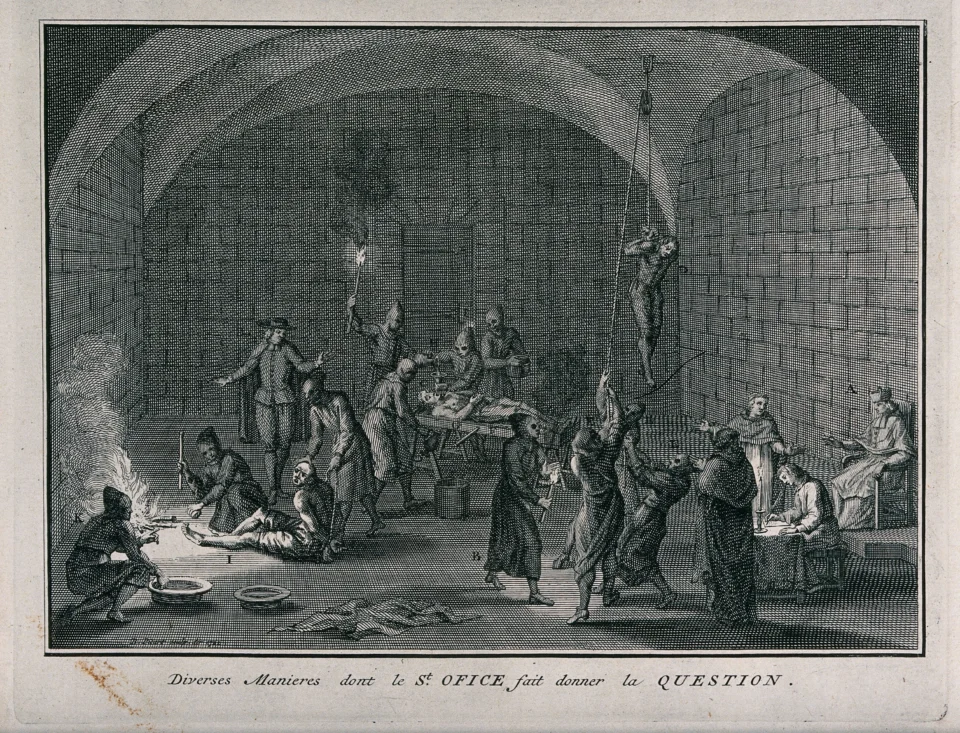
The first auto de fe in New Spain
In October 1528, Fray Vicente de Santa María held the first documented auto de fe in the capital of New Spain. Although the sources are scarce, it is known that Hernando Alonso and Gonzalo de Morales were burned as heretics, while other accused received lesser penalties.
The auto de fe consisted of a public ceremony in which the Inquisition presented the sentenced prisoners, explained their faults and exposed them to punishment. This first event marked a precedent in the use of humiliation and chastisement as part of religious justice.
After this episode, the inquisitorial activities diminished for a while, until the responsibility fell on the first bishop, Fray Juan de Zumárraga, with whom the next stage would begin: the Episcopal Inquisition.
Conclusion
The so-called monastic Inquisition in New Spain was a period of transition, marked by the action of Franciscan and Dominican friars who assumed inquisitorial functions without an established tribunal. From the first ordinances of Cortés to the auto de fe of 1528, this period reveals a context in which evangelization, politics and justice were intertwined in a territory in transformation.
Some frequent doubts about the first inquisitors in New Spain: Franciscans, Dominicans and the early autos de fe (autos de fe)
When was the Tribunal of the Holy Office formally established in New Spain?
The Tribunal of the Holy Office was founded in 1571. Prior to that date, inquisitorial functions were exercised irregularly by civil authorities, Franciscan friars and Dominicans.
Who was the first inquisitor in New Spain?
Fray Martin de Valencia is considered the first inquisitor in New Spain, although not officially. Later, Dominicans such as Fray Tomás Ortiz and Fray Domingo de Betanzos assumed this role.
What was the monastic Inquisition?
The period in which the friars, without an established tribunal, exercised inquisitorial functions in New Spain during the 1520s and 1530s is called the “Monastic Inquisition”.
What was the first auto de fe in New Spain?
The first documented auto de fe occurred in October 1528, celebrated by Fray Vicente de Santa María, in which Hernando Alonso and Gonzalo de Morales were burned, accused of heresy.
Why were some conquistadors prosecuted at this stage?
Many of the former participants in Cortés’ military journey were accused of blasphemy and heresy. Cases such as that of Rodrigo Rengel show how politics and internal tensions influenced early inquisitorial trials.
–