
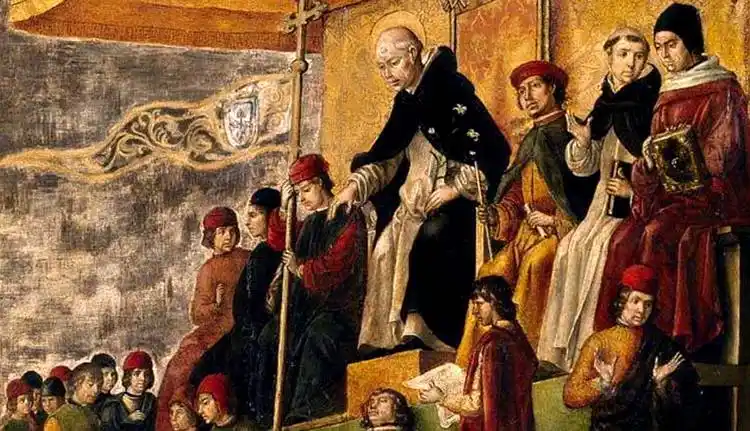
The Episcopal Inquisition in New Spain
After the brief period of the monastic Inquisition, the responsibility of overseeing orthodoxy fell to the bishops. For this reason, the period between 1528 and 1571 is known as the Episcopal Inquisition, the year in which the Tribunal of the Holy Office was finally established in Mexico City, dependent on the Supreme Court in Castile.
During these decades, the inquisitorial function was marked by political tensions, internal power struggles and the difficult task of imposing the Catholic faith in a newly evangelized territory.
Zumárraga, bishop and inquisitor
In 1527, Emperor Charles V proposed the Franciscan friar Juan de Zumárraga to occupy the bishopric of Mexico. Without papal bulls, his authority was initially weak and ambiguous, but after his consecration in 1533 he consolidated as bishop and soon received the title of apostolic inquisitor.
Sus primeras actuaciones se centraron en casos de bigamia y concubinato, que si bien no eran estrictamente herejía, se consideraban delitos contra la moral cristiana. Pero pronto surgió un reto mayor: el de los indígenas recién evangelizados que mantenían prácticas religiosas tradicionales en secreto.
The most famous case was that of Don Carlos Ometochtzin, chieftain of Texcoco, a direct descendant of Nezahualcoyotl. Accused of idolatry, human sacrifice and inciting resistance against Castilian rule, he was condemned to the stake on November 30, 1539. Although Zumárraga acted convinced of his duty, the sentence was considered excessive by the Supreme Council, which soon after ordered to moderate the rigor towards the recently converted Indians.
Visitor Tello de Sandoval
In 1543, Francisco Tello de Sandoval, royal visitor and apostolic inquisitor, arrived in New Spain. His presence indirectly annulled Zumárraga’s faculties. During his brief tenure (1544-1547), he reviewed causes initiated by local bishops, especially for heresy and bigamy.
Tello ordered investigations and preventive imprisonment, but did not pass sentence, aware of the precedent of the case of Don Carlos and the royal order not to severely apply the Inquisition to the indigenous people.
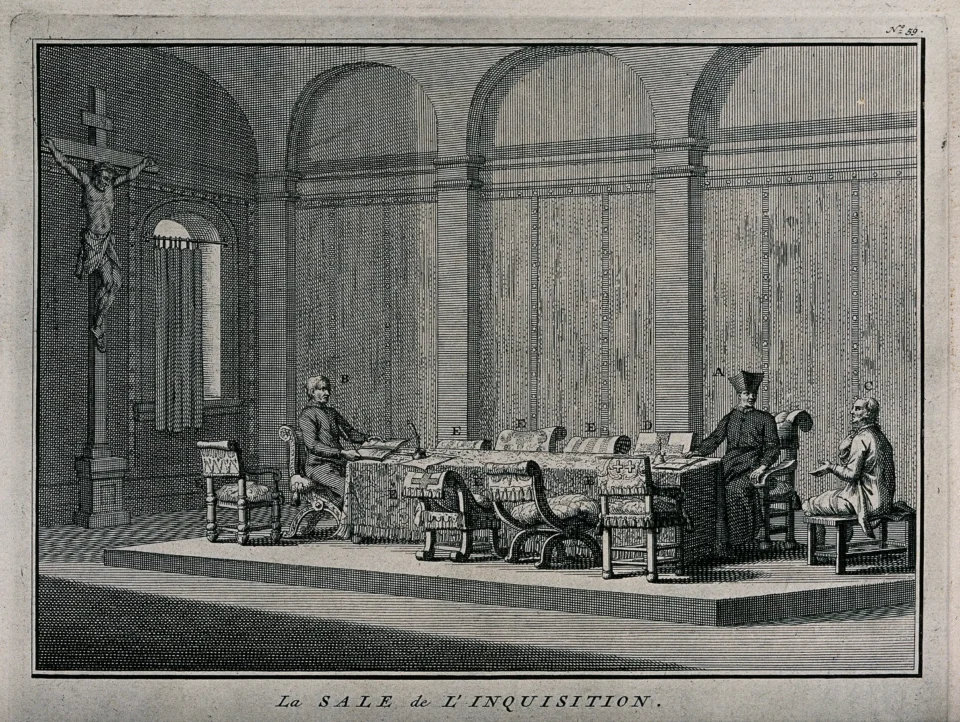
Montúfar and the proceedings against foreigners
After Tello’s departure, the inquisitorial faculties returned to the bishops. The most prominent in this period was Archbishop Alonso de Montúfar (1551-1572). His attention was focused on two fronts:
- Foreigners suspected of Protestantism, in a context in which the Catholic monarchy was fighting the Lutheran expansion in Europe. Famous cases were those of Roberto Tomson, English, and Agustín Boacio, Italian, condemned in the auto de fe of 1560.
- The vigilance of the regular clergy, with investigations into the conduct and orthodoxy of the friars, unleashed a long conflict with the religious orders and strengthened the authority of the secular clergy.
Books under suspicion
Montúfar also paid special attention to books printed or introduced in New Spain. Two cases were emblematic:
- La Doctrina breve muy provechosa (1543), written by Zumárraga.
- The Diálogo de doctrina cristiana en lengua de Michoacán (1559), by the Franciscan friar Maturino Gilberti.
Both texts generated controversy due to the way in which they presented the doctrine and the use of indigenous languages.
The case of Sister Elena de la Cruz
In 1568, Montúfar and his provisor, Fray Bartolomé de Ledesma, prosecuted Sister Elena de la Cruz, a learned nun with uncommon theological knowledge for the time. Her reading of authors such as Fray Luis de Granada and a Carthusian who questioned the necessity of the sacraments raised suspicions of heterodoxy.
Although she was reduced to prison, she showed repentance and received a lenient sentence. The case caught the attention of modern historians, who see in Sister Elena an intellectual precursor of later figures such as Sister Juana Inés de la Cruz.
Conclusion
The Episcopal Inquisition in New Spain was a period of transitions, tensions and experiments with authority. Zumárraga, Tello and Montúfar acted in a scenario where indigenous idolatry, suspicions of Protestantism and debates about books and doctrine were mixed. All this paved the way for the foundation in 1571 of the Tribunal of the Holy Office, which would mark a new stage in the inquisitorial history of the viceroyalty.
Some clarifications and frequent doubts about the Episcopal Inquisition in New Spain
What was the Episcopal Inquisition in New Spain?
This is the name given to the period between 1528 and 1571 in which the bishops, in the absence of a Tribunal of the Holy Office, assumed inquisitorial functions in the viceroyalty.
What role did Fray Juan de Zumárraga play in the Inquisition?
As bishop of Mexico and later apostolic inquisitor, he prosecuted several cases, the most famous being that of Don Carlos de Texcoco, an indigenous nobleman condemned to be burned at the stake in 1539.
Why was the rigor against the indigenous people in the inquisitorial processes moderated?
After the execution of Don Carlos, the Supreme Council ordered that the Inquisition should not be applied with severity to the recently evangelized Indians, which was later included in the legislation of the Indies.
Who was Francisco Tello de Sandoval and what did he do in the Inquisition?
He was royal visitor and apostolic inquisitor between 1544 and 1547. He reviewed cases of heresy and bigamy, but avoided passing sentences against indigenous people, aware of the Crown’s orders of moderation.
What cases stood out during the time of Archbishop Montúfar?
Montúfar conducted trials against foreigners suspected of Lutheranism, such as Roberto Tomson and Agustín Boacio, and closely monitored the orthodoxy of the regular clergy and the books printed in the viceroyalty.
Who was Sister Elena de la Cruz and why was she prosecuted?
She was an educated and theologically trained Novo-Hispanic nun who in 1568 was accused of holding heterodox ideas. After showing repentance, she received a lenient sentence.
–