
Trade played a fundamental role in the economic, political and cultural expansion of the Mexica dominion. Although the bulk of the population participated in modest and subsistence exchanges, it was within the Tenochca elites where a complex network of trade relations, specialized routes and key figures such as the pochtecas, true protagonists of long-distance exchange, emerged. This article explores how these dynamics functioned, what products circulated, and what role traders played in the organization of pre-Hispanic markets.
Trade in everyday life
Among the Mexica popular sectors, the exchange of goods arose from a basic need for subsistence. Most producers were also consumers and sellers of what they managed to grow or produce. In this context, the appearance of intermediaries was scarce, since production was barely enough to cover family needs. Thus, small exchanges served to level consumption, and when an individual acquired items considered sumptuary, this represented an extraordinary economic effort that often reduced his or her general well-being.
Trade from power
For the elites, trade represented more than mere subsistence: it was a symbol of power, prestige and control. The tlatoque (rulers) and pipiltin (nobles) not only had privileged access to exclusive products thanks to the tribute they received from their subjects and the subjugated peoples, but also accumulated goods as a status symbol. These tributes included basic foodstuffs such as corn and amaranth, as well as sumptuary products: jade, cacao, quetzal feathers, fine ceramics and decorated textiles.
Some of these goods were used to reward warriors, distinguished artisans or ambassadors; others were treasured, and others were returned as diplomatic gifts to tributary peoples. This logic fed an increasingly complex commercial structure and gave way to the consolidation of the pochtecas.
The emergence and expansion of the pochtecáyotl
The Pochtecas were long-distance traders and appeared initially in Tlatelolco, during the rule of Cuacuauhpitzáhuac. Later, the Mexica Tenochcas developed their own mercantile system, with at least seven commercial organizations registered before the arrival of the peninsulars. After the defeat of Azcapotzalco in 1428 and the subjugation of Tlatelolco in 1473, economic and commercial control passed into the hands of Tenochtitlan.
These merchants were not simple salesmen; they were part of an institution with multiple functions and structures of their own. They had exclusive courts, performed their own rituals, acted as ambassadors, emissaries and even spies in times of war. Their influence grew so much that they came to rival the nobility, obtaining privileges such as the possession of land and exemption from the payment of personal tribute.

The relationship between pochtecas and artisans
In many cases, the Pochtecas worked closely with specialized artisans, such as the amantecas, experts in feather art. The traders provided the raw materials and then distributed the finished products. This productive chain not only strengthened the local economy, but also allowed the specialization of certain neighborhoods and the generation of cultural identity around certain trades.
The character of these traders was recorded in Nahuatl texts collected by Fray Bernardino de Sahagún and translated by Miguel León-Portilla: “The pochteca: trafficker, seller; he makes loans, he makes contracts; he accumulates wealth, he multiplies it. The good merchant: he is a traveler, a wayfarer; he makes profits; he finds what he is looking for; he is honest.”
The great tianguis
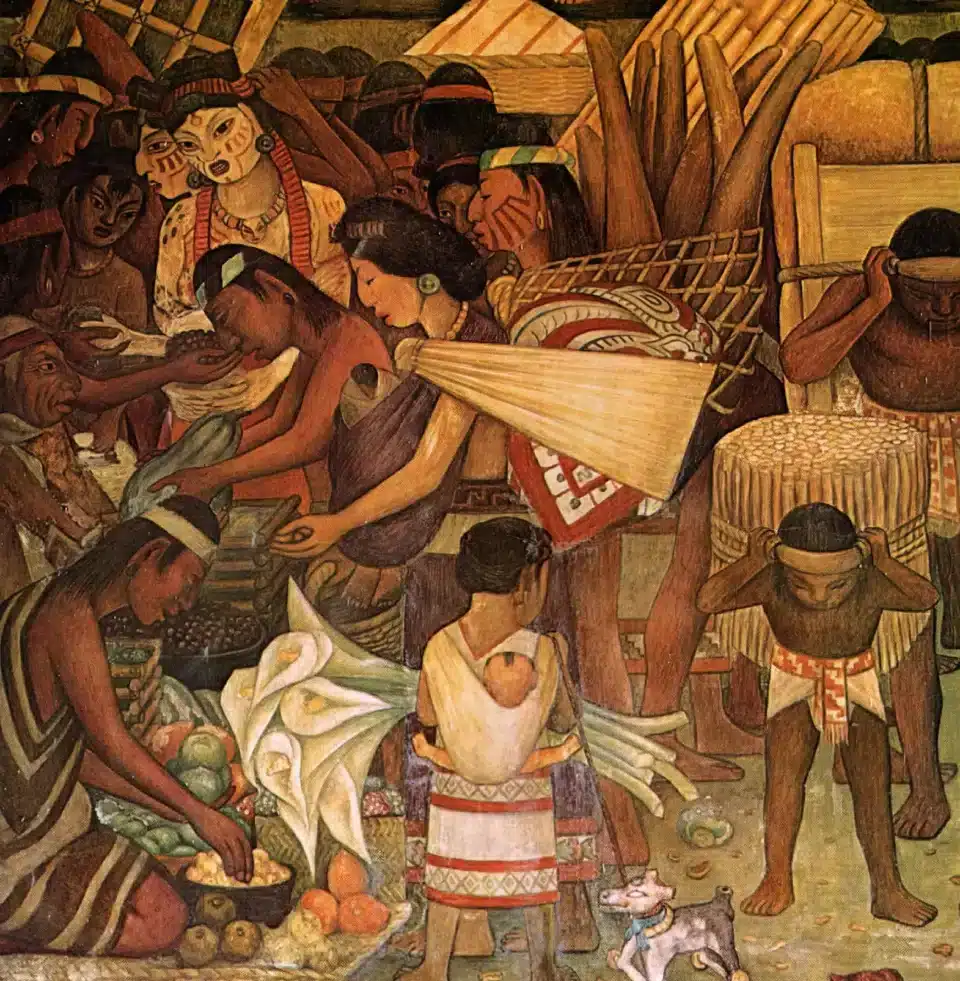
The growth of trade led to the expansion of specialized markets, known as tianquiztli. The most emblematic was the Tlatelolco market, described by Cortés as “twice as large as the plaza of Salamanca” and by Bernal Díaz del Castillo as a site of such magnitude and order that “in two days it could not be completely covered”.
Other notable markets included that of Tlaxcallan, which brought together more than thirty thousand merchants; that of Cholula, specializing in ceramics and jewelry; that of Texcoco, with weaving and painting artists; that of Acolman, known for the dog trade; and that of Azcapotzalco, dedicated to the buying and selling of people (tlatlacohtin), with ritualized practices of display, dance and music.
Routes and commercial destinations
The Pochtecas organized expeditions to distant regions, accompanied by tamemes or porters, and dressed as if they were going to war. They were divided into strategic routes: some to the Pacific coast (Soconusco region) to obtain cacao, quetzal feathers, jade and precious metals; others to the Xicalanco region, on the Gulf coast, where they obtained products from Yucatan, Honduras and even the Caribbean.
On these trips they traded luxury goods for the elite and utilitarian objects for the people, from ear muffs and tools to medicines and dyes. Upon their return, they would present the items obtained to the huey tlatoani as a symbol of loyalty and mission accomplished. For this reason, they were treated with great respect and esteem, comparable to even the most distinguished warriors.
Conclusion
Mexica trade was not simply an economic activity, but an institution deeply linked to the social, political and military structure of the Tenochca lordship. The pochtecas, with their network of routes, their own code and multiple functions, became an emerging sector with a crucial role in the expansion of Tenochtitlan. Beyond the bartering of products, trade represented a force for cultural cohesion, social prestige and territorial control that contributed decisively to Mexica splendor on the eve of the first documented contact with Europeans.
–