
Introduction: the Holy Office crosses the Atlantic Ocean
The Inquisition in New Spain was not an improvised organism, but the direct extension of a model already consolidated in the Iberian Peninsula. After the royal decree of Philip II in 1569 and the arrival of Inquisitor Pedro Moya de Contreras in 1571, the Holy Office was formally established in Mexico City. Before this, however, there already existed forms of religious control that sought to monitor the faith of recent converts. To understand these origins, it is useful to explore the transition from a provisional system of ecclesiastical discipline to a tribunal of enormous power that would mark the life of New Spain.
First attempts at religious control before the formal tribunal
From the first decades following the military journey of Cortés and his indigenous allies, ecclesiastical authorities began to prosecute conduct considered heretical or contrary to the Catholic faith. The bishops and the Royal Audiencia of Mexico, although without a formal inquisitorial tribunal, acted against cases of apostasy, blasphemy or indigenous practices linked to their traditional religions. These efforts reflect the concern to consolidate orthodoxy in a viceroyalty that was still in the process of political and spiritual reorganization.
The royal decree of Philip II and the founding of the tribunal
In 1569, Philip II issued the royal decree that ordered the creation of a tribunal of the Inquisition in Mexico, following the peninsular model. Two years later, in 1571, the tribunal was installed in Mexico City, under the authority of the Crown of Castile and independent of the local bishops. Thus, the Holy Office in the viceroyalty became one more instrument of monarchical power, in charge of overseeing the faith, but also of maintaining social and political cohesion.
Pedro Moya de Contreras: first novo-Hispanic inquisitor
The person in charge of organizing the tribunal was Pedro Moya de Contreras, the first inquisitor of New Spain. His figure is exceptional: in addition to being an inquisitor, he was archbishop of Mexico and later viceroy, accumulating unprecedented power. Moya de Contreras structured the Holy Office with its own headquarters, officials and rules, ensuring that it would answer to the Supreme Court in Spain and the Crown rather than to the local episcopal authority.
Prosecuted offenses and book censorship
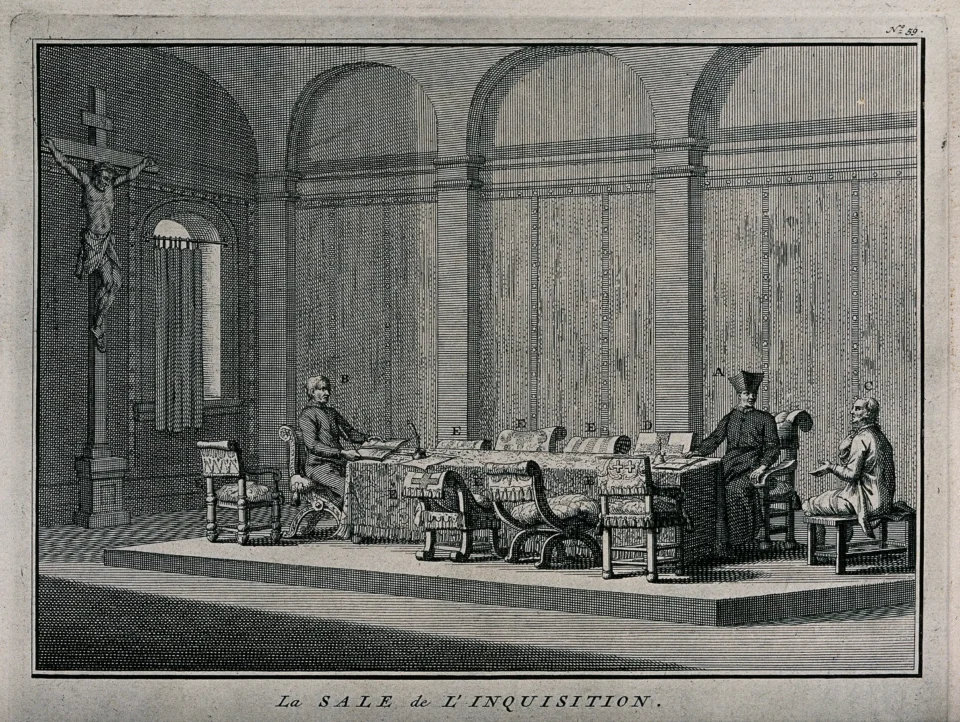
The novo-Hispanic court prosecuted crimes of faith such as heresy, Judaism practiced in secret by converts, blasphemy, bigamy, sorcery and the reading of forbidden books. Control of the written word was one of their most effective weapons: libraries were searched and shipments of books censored. This surveillance system generated fear, as no one was completely safe from being investigated.
The first auto de fe in Mexico City (1574)
On February 4, 1574, the first auto de fe was held in the viceregal capital. It was a public spectacle in which sentences were handed down against several defendants, some accused of Judaizing and others of conduct considered contrary to the faith. The event had a strong impact on the novo-Hispanic society: in addition to punishing, it sought to exemplify and warn that the Holy Office had come to stay as a permanent institution.
Conclusion: a court of the monarchy in the Americas
The foundation of the Inquisition in New Spain responded to the centralizing logic of the Crown of Castile. From its earliest years, the Holy Office acted not only as a religious tribunal, but also as an organ of political and social control, capable of monitoring consciences and disciplining entire communities. Its origins, between the provisional control of bishops and the splendor of the autos de fe, marked the beginning of an institution that would profoundly influence the life of the viceroyalty.
Questions and clarifications on the origins of the Inquisition in New Spain.
When was the Inquisition formally established in New Spain?
The tribunal of the Holy Office was founded in 1571, following the royal decree of Philip II (1569) that ordered its creation in Mexico City.
Who was the first inquisitor in New Spain?
Pedro Moya de Contreras, who in addition to being an inquisitor, was archbishop of Mexico and later viceroy, concentrating great political and religious power.
What crimes were prosecuted by the Inquisition in New Spain?
The main ones were heresy, Judaism practiced in secret, blasphemy, bigamy, sorcery and the possession of forbidden books.
What was the first auto de fe in Mexico and when was it held?
The first auto de fe was held in Mexico City on February 4, 1574. It was a public act in which sentences were handed down against defendants, with great social and symbolic impact.
Did the Inquisition in New Spain depend on the Pope or the Crown?
Although it was a religious tribunal, in practice it depended on the Crown of Castile and the Supreme Court in Spain, not directly on the Holy See.
Were there forms of inquisitorial control before 1571?
Yes. From the years after the fall of the Mexica dominion, the bishops and the Royal Court acted provisionally against heresies and conduct contrary to the faith, until the formal founding of the tribunal.
–