
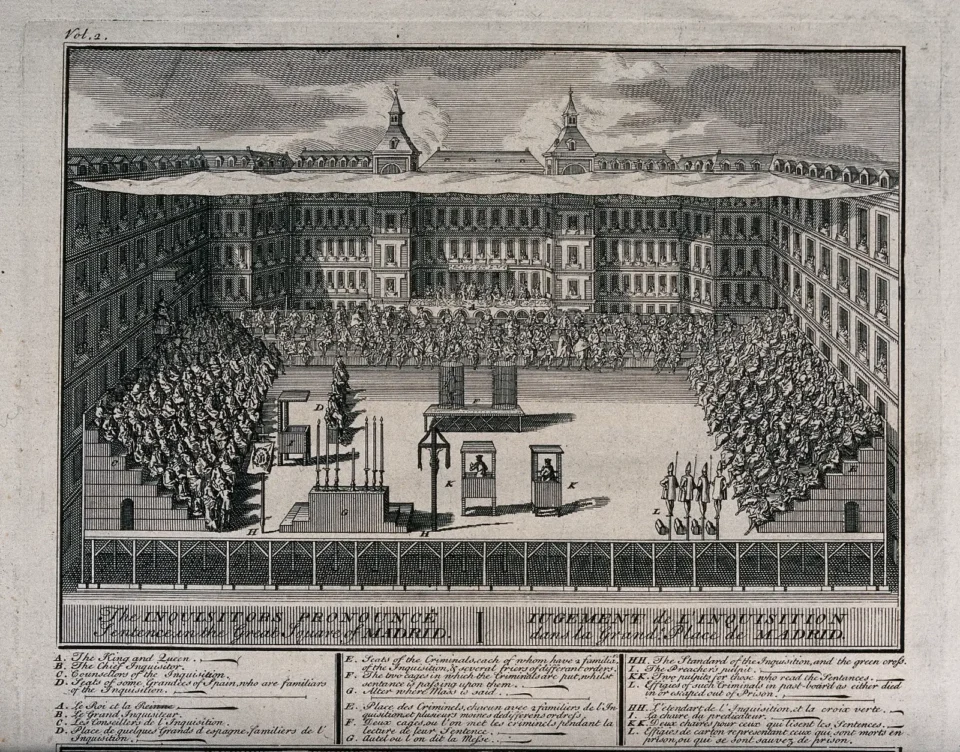
Before being established in New Spain, the Inquisition already had a long history in Europe. What arrived in America was not a new creation, but an institution with centuries of evolution. Understanding the origins of the Spanish Inquisition allows us to understand how it was transformed into an instrument of power that, beyond religious matters, became a political organ at the service of the monarchy. From the Council of Verona in 1185 to the figure of Torquemada in the 15th century, the Holy Office was configured as the direct antecedent of what would later mark the life of New Spain.
First steps: from the Council of Verona to the Dominicans
In the Middle Ages, heresy was considered a crime against the faith and, therefore, against God himself. In 1185, the Council of Verona granted bishops the power to judge those suspected of heresy. If found guilty, they were to be handed over to civil authority for punishment, including capital punishment. This was the first antecedent of the Tribunal of the Holy Office of the Inquisition.
The Inquisition as a court of secret investigation
Unlike other tribunals of the time, the Holy Office had the power to thoroughly and secretly inquire into and investigate the conduct and beliefs of persons suspected of heresy. This ability to act without the need for formal accusation and with a high degree of autonomy made it a feared institution. The very term inquisitio refers precisely to this work of thorough investigation, which could be extended to any individual whose faith was questioned.
The institution was strengthened with the foundation in 1216 of the Order of Preachers, known as the Dominicans, on the initiative of Saint Dominic of Guzman. Shortly thereafter, Pope Honorius III granted him the powers of delegated inquisitor. From then on, the Dominican friars were closely linked to the Inquisition, marking a key point in their independence with respect to the episcopal power.
The Council of Toulouse and the Papal Organization
In 1229, during the pontificate of Gregory IX, the Council of Toulouse formally organized the Inquisition as a tribunal dedicated to the persecution of heresy. Its dependence on the Holy See was total: the pope appointed the judges, regulated the proceedings and supervised its decisions. At this stage, tribunals were established in several European kingdoms, especially entrusted to Dominican friars.
Spain was no exception: in the different peninsular kingdoms independent tribunals arose, always under papal control.
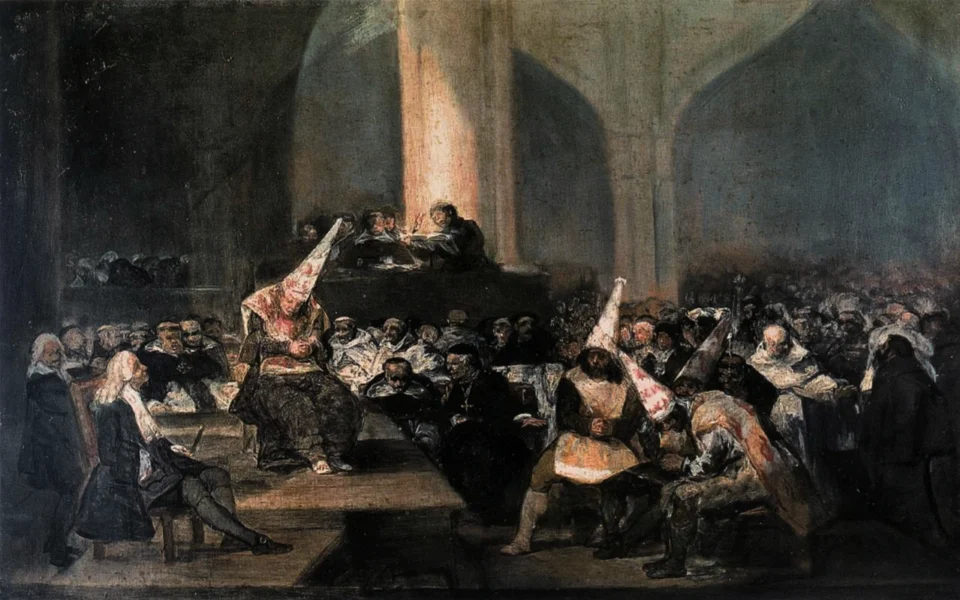
The turn of the Catholic Monarchs
The situation changed radically in 1469, with the marriage of Ferdinand of Aragon and Isabella of Castile, known as the Catholic Monarchs. Their project of national unification required centralizing power and reducing the influence of external institutions, including the Holy See.
In 1478 they obtained from the pope a bull that allowed them to appoint inquisitors and organize the courts according to their own interests. It was a decisive political triumph, since the monarchy took possession of a court capable of monitoring even the conscience of its subjects.
The context was particularly delicate: a large Jewish population lived on the peninsula, and many conversos – new Christians – were viewed with suspicion. The Inquisition became a key instrument for monitoring, punishing and, ultimately, legitimizing measures such as the expulsion of the Jews in 1492.
La Suprema and Torquemada
The Crown carried out two measures that defined the Inquisition from then on. The first was the creation of the position of inquisitor general, responsible for all the tribunals, including those that would later be established in America.
The second measure was the creation of the Supreme Council of the Inquisition, known as La Suprema. This collegiate body, similar to a ministry, centralized inquisitorial power and subordinated it to the Crown.
In 1483, Fray Tomás de Torquemada was named general inquisitor and first president of the Supreme Council. He was accompanied by Bishop Alonso de Carrillo and two lay jurists, Sancho Velásquez de Cuéllar and Poncio de Valencia. From then on, the Holy Office ceased to be a purely ecclesiastical tribunal: it became a judicial organ of the State, at the service of the monarchy.
Conclusion
The origins of the Spanish Inquisition show how a medieval ecclesiastical court became a powerful political instrument. With the centralization of the Catholic Monarchs, the creation of the post of inquisitor general and the establishment of La Suprema, the monarchy consolidated an unprecedented control mechanism. This background is fundamental to understand the way in which the Holy Office was implemented in New Spain, where it remained an institution dependent on the Crown and not on the Holy See.
Some frequently asked questions about Spanish intuition
When did the Inquisition begin in Spain?
The most remote antecedent is found in the Council of Verona in 1185, although as an organized institution it took shape in 1229 with the Council of Toulouse, under Pope Gregory IX.
What role did the Dominicans play in the Inquisition?
Since the approval of the Order of Preachers in 1216, the Dominican friars became the main inquisitors, consolidating the independence of the Holy Office from the power of the bishops.
Why were the Catholic Monarchs key to the Inquisition?
Ferdinand and Isabella obtained in 1478 a papal bull that allowed them to appoint inquisitors and control the courts. This turned the Inquisition into an instrument of the monarchy, rather than of the Church.
Who was Tomás de Torquemada and why is he important?
Appointed inquisitor general in 1483, Torquemada was the first president of the Supreme Council of the Inquisition (La Suprema). His figure symbolizes the centralization and political power of the Holy Office in Spain.
Did the Spanish Inquisition depend on the Pope or on the monarchy?
Although in its beginnings it was under papal authority, after the Catholic Monarchs it was placed under the control of the Crown of Castile. Since then it was a judicial body at the service of the monarchy.
Why is this origin important to the history of Mexico?
Because the court that was later established in New Spain was a direct extension of the Spanish model. Knowing its roots in the Iberian Peninsula allows us to understand how it functioned in the viceroyalty.
–