
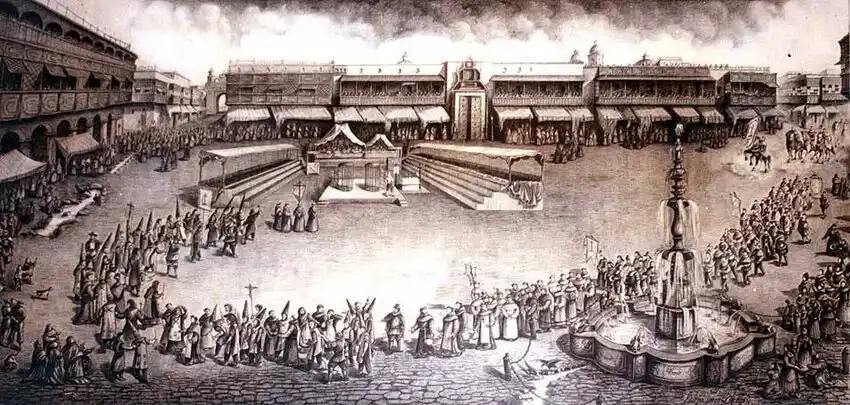
The visit to the Tribunal of the Holy Office in Mexico, carried out between 1645 and 1662, was one of the most delicate episodes in the history of the Inquisition in New Spain. Although the autos de fe continued to be events of great spectacle and public devotion, internal conflicts, accusations of corruption and disputes over power began to brew within the tribunal itself.
What appeared to be a solid institution, a symbol of religious authority, was questioned for abuses, negligence and irregular management of resources, which led the Supreme Council to order a direct inspection.
The glow of the auto de fe and the shadows of the tribunal
In 1649, the Inquisition held a general auto de fe with all the splendor that had characterized its public ceremonies. However, behind the glitter of that act were hidden complaints and denunciations that had been accumulating for years. The inquisitors and ministers were singled out for their excesses, for their lack of rigor in the processes and, above all, for shady dealings in economic matters.
Given the seriousness of the accusations, the Supreme Council of the Inquisition decided to intervene. Initial attempts to open a formal process against one of the inquisitors were unsuccessful, which made evident the need for a more thorough review within the novo-Hispanic tribunal itself.
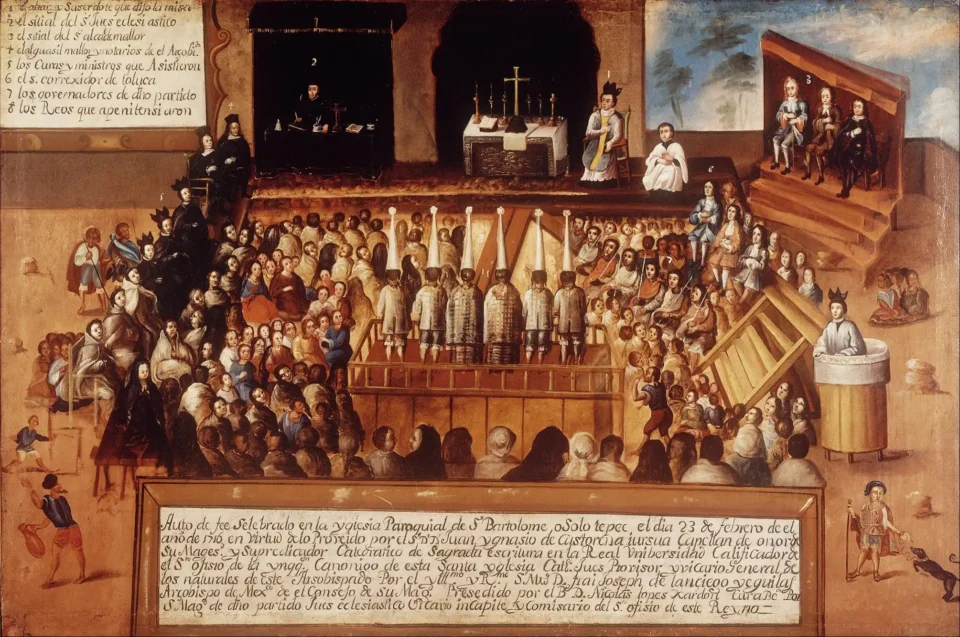
The intervention of Juan de Mañozca, Archbishop of Mexico.
In 1645, the Supreme Council entrusted the delicate task of visiting the tribunal to Don Juan de Mañozca, Archbishop of Mexico, who was appointed inquisitor-visitor. His mission was to investigate the conduct of the inquisitorial ministers and gather evidence on the abuses committed.
Mañozca began his work with rigor, but in 1651 he requested to be relieved, arguing fatigue and health problems. However, the information he had gathered was so compromising that the Council considered it necessary to continue with the investigation.
Pedro de Medina Rico and the final sentences
After Mañozca’s resignation, the Council appointed Don Pedro de Medina Rico as the new inquisitor-visitor. He took on the case with the task of bringing closure to the long review process. Finally, in 1662, sentences were handed down against the inquisitors and ministers who had been the subject of the visitation, thus concluding seventeen years of investigations and internal tensions.
This prolonged episode revealed the frictions between religious power, inquisitorial administration and economic interests, demonstrating that the Inquisition not only pursued heresies, but also had to face its own internal conflicts.
Conclusion
The visit to the Tribunal of the Holy Office between 1645 and 1662 shows a little known aspect of the Inquisition in New Spain: its internal vulnerability. Although it continued to project an image of strength and devotion, inside it faced abuses of authority, corruption and struggles for institutional control.
This case not only evidences the complexity of the inquisitorial machinery, but also the limits of ecclesiastical power when its own members were on trial. A reminder that, even within the Holy Office, vigilance and punishment could be turned inward.
Frequently asked questions and clarifications on the visit to the Tribunal of the Holy Office (1645-1662)
What was the visit to the Tribunal of the Holy Office in Mexico?
It was an internal inspection ordered by the Supreme Council of the Inquisition between 1645 and 1662, in order to investigate allegations of corruption, abuses of power and negligence within the court itself in New Spain.
Why did you decide to make this visit?
The authorities of the Inquisition in the peninsula received numerous complaints against the novo-Hispanic inquisitors and ministers, especially for the mismanagement of resources and arbitrary decisions. To maintain the moral authority of the Holy Office, it was considered necessary to investigate directly on the scene.
Who led the investigation?
The first inquisitor-visitor was Juan de Mañozca, archbishop of Mexico, who began the collection of evidence in 1645. Later, after his resignation for health reasons in 1651, he was replaced by Pedro de Medina Rico, who concluded the process and dictated the sentences in 1662.
What kind of abuses were reported?
The allegations included negligence in the proceedings, financial irregularities, influence peddling and favoritism within the court. Some inquisitors were accused of benefiting financially from goods confiscated from convicts.
What were the consequences of this visit?
The investigations culminated in sentences against several ministers and inquisitors, which set a precedent for the internal supervision of the Inquisition. However, it also highlighted the tensions between ecclesiastical power, inquisitorial authority and economic interests that coexisted within the viceregal system.
Why is this episode important to the history of the Inquisition in New Spain?
Because it shows that the Holy Office was not an institution free of internal conflicts, and that even within its structure there were mechanisms of control and correction. It also reveals the human fragility of its members and the political and moral complexity of the seventeenth century in New Spain.
–