
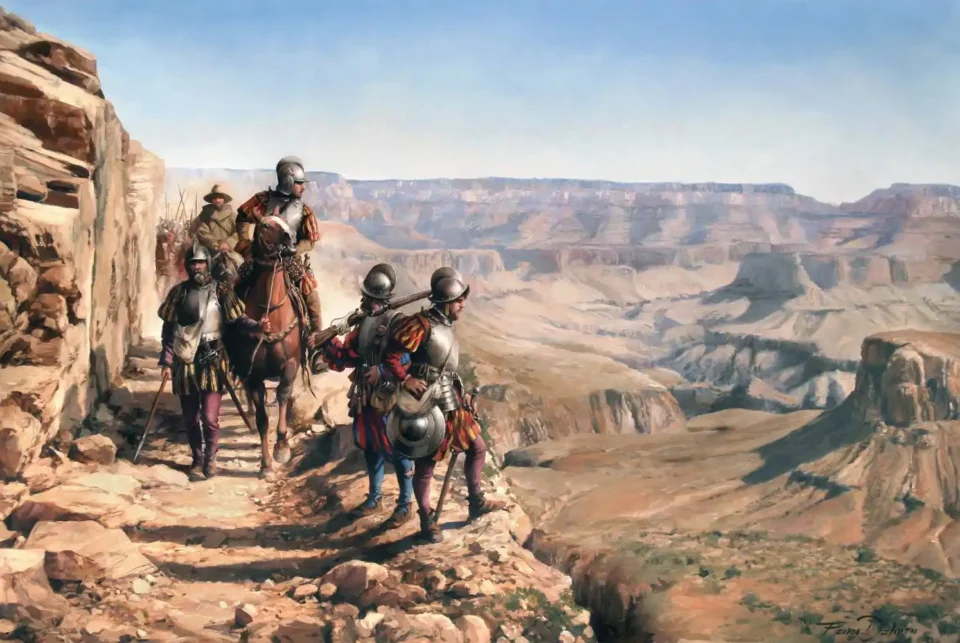
In the mid-sixteenth century, when the viceroyal administration sought to consolidate its presence in the northern part of the American continent, an ambitious attempt was made to establish a permanent settlement in the lands of Florida. Led by Tristán de Luna y Arellano in 1559, this expedition – backed by Viceroy Luis de Velasco – promised to open a land route between the gulf coast and the interior lands, facilitating communication with New Spain and extending the reach of the Catholic monarchy. However, what seemed to be a well-calculated project ended up revealing the fragility of the imperial plans and the complexity of the territory they intended to dominate.
The Viceroyalty’s commitment to La Florida
Tristán de Luna’s expedition was not an isolated occurrence. It was part of a broader policy promoted by the Crown of Castile and executed by the viceroy of New Spain, with the purpose of preventing other European powers, such as France, from occupying territories in the north. The order was clear: establish a city in Ochuse Bay (present-day Pensacola), advance inland until reaching the Appalachians and establish a strategic pass to the north.
Luis de Velasco, the first viceroy born in the peninsula who governed with a pragmatic style, saw in Tristán de Luna an experienced captain with favorable family relations to lead the enterprise. On board more than a dozen ships and with about 1,500 people -among soldiers, settlers, women, Dominican friars and allied Indians- one of the most ambitious expeditions of the 16th century was launched to the southeast of what is now the United States.
Shipwreck and chaos: the beginning of the disaster
The initial enthusiasm collapsed shortly after landing. Barely installed on the coast, a violent hurricane destroyed most of the supplies and boats, leaving the expeditionaries in a critical situation. The subtropical climate, unfamiliar to many, aggravated the situation: disease, hunger and disorganization began to undermine the morale of the group.
Faced with the emergency, Luna sent reconnaissance parties into the interior, looking for resources and a more suitable place to settle. But the reports were confusing and contradictory. The routes were rough, supplies were scarce, and the indigenous peoples were not always receptive to the foreign presence.
The role of indigenous peoples: cooperation and resistance
The native peoples of the region, such as the Choctaw and the peoples of the Coosa Valley, were ambiguously involved in this enterprise. Some maintained initial contacts that allowed for the exchange of provisions and temporary refuge. However, attempts to impose Castilian authority over these territories soon generated friction.
Unlike the regions of the Mesoamerican highlands, where there was already a long history of interaction between lordships and trade routes, the southeastern United States had a fragmented political organization, with regional confederations, systems of local loyalties and a strong spiritual connection to the land. This complexity was not understood by the Castilians, who interpreted the lack of Mesoamerican-like structures as an absence of legitimate power.
The collapse of the project and the return to reality
As the months passed, tensions between officers, soldiers and Luna himself became unbearable. His authority was severely questioned, and the inability to supply the expedition provoked mutinies and desertions. The promised city was never formally founded. What was to be the beginning of a new viceregal province ended in retreat, failure and abandonment.
In mid-1561, two years after the landing, the survivors returned to New Spain in deplorable conditions. Viceroy Velasco had to recognize that the project had failed, not only because of natural difficulties, but also because of an overestimation of imperial capabilities and a profound underestimation of the environment and its inhabitants.
Conclusion: a project that revealed the limits of imperial power
The expedition of Tristán de Luna y Arellano was not simply an unfortunate episode. It was a mirror of the viceroyalty’s limitations to expand without first thoroughly understanding the territory and those who inhabited it. The disaster showed that neither economic resources nor viceregal orders were enough to subdue or integrate unknown regions.
The Florida enterprise showed that the fragility of imperial plans lay not only in the hostile nature, but in the inability to adapt strategies to the political, spiritual and ecological context of the indigenous peoples of the north. It was, in many ways, an early warning that viceregal rule would have to be negotiated, resisted or even abandoned when it could not find fertile soil to germinate.
–