
To speak of the Church in New Spain is not only to refer to religion. It was an institution that organized daily life, intervened in politics, managed economic resources and coexisted closely with civil authority. In order to understand its strength and influence, three axes must be observed: the Royal patronage, the organization of the clergy and the role of parishes in cities and communities.
The Royal Patronage: privileges and obligations of the Crown
The Novo-Hispanic Church was governed by a figure known as Regio Patronato Indiano. What was this? In short, a system in which the Pope granted the kings of Castile (whom historiography usually calls the “Catholic Kings” and their successors) exclusive privileges over the Church in America.
These privileges were granted through papal bulls. A bull was an official document issued by the pope that had the force of law within the Church. Among them was the bull Inter caetera of Alexander VI in 1493, as well as another one from the same pope in 1501 and another one from Julius II in 1508. With them, the Holy See (that is, the Vatican) not only recognized the dominion of the peninsular kingdoms over the new territories, but also delegated to them the obligation to evangelize and found churches in those lands.
In this scheme, the king was the “patron” of the Church in New Spain and the viceroy acted as vice-patron. This meant that the royal authority could:
- Sending and organizing religious missions.
- Collecting and administering tithes (a religious tax equivalent to one tenth of the crops or income, destined to support the cult).
- Propose candidates for ecclesiastical positions, from chaplains to canons.
- Authorize the construction of temples, from majestic cathedrals to rural chapels.
The king was even granted the right to review ecclesiastical sentences and control the publication of papal documents in the viceroyalty, which was known as “el pase regio”. Although disputed, these privileges were constantly practiced and turned the Church into a space closely linked to the Crown.
The royal patronage had an antecedent in the so-called patronato particular, a medieval custom by which individuals could finance the construction of a church and, in exchange, obtain the title of patron, with certain privileges over that religious institution. In the American case, this patronage was not individual, but was extended to the Crown of Castile.
The agreement was clear:
- The Crown was to pay for and organize evangelization.
- In return, he could control the administration of tithes, religious foundations and clerical appointments.
Thus, although the Church ultimately depended on Rome, in practice the Church in New Spain functioned as a space controlled by the monarchy.
Why did Rome accept this situation? Because at the time of the Protestant Reformation, the peninsular kingdoms (what is now Spain) were the main defenders of Catholicism. For the Holy See, which was facing the loss of territories in Europe, the support of Castile ensured not only religious fidelity, but also the incorporation of millions of new faithful in America.
However, the relationship was not free of friction. Religious orders used to send representatives directly to Rome to obtain benefits in their favor, bypassing royal authority. In addition, bribery (bribes) was common in both the Roman curia and royal councils to obtain office or privilege.
The Viceroy as Vice-Patron
In practice, the viceroy acted as vice-patron of the Church. This gave him the right to propose candidates for some ecclesiastical benefices, although never for bishop positions. With time, this power was limited and the viceroys were left with less power in this regard.
Its most important function was to intervene when conflicts arose within the clergy or when an act was considered contrary to canon law. In such cases, he could apply the “recourse of force“: temporarily suspending religious action until it was resolved in Rome or at the Crown.
As for the construction of temples, although it was said that the king financed them, in reality the resources came from New Spain itself, often from tithes or contributions from confraternities and individuals.
Bishops and ceremonies: a complex process
The appointment of a bishop was a lengthy process involving several stages:
- Royal presentation: the king proposed the person. From that moment on, he was considered a “de facto” bishop.
- Papal approval: Rome confirmed the election, which made him a bishop “by right”.
- Episcopal consecration: another bishop formally consecrated him.
- Inauguration in the cathedral: public ceremony in front of the ecclesiastical chapter and in the presence of the viceroy or a civil authority.
This order was not always respected. Some bishops ruled without having been consecrated or confirmed, such as Archbishop Cuevas y Dávalos, who died in office without having received papal approval.
If a bishop died, the see was declared vacant, announced with the “bell of vacancy” in the city. At that time, the ecclesiastical chapter – a collegiate body of canons – assumed the government.
The ecclesiastical chapter: heart of the cathedral
The chapter was not only an administrative body, but the center of ecclesiastical life in each diocese. Among its responsibilities were:
- Maintain and beautify the cathedral.
- To administer chapels and confraternities.
- Collecting alms.
- Organize music and ceremonies.
- Manage the economic resources of the cathedral.
The canons could also hold positions outside the cathedral. For example, one of them acted as canon of the University of Mexico, which evidenced the close relationship between Church and education.
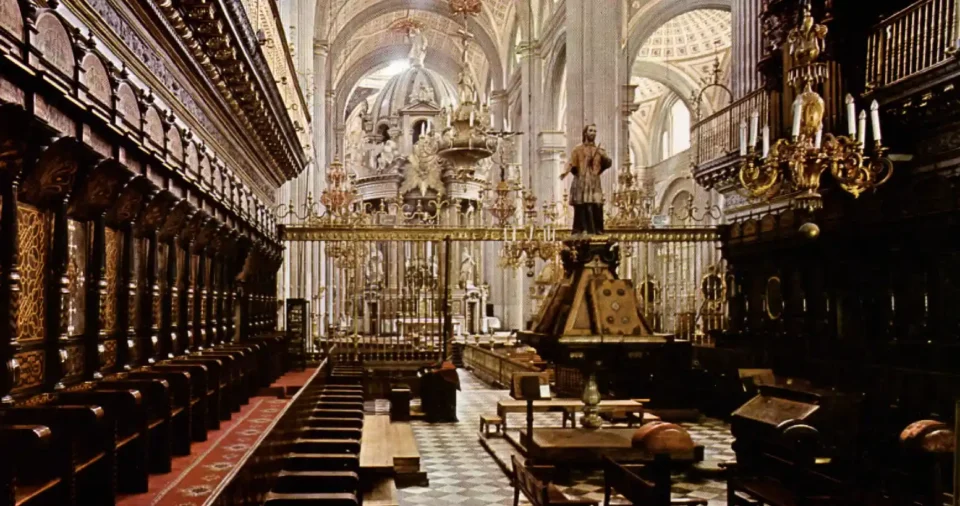
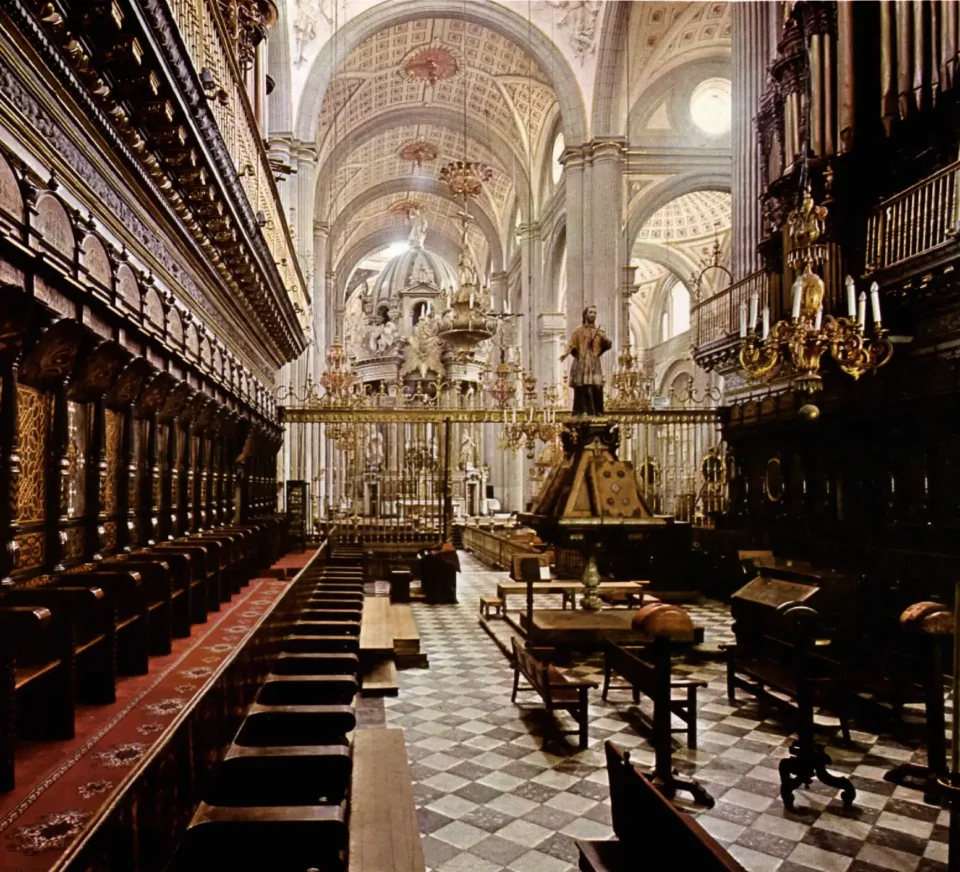
Their importance was reflected in the magnificence of the chapter houses and the ample space reserved for the canon choir in the cathedrals. On occasions, the chapter even confronted the bishop himself or the viceroy when it felt its rights were violated.
Parishes, parsonages and daily life
Beyond the cathedrals, the Church extended through the parishes, each one in charge of a priest of souls. The priest, assisted by vicars, administered sacraments such as baptisms, marriages and last rites. To support themselves, the parishes collected alms and parish fees.
In large cities there were several parishes, in addition to the tabernacle of the cathedral. Each diocese was divided into curates, but since many parishes were in areas of difficult access, a system of communication called cordillera was used: pastoral letters were transmitted from parish to parish until the entire diocese was covered.
At the lowest levels were the doctrines and chaplaincies.
- The doctrinas were rural communities attended by a doctrinero, who was in charge of religious instruction and administering the sacraments.
- Chaplaincies, more common in urban environments, were usually founded by popular initiative as expressions of devotion and piety.
The Church in New Spain was a parallel and complementary power to the viceroyalty. The royal patronage allowed the Crown to control fundamental aspects: appointments, missions, construction of temples and management of tithes. However, this control was not absolute: the religious orders, the cabildos and some bishops sought to maintain autonomy, which generated frequent friction.
In the end, the union between Church and monarchy configured a model in which religion not only guided spiritual life, but also regulated the politics, economy and social organization of the whole of New Spain.
Some important clarifications about the Church in New Spain
What was the Regio Patronato Indiano?
It was a system by which the pope granted the kings of Castile the right to organize and control the Church in America. This included appointing priests, authorizing the construction of temples, administering tithes and supervising missions.
What is a papal bull?
It was an official document issued by the pope that had legal validity in the Church. Through bulls, the Crown of Castile was granted privileges over the Church in America.
What was the viceroy’s role as vice-patron?
The viceroy represented the king in the viceroyalty. As vice-patron, he could propose clergymen for minor positions, intervene in religious conflicts and supervise the application of the royal patronage.
What was an ecclesiastical chapter?
It was a collegiate body of canons that administered the cathedral, organized ceremonies, managed resources and, in the absence of the bishop, governed the diocese under the formula “sede vacante”.
How were parishes organized in New Spain?
Each parish was headed by a priest, assisted by vicars. Their function was to administer sacraments such as baptisms, marriages and funerals. They were financed by alms and parish fees.
What was the cordillera system?
It was a method of communication between parishes: pastoral letters were passed from one parish to another until the entire diocese was covered. Although slow, it was safe and economical.
What was the difference between doctrines and chaplaincies?
Doctrines were rural communities attended by doctrineros to impart religious instruction and sacraments. The chaplaincies were usually located in urban areas and were born out of popular fervor or private donations.
–