
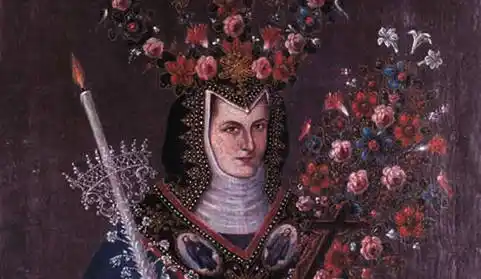
The New Spain of the 17th century was a scenario in which religiosity permeated all aspects of daily life. Women’s convents, spaces of enclosure and contemplation, also became places where stories of miracles, ecstasies and supernatural visions emerged. However, what we know of these episodes are not evidence of divine phenomena, but written testimonies that reflect the religious mentality and social climate of the time.
One of the most famous episodes occurred in 1624, in the midst of the fierce conflict between the Viceroy Marquis of Gelves and Archbishop Juan Perez de la Serna. During those disturbances, two nuns from Mexico City claimed to have had revelations linked to the riot that shook the capital. Their declarations were recorded, and today they give us a glimpse into the way in which the supernatural mingled with politics and daily life in the viceroyalty.
The riot of 1624: politics and religion intertwined
In January 1624, the dispute between the viceroy and the archbishop escalated to the point of provoking a popular riot that forced the Marquis of Gelves to flee in disguise and take refuge in the convent of San Francisco. The tension was so great that the city was placed under religious interdict (cessatio a divinis), which meant that no masses or sacraments could be celebrated in the capital.
In this climate of uncertainty, the declarations of two visionary nuns emerged: Ana de San Ambrosio, from the convent of Jesús María, and Ana de San Francisco, from the convent of La Concepción. Their accounts were recorded in official records, under oath and in the presence of ecclesiastical authorities.
Mother Anne of St. Ambrose’s Vision
Anne of St. Ambrose, about 60 years old and with four decades in religious life, claimed to have had a series of revelations during Christmas 1623. According to her testimony:
- While he was trying to receive communion, he saw the Blessed Sacrament turned into an ember of fire, from which flames seemed to consume the priest.
- He heard an inner voice explaining that this symbolic fire represented the viceroy’s disobedience towards the archbishop. The Marquis of Gelves had violated the right of ecclesiastical asylum, which granted protection to those who took refuge in temples. By ordering the forcible removal of an accused refugee in a church, the viceroy broke a principle considered sacred and unleashed the confrontation with the archbishop.
Although the event seemed small -the arrest of a single person taking refuge in a temple-, the reaction was much greater. The population of Mexico City was already accumulating discontent over taxes, shortages and abuses of power, and saw in the viceroy’s action an affront against the Church and against the faith itself. Thus, what began as a one-time incident became a massive riot that shook the viceregal palace and forced the Marquis de Gelves to flee in disguise.
- He also said he had received a foreshadowing of the riot, seeing point by point what would happen weeks later in the viceregal palace and in the main square.
- According to her, among the defenders of the palace there were not only people, but also demons who participated in the riot.
The most striking thing is that he assured that, when the riot occurred -provoked by popular indignation at the clash between the viceroy and the archbishop-, nothing surprised him because he had already seen it in vision.
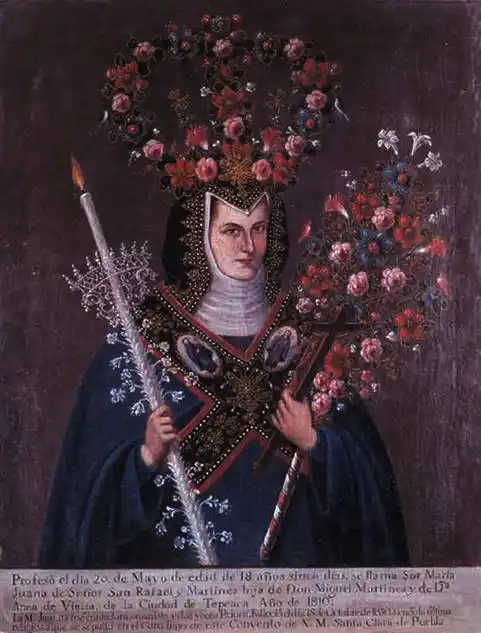
The revelation of Mother Anne of San Francisco
The second witness, Ana de San Francisco, 72 years old and with more than half a century of religious life, declared having received similar revelations:
- He said that the interdict imposed on the city was revealed to him as a sign of great afflictions to come.
- He assured that the banishment of the archbishop and the popular uprising had already been shown to him by divine inspiration.
- According to his testimony, the young men who attacked the palace were not simple boys, but souls from purgatory accompanied by their guardian angels, who took on a human appearance to fulfill God’s will.
- He even claimed to have seen among them the soul of Mother Inés de la Cruz, recently deceased, participating in the riots.
These words, recorded in notarial acts, show how the nuns interpreted political events within a framework of spirituality and mysticism.
Testimony, not evidence
It is important to emphasize that what we have today are religious testimonies written in a context deeply marked by faith and the providential vision of history. There is no evidence that these visions occurred in reality as supernatural phenomena.
For seventeenth-century society, however, these accounts served as a way of making sense of political events and reinforcing the authority of the Church in the face of conflicts with viceregal authorities. The archbishop himself ordered the compilation of these statements, perhaps as moral and political support before the Crown.
Conclusion
The testimonies of the visionary nuns of 1624 are a fascinating reflection of the Novo-Hispanic mentality, where the supernatural and the political could intertwine without contradiction. More than real miracles, they are symbolic accounts, charged with the spirituality of their time, which allow us to understand how social and religious conflicts were experienced in viceregal Mexico City.
Read today, these documents do not show us proof of the divine, but rather windows into the collective imagination of New Spain: a world in which demons, souls in purgatory and revelations were part of everyday language to explain what was happening in reality.
Some doubts and clarifications about the testimonies of visionary nuns in New Spain.
What is the right of ecclesiastical asylum?
It was the protection offered by the temples to the people who sought refuge in them. No one could be arrested inside a church without violating this principle, considered sacred by the Church.
What did the cessatio a divinis mean?
It was an ecclesiastical measure that suspended religious services in an entire city: no masses, baptisms or sacraments were celebrated. In 1624, Mexico City came under this sanction, which increased the tension between the population and the civil authorities.
Why did a single arrest provoke such a large riot in 1624?
The arrest was the spark, but behind it there was an accumulated malaise: abuses of power, taxes, famine and the open clash between the viceroy and the archbishop. The people interpreted the violation of the ecclesiastical asylum as an offense to the faith, which unleashed a popular outburst.
Were the visions of the nuns real?
There is no evidence that they were supernatural phenomena. What we have are written testimonies that reflect how reality was interpreted in a religious key in the 17th century.
The archbishop ordered that they be recorded to show that the events had a divine background and to reinforce his authority vis-à-vis the Crown, at a time of confrontation with the viceroy.
What do these testimonies teach us today?
More than miracles, they are a window into the collective imagination of New Spain, where the supernatural and the political could intertwine as part of everyday life.
–