
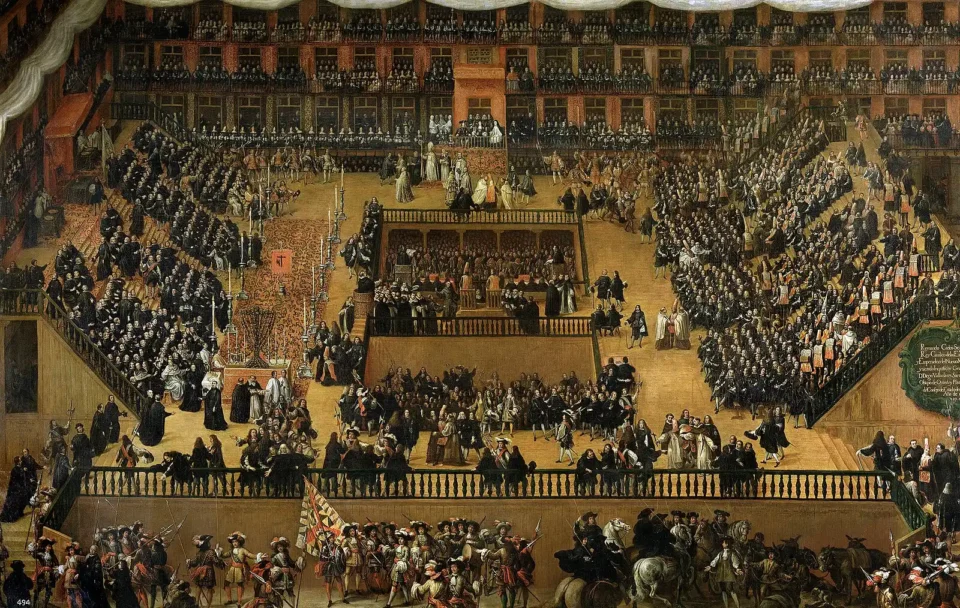
An auto de fe was a public ceremony organized by the Tribunal of the Holy Office, where sentences were read against those accused of religious crimes and the corresponding punishments were carried out. These acts combined religious solemnity, display of power and social control, and could include anything from penance to burning at the stake.
In New Spain, the first autos de fe showed the extent of the Inquisition: European corsairs accused of Protestantism, families accused of Judaizing and high-ranking personalities put on trial. Among them, the case of the Carvajal family became one of the most remembered episodes of the Inquisition in the viceroyalty.
The first auto de fe of 1574
The first auto de fe celebrated in New Spain took place in 1574. It included the cause of Don Pedro Juarez de Toledo, prosecuted in Guatemala for heresy. Transferred to Mexico City along with his file, he died in prison in September 1569. He was later declared innocent and his honor and goods were restored.
This act was celebrated by the population as a reparation of injustice, although the auto was especially notable for the presence of English and French corsairs, accused of being “Lutherans”. Five of them were condemned to death in person, that is, executed at the stake.
The Auto de fe of 1590
Between 1574 and 1590 there were four minor autos in which there were also those condemned to death. The auto of February 24, 1590 was notable because among the defendants were don Luis de Carvajal “el Viejo”, governor of Nuevo León, his sister doña Francisca Núñez de Carvajal, her daughters and Luis de Carvajal “el Mozo”.
The governor died in prison, while the others were reconciled. The persecution against this family became famous in the annals of the Novo-Hispanic Inquisition, especially for the tragic fate of Luis de Carvajal “el Mozo”.
The general order of 1596
On December 8, 1596, the most solemn auto of the XVI century was celebrated in the Plaza Mayor of Mexico City. It was attended by the viceroy, the Audiencia, the ecclesiastical chapter, the University and a multitude of people. The chronicles describe how the convicts paraded with painted sambenitos, ropes and corozas, carrying candles and a green cross, accompanied by religious who exhorted them to repentance.
A total of 49 people were prosecuted, of which nine were condemned to the stake as judaizers. Among them were five members of the Carvajal family: Doña Francisca, her three daughters and Luis de Carvajal “el Mozo”. They had been reconciled in 1590, but were now executed as relapsed and contumacious.
The process against this family, and in particular against Luis, is considered one of the most dramatic testimonies in the history of the Inquisition in New Spain.
The auto de fe of 1601
On February 15, 1601, the first auto of the 17th century took place. Again members of the Carvajal family appeared: Ana, 19 years old; Leonor, 14 years old; and Doña Mariana Núñez de Carvajal, condemned to death. Eyewitnesses pointed out that she died with contrition, asking for mercy and confessing the Catholic faith, which moved those present.
In this car was also executed a German, Simon of James, accused of Calvinism. Despite feigning insanity to avoid condemnation, he was burned alive. On the scaffold he refused to accept the cross offered to him and died with a gag in his mouth, due to the blasphemies he uttered.
Conclusion
he autos de fe held in New Spain between 1574 and 1601 show the rigor of the Inquisition and its public nature. European corsairs accused of Protestantism and entire families accused of Judaizing were the protagonists of ceremonies that mixed justice, punishment and spectacle.
However, it is important to note that, although these acts were engraved in the collective memory by the executions at the stake, in reality very few inmates were put to death compared to the large number of defendants who received lesser penalties, such as penances, confiscation of property or reconciliations.
The case of the Carvajal family, and in particular that of Luis de Carvajal “el Mozo”, remained as a symbol of the drama and severity that accompanied the history of the Inquisition in the viceroyalty, reminding us that the weight of these ceremonies fell on both the public exhibition and the extreme condemnations.
Frequently asked questions about the first autos de fe in New Spain
What was an auto de fe in New Spain?
An auto de fe was a public ceremony organized by the Tribunal of the Holy Office of the Inquisition. In it, sentences were read against those accused of religious crimes and the penalties were executed, which could range from penitence to being condemned to the stake.
When was the first auto de fe held in New Spain?
The first auto de fe took place in 1574. Among the most outstanding cases was that of Pedro Juárez de Toledo and the condemnation of several English and French corsairs accused of being “Lutherans”.
Who were the Carvajals and why were they prosecuted?
The Carvajal family, headed by Luis de Carvajal “el Viejo” and his nephew Luis de Carvajal “el Mozo”, was accused of secretly practicing Judaism. Several of its members were reconciled in 1590, but years later many of them were executed as relapsos in the autos of 1596 and 1601.
Where were the autos de fe celebrated in New Spain?
The most emblematic place was the Plaza Mayor of Mexico City (today’s Zócalo). There, scaffolds were erected and solemn processions were organized with the attendance of authorities, clergymen, universities and a large number of public.
How important were the autos de fe in New Spain society?
The autos de fe not only sought to punish the accused, but also to reinforce the authority of the Inquisition and the Catholic Church before the population. They were public acts of great impact, combining religion, politics, justice and spectacle.
–