
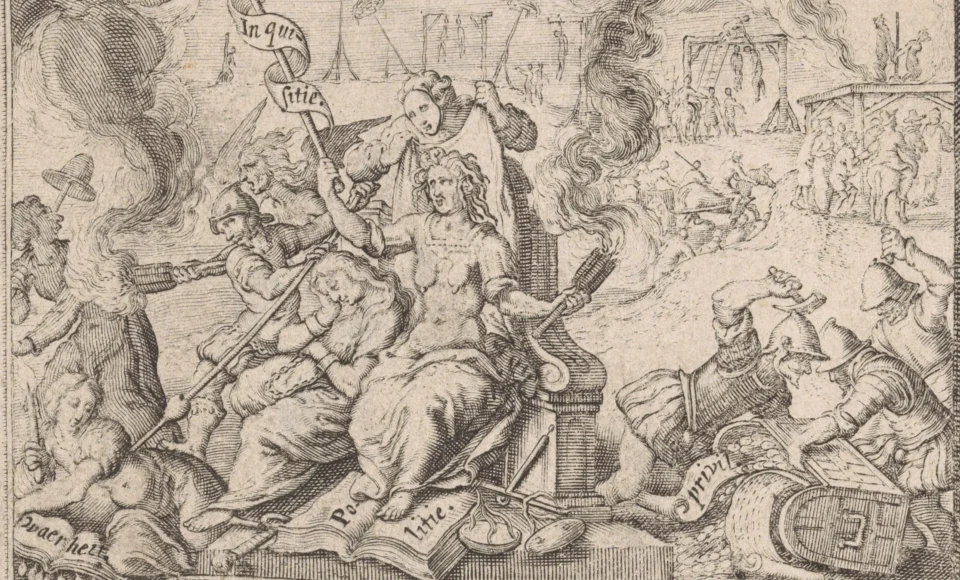
With the formal establishment of the Tribunal of the Holy Office in Mexico City in 1571, a new stage in the inquisitorial history of the viceroyalty began. Unlike the early monastic and episcopal periods, the Inquisition acquired a defined structure and its own judicial procedures, directly dependent on the Supreme Council of the Inquisition in Castile.
This article addresses two fundamental aspects: the internal organization of the court and the judicial procedures that regulated its activities, including the autos de fe that marked the public life of the viceroyalty.
The organization of the Tribunal of the Holy Office
The court depended on the Supreme Council of the Inquisition, presided over by the general inquisitor in Castile. In its structure, the highest authority were the inquisitors, who were usually several. Among the main officials, the following stood out:
- The prosecutor, in charge of promoting the proceedings.
- The secretary of the Secret, who gave public faith and authorized acts, proceedings, dispatches and edicts.
The inquisitors counted on a body of consultants of the Holy Office, learned persons of high social standing who issued votes in serious decisions, such as sentences of torment or death.
Another important group were the qualifiers of the Holy Office, specialists in theology and religion who ruled on complex and debatable issues.
In the police sphere, the court had a high sheriff, wardens for the secret and penitentiary prisons, and the relatives of the Holy Office, auxiliaries who carried out surveillance and detention functions.
In administrative and fiscal matters, there were the Receiver General, the accountant, notaries for seizures and the court, attorneys for the Treasury and a prison provider. For the defense, there was a prisoner’s attorney, who intervened only when the prisoner did not have his own counsel.
The Inquisition also had specialized personnel: doctor, surgeon-barber, apothecary, master builder, printer, chaplain, interpreters, criers, porters and assistants called “honest and religious persons” who witnessed ratifications. Occasionally, bookstore visitors and book collectors were appointed.
Outside Mexico City, the Holy Office had commissioners, almost always priests, distributed in cities and towns of the viceroyalty. They received complaints, carried out investigations and reported to the court, although they lacked the power to apply torment or sentence.
An indispensable requirement for all employees was to demonstrate cleanliness of blood, that is, to prove to be an old Christian with no ancestors penitentiated by the Inquisition. Even a doorman of the Holy Office enjoyed social prestige for this reason.
The court rigorously maintained a system of records and archives, preserved today in the General Archive of the Nation as one of the most complete branches of the viceregal administration.
The judicial proceedings of the Inquisition
When a tribunal was established, an initial ceremony called an oath was performed, in which local authorities promised to denounce suspects and to collaborate with the Holy Office. This was followed by the reading of the general edict of grace, in which the guilty were urged to denounce themselves under threat of excommunication.
The fundamental rule of the entire procedure was absolute secrecy, which included the inquisitors themselves. This left the accused at a disadvantage, as he did not know who was denouncing him and what exactly he was accused of.
Any complaint, even anonymous, was valid. If any evidence was found, the accused was arrested, his property secured and a statement was taken about his family, faith and customs. He almost always pleaded ignorance, which made him look “negative” and formally opened the process.
During the entire trial, the accused remained in the secret prison, incommunicado. Witnesses testified under oath and their identity was kept hidden, with no possibility of confrontation.
Torment was an exceptional recourse, reserved for serious cases or contumacious defendants. Although it was a common practice in European courts, the Inquisition was especially associated with it because of the black legend. In New Spain it was used mainly with cords and water. The torment had to be requested by the prosecutor, authorized by consultants and recorded in detail by a notary, including the lamentations of the prisoner. If he confessed, the torment ceased; if not, he was said to have “conquered the torment”, although he was not informed of this.
The executioner always covered his face and a doctor attended to the prisoner afterwards, although the injuries were considered the responsibility of the accused himself for not confessing.
Sentences and penalties
The sentences could be:
- Acquittal of the charge, if the defendant proved his innocence.
- Acquittal of the instance, if there was insufficient evidence.
- Reconciliation, when he confessed, showed repentance and abjured, with penalties ranging from life imprisonment and galleys to acts of public humiliation, always with fines and confiscation of property.
- Relaxation, i.e., surrender to the secular arm for execution: garrote or burning at the stake.
Relaxation could even be applied to the deceased, whose remains were exhumed and burned, or to absentees, represented by statues.
The convicts remained in prison until the celebration of an auto de fe, a public act in which the sentences were read. The penitentiaries wore sambenito and coroza with painted flames according to the sentence.
The particular autos particulares were held in convents with few defendants; the autos generales were held in the main square, with great solemnity, in the presence of the viceroy, the Audiencia, the cabildos, the university, the clergy, the nobility and the people. In them, the authorities and the inquisitors were given a platform, and after the sentences, the convicted prisoners were handed over to the secular arm.
The final torture was considered a public and edifying spectacle, accompanied by exhortations from friars who encouraged the prisoners to confess in order to avoid the stake. Although many accepted, some remained firm in their convictions until death.
Conclusion
The organization and procedures of the Inquisition in New Spain reveal a tribunal with well-defined hierarchies, a strong bureaucratic and judicial apparatus, and a procedural system marked by secrecy, denunciations and social control.
Although practices such as torment and autos de fe seem atrocious to us today, in their time they were part of the European judicial culture. In the New Spain, the Holy Office not only watched over religious orthodoxy, but also represented a source of social prestige and income for the Crown.
Some clarifications and frequently asked questions
How was the Tribunal of the Holy Office organized in New Spain?
The court was headed by the inquisitors and included officials such as the prosecutor, the secretary of the Secret, consultants, qualifiers, bailiffs, prison wardens and relatives of the Holy Office. It also included specialized personnel such as doctors, notaries, interpreters and criers.
What were the requirements for employees of the Inquisition?
All officials, even those of lower rank, had to demonstrate cleanliness of blood, that is to say, prove that they were old Christians without ancestry penitentiated by the Holy Office.
How did the judicial processes of the Inquisition begin?
The proceedings began with an oath of cooperation from the local authorities and the publication of the general edict of grace, which invited the guilty to denounce themselves under threat of excommunication.
Why were the Inquisition trials secret?
Secrecy was considered a fundamental rule. The accused did not know their accusers or the details of the accusations, which made it difficult for them to defend themselves.
Was torture always used in inquisitorial trials?
No. Torment was applied only in serious cases or when the accused persisted in denying the charges. In the Inquisition of New Spain, cords and water were mainly used, and it had to be authorized by the consultants.
What types of sentences did the Inquisition pass?
They could be acquittal of the charge, acquittal of the instance, reconciliation with varied penalties or relaxation, which implied surrender to the secular arm to execute the death penalty.
What were the autos de fe?
They were public ceremonies in which the sentences were read. The autos particulares were held in convents with few defendants, while the autos generales were held in the main square with great solemnity and attendance of civil, religious and public authorities.
–