
In the context of the viceroyalty of New Spain, the Catholic Church needed to unify criteria on how to organize evangelization, regulate the life of the clergy and define its relations with the civil authority. For this purpose, councils were held, formal meetings where bishops, provincials of religious orders and representatives of the ecclesiastical hierarchy debated and established common norms.
A council is, in general terms, an assembly of church authorities that meets to make decisions on doctrine, discipline and organization. In the case of New Spain, these meetings were fundamental in shaping religious and social life in the 16th and later centuries.
First meetings and the road to the councils
Since the arrival of the first Franciscan friars in 1524, informal meetings called juntas apostólicas were held. These meetings discussed issues such as the administration of the sacraments and the norms to be followed by the new Christians.
For example, it was established that recently converted Indians could not receive communion until they had papal authorization, which was achieved in 1537 with the brief Pastorali Officio of Paul III.
Over time, these councils evolved into larger assemblies, with the participation of bishops, friars and viceregal authorities. This was how the foundations were laid for the provincial councils in New Spain.
The Council of 1546 and the tensions of its time
In 1544, Francisco Tello de Sandoval arrived in Mexico, in charge of applying the New Laws of 1542, which regulated the encomiendas and sought to improve the situation of the indigenous peoples. Although its application was limited by the pressure of the encomenderos and the fear of uprisings, Tello also promoted the convocation of an ecclesiastical meeting, held in 1546.
Bishops and provincials of the religious orders participated in this meeting. One of the most tense episodes was the presence of Fray Bartolomé de las Casas, who, after his disputes in Chiapas, organized a parallel junta in Santo Domingo. There, the enslavement of the indigenous was declared illicit, while the official junta sought mainly to ensure that the encomenderos fulfilled their religious responsibilities towards the encomendados.
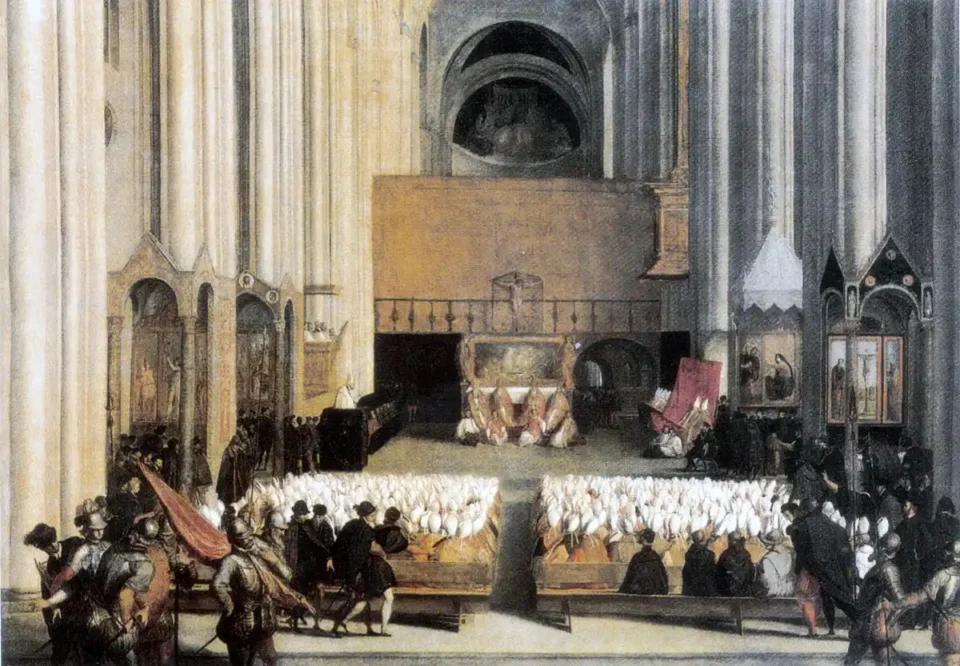
The First Mexican Council (1555-1556)
Convened by the Dominican archbishop Alonso de Montúfar, it brought together the main bishops of the region, provincials of religious orders, viceregal authorities and members of the Cabildo of Mexico City.
The result was a body of legislation composed of 93 chapters, published in 1556 by Juan Pablos, the first printer in New Spain. Its provisions focused on:
- Reinforce the morality of the clergy, prohibiting gambling, usury, irregular marital cohabitation and commerce.
- Limit abuses in the collection of parish fees.
- To favor the indigenous peoples, exempting them from fines and penalties of excommunication “considering their misery and taking into account that they are new to the faith”.
- Prohibit burials on church walls, which would mark the absence of funerary sculpture in New Spain.
- Control the sale of religious images, which had to have ecclesiastical approval.
The Second Mexican Council (1565)
Montúfar convoked a second council, in which 28 chapters were drafted. Among its provisions were:
- Ratification of norms against usury, clerical trading and extortion in the sacraments.
- New clarifications on canonical discipline.
- Exemption of indigenous peoples from paying tithe, a benefit that reflected the paternalistic policy towards the new faithful.
- Repeal of decrees that contradicted the Council of Trent, whose influence was beginning to be strongly felt in New Spain.
The Third Mexican Council (1585)
The most important was the one convened by Archbishop Pedro Moya de Contreras, who also served as visitor and governor of New Spain. Meeting in 1585, this council was the only one to receive papal approval and became a point of reference for centuries to come.
His decrees, contained in 576 paragraphs divided into three books, thoroughly regulated the structure of the Church:
- They defined the relationship between regular and secular clergy.
- They organized dioceses, ecclesiastical councils and parishes.
- They ratified the preferential attention to indigenous peoples, exempt from fines and tithes.
- They adapted the Tridentine decrees to the Novo-Hispanic context.
A decisive point was the exclusion of indigenous people, people of African descent and castes from access to the priesthood. This decision profoundly marked ecclesiastical life in Mexico.
Although the council ended in 1585, its promulgation was delayed until it received royal and pontifical approval, achieved in 1589 thanks to the bull Romanum Pontificem of Pope Sixtus V.
Conclusion: the councils and their legacy
The councils of New Spain were much more than religious meetings: they marked the course of the Church and its relationship with New Spain society. They established norms of discipline, regulated the life of clergy and faithful, and adapted the Tridentine reforms to the American context.
Through them, the tensions between bishops, friars, encomenderos and civil authorities are evidenced, as well as the central role of the Church in the organization of the viceroyalty. Their decisions not only influenced the spiritual life of the 16th century, but also the configuration of the Mexican Church in the following centuries.
–