
La organización eclesiástica en la Nueva España fue uno de los pilares del régimen virreinal. A través de los obispados, la monarquía católica y el papado aseguraban tanto la difusión de la fe como el control político de los territorios recién incorporados. La creación de diócesis no siempre respondió a criterios pastorales, sino también a premios a aliados indígenas o a decisiones estratégicas de gobierno. Esta compleja red fue creciendo desde el siglo XVI y definió gran parte de la vida religiosa y social novohispana.
What is a diocese and how is it different from a church?
A diocese is a large territorial division of the Catholic Church, directed by a bishop. Its function was to organize the religious life of all the temples, convents and parishes within that territory. Simply put, a diocese is a religious jurisdiction that encompasses many communities.
In contrast, a church (whether parish, convent or cathedral) is a physical space where the faithful gather to celebrate mass and receive the sacraments. While a church serves a particular community, a diocese is regional in scope and establishes the bishop’s authority over all the churches in his area.
Por ejemplo, la diócesis de Tlaxcala incluía numerosas parroquias y templos de distintas poblaciones, todos bajo la autoridad de fray Julián Garcés como obispo.
The first bishopric: from Cozumel to Tlaxcala and Puebla
El papa León X creó en 1518 el obispado Carolense, en honor a Carlos V, cuando apenas se conocía la isla de Cozumel. Poco después, este obispado fue trasladado a Tlaxcala como reconocimiento por su apoyo en la jornada militar de Cortés contra el señorío mexica. Su primer obispo fue el dominico fray Julián Garcés, quien en 1527 presentó sus bulas ante el cabildo de la Ciudad de México, la única autoridad constituida entonces.
En 1539, la sede episcopal pasó a Puebla de los Ángeles, ciudad fundada ocho años antes, donde Garcés fue pieza clave. Aunque la cédula real de 1544 confirmó este traslado, la diócesis conservó el título de Tlaxcala hasta inicios del siglo XVII.
The Diocese of Mexico-Tenochtitlan and the archbishopric
In 1527 the diocese of Mexico-Tenochtitlan was also erected, whose first bishop was the Franciscan Fray Juan de Zumárraga. He arrived in 1528 without being consecrated, since the pontifical approval was not given until 1530. Years later he traveled to Spain, where he received his consecration.
In 1546, this diocese was elevated to the category of archdiocese, with the American cathedrals remaining under its jurisdiction as suffragans. Zumárraga was its first archbishop, although he was only able to govern for two years.
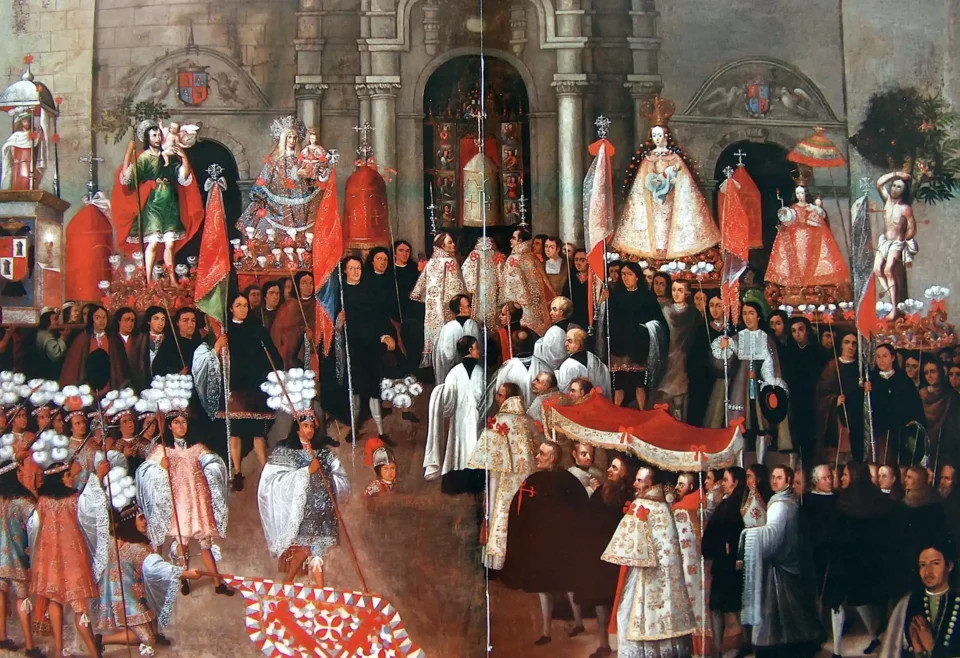
New dioceses in the 16th century
Ecclesiastical expansion continued rapidly. Among the principal dioceses founded were:
- Antequera de Oaxaca (1535): covered the entire southern region of the viceroyalty.
- Patzcuaro (1538): with Vasco de Quiroga as bishop, later moved to Valladolid.
- Ciudad Real de Chiapas (1545): first seat of Fray Bartolomé de las Casas, remembered for his defense of the indigenous peoples. His firm stance against the abuses of encomenderos and civil authorities generated such strong tensions that he was finally forced to abandon the diocese.
- Compostela (1548): transferred to Guadalajara in 1560.
- Mérida (1561): in charge of the Yucatán peninsula.
- Verapaz, Guatemala, León de Nicaragua and the Philippines: all under the authority of the archbishopric of Mexico.
Posteriormente, en 1623 se erigió la diócesis de Durango, clave para la región de Nueva Vizcaya, y en el siglo XVIII la de Linares, en el Nuevo Reino de León.
Difficulties of extension and undefined boundaries
El territorio asignado a cada diócesis en la Nueva España era enorme y con fronteras poco precisas. Esto dificultaba cumplir con las visitas pastorales que pedía el Concilio de Trento (1545–1563), una gran reunión de obispos y teólogos que buscó reformar la Iglesia católica en plena época de la Reforma protestante. Entre sus acuerdos, se estableció que los obispos debían recorrer personalmente sus diócesis para supervisar al clero, confirmar a los fieles y asegurar la correcta enseñanza de la doctrina.
In practice, this was almost impossible in New Spain. Some prelates, such as the Puebla bishop Mota y Escobar, undertook long tours, but were never able to cover the entirety of their jurisdiction. The bishopric of Tlaxcala-Puebla, for example, extended from the Gulf of Mexico to part of the Pacific; that of Mexico also reached both coasts; and that of Guadalajara seemed to get lost indefinitely on the northern border. These dimensions reflect the territorial ambition of the Church, but also the enormous challenges of effectively serving such a diverse and dispersed population.
Conclusion: The Birth of the Church in New Spain
The erection of dioceses in New Spain was a process of great political and spiritual importance. The bishoprics not only organized religious life, but also reinforced the authority of the Crown and the papacy over the territories. However, the diffuse boundaries and dimensions of each jurisdiction meant that many communities were left on the margins of pastoral attention. The result was a powerful Church, but with internal tensions and permanent challenges to approach the entire population of the viceroyalty.
Common doubts about dioceses in New Spain
What exactly is a diocese?
It is a territorial division of the Catholic Church directed by a bishop. Its function was to organize the religious life of a broad group of parishes, temples and communities within a region.
How is a diocese different from a church or parish?
A church is a physical space where masses and sacraments are celebrated for a local community. A diocese, on the other hand, encompasses many communities and is under the authority of the bishop, who oversees the work of all the churches in his jurisdiction.
Why did some dioceses change their see?
Sometimes they were moved for strategic, political or practical reasons. The most famous case is the bishopric of Tlaxcala, which was moved to Puebla in 1539, a new and better located city for ecclesiastical administration.
What role did Fray Bartolomé de las Casas play as bishop?
He was the first bishop of Chiapas and stood out for defending the indigenous peoples. His confrontations with encomenderos and civil authorities were so intense that he ended up leaving the diocese.
How did the size of the dioceses affect the bishops?
The Council of Trent requested that the bishops personally visit their entire territory. However, in New Spain the dioceses were so extensive that it was impossible to comply. Some, such as Mota and Escobar, made extensive tours, but never managed to cover their entire jurisdiction.