
During the 16th century, livestock farming transformed large areas of the Viceroyalty of New Spain. Although livestock is often associated with Spanish settlers and large rural estates, the truth is that various indigenous peoples managed to develop significant livestock wealth, especially in the area of small livestock.
The most notable case was that of the Mixteca, where indigenous communities not only actively participated in animal husbandry, but at certain times outnumbered the Spanish landowners in the region. This economic reality helps explain why large estates did not flourish in this territory as they did in other areas of the viceroyalty.
Large and small livestock: differences in ownership
In general terms, large livestock was not owned by indigenous peoples, except for a few animals used for plowing the land in areas where the plow and agricultural techniques of European origin were adopted. Small livestock, on the other hand, was widely owned and managed by indigenous communities.
According to Lesley B. Simpson’s calculations, by the end of the 16th century, the indigenous peoples of the Upper and Lower Mixteca—not counting the coastal area—owned approximately 238,000 head of small livestock. This figure was surpassed only by the regions of Tlaxcala-Puebla, with 418,000, and Zimatlán-Xilotepec, with 360,000.
These figures show that indigenous livestock farming was not a marginal phenomenon, but rather a well-established activity within the regional economy.
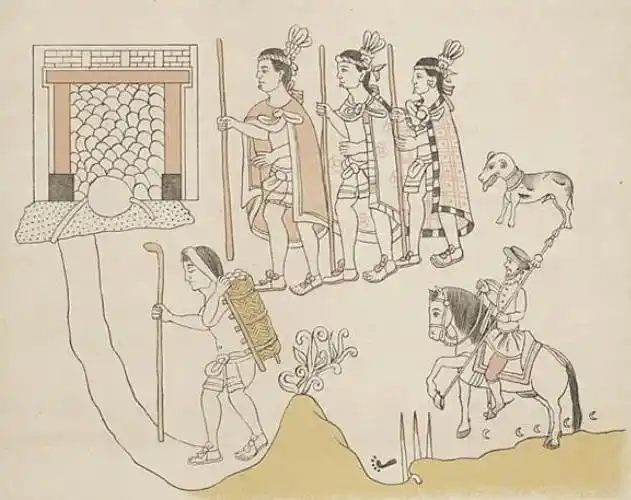
La Mixteca: an exceptional case of livestock wealth
The most surprising thing about the Mixtec landscape is not only the volume of livestock, but the comparison with Spanish landowners in the same region. While the indigenous people had 238,000 head of cattle, the Spaniards had 157,000, or 81,000 fewer.
Furthermore, if other herds raised by indigenous communities on vacant land outside formally owned estates are taken into account, the figure could be adjusted even further. In that case, the number of indigenous animals would increase considerably, widening the gap with Spanish landowners.
This is the only known case in which indigenous livestock wealth clearly surpassed that of the Spanish in the same region of the viceroyalty.
Social cohesion and limits on large property ownership
The prosperity of livestock farming in the Mixteca region cannot be understood solely in numerical terms. The text points out that this wealth was accompanied by the industriousness and social cohesion that characterized the Mixtec peoples.
This combination of community organization and productive capacity helps explain why large Spanish estates did not develop in this region with the same intensity as in other parts of New Spain. The indigenous economic base was sufficiently solid to sustain its own structures and limit the expansion of the hacienda.
In this sense, indigenous livestock farming was not only an economic activity, but also a factor that influenced the territorial and social configuration of the viceroyalty.
Conclusion
Indigenous livestock farming in the Viceroyalty of New Spain was a significant reality during the 16th century. Although large livestock was generally beyond their control, small livestock represented an important source of wealth for various communities.
The case of the Mixteca stands out as an exceptional example: there, indigenous peoples not only actively participated in livestock farming, but also managed to outnumber the Spanish landowners in the region in terms of livestock. This economic strength, coupled with their social cohesion, helped to slow down the development of large estates.
Thus, the history of livestock farming in the viceroyalty reveals a more complex picture than is often imagined: indigenous communities with productive capacity, internal organization, and real economic weight within the viceregal structure.
What few people know about indigenous livestock farming in the Mixteca region
Did indigenous peoples own livestock in the Viceroyalty of New Spain?
Yes. Although large livestock was not generally owned by indigenous peoples—except for some animals used for farming where the plow was adopted—small livestock was widely raised and managed by indigenous communities, especially during the 16th century.
Which region stood out for its wealth of indigenous livestock?
The most notable region was the Mixteca (Upper and Lower). By the end of the 16th century, its indigenous communities owned approximately 238,000 head of small livestock, a figure that even exceeded that of Spanish landowners in the same region.
In which regions were there more indigenous cattle besides the Mixteca?
According to the calculations cited in the text, the regions of Tlaxcala-Puebla and Zimatlán-Xilotepec recorded even higher numbers of small livestock owned by indigenous people. However, in those cases, Spanish owners had more head of livestock than the natives.
Why is the Mixteca considered an exceptional case?
Because it is the only known case in which indigenous livestock wealth clearly surpassed that of the Spanish in the same region. This difference is even greater when considering herds raised on vacant land outside of formal ranches.
What relationship did livestock farming have with the social structure of the region?
The text points out that livestock wealth, together with the industriousness and social cohesion of the Mixtec peoples, contributed to the fact that large Spanish estates did not develop there with the same force as in other parts of the viceroyalty.