
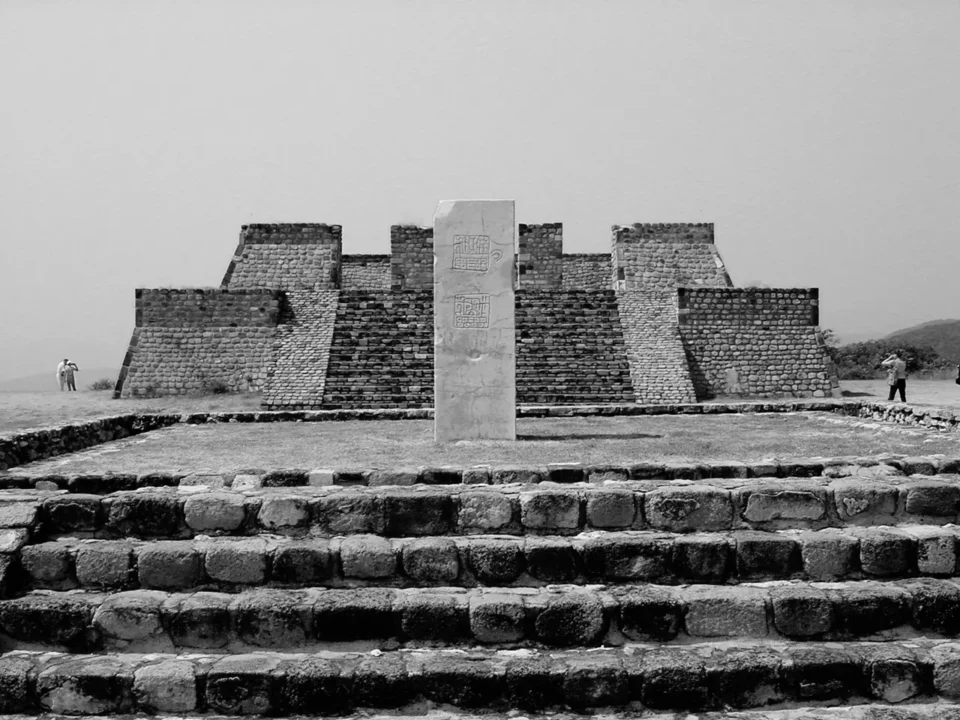
In Mesoamerican archaeology, each fragment tells a story. Among all the material remains left to us by ancient civilizations, ceramics occupy a special place. Through its forms, styles and manufacturing techniques, we can learn not only about the daily customs of pre-Hispanic peoples, but also about their cultural evolution, their migrations, and the links between great centers such as Teotihuacán and Xochicalco. This article explores how ceramic finds help us to reconstruct the role of Xochicalco as a true crossroads between Mesoamerican cultures.
One of the most valuable elements for Mesoamerican archaeology is, without a doubt, ceramics. Although it tends to go unnoticed by the average visitor, fragments of vessels, figurines and everyday objects made of fired clay have made it possible to reconstruct much of the history of civilizations such as Teotihuacan and its relationship with other centers, such as Xochicalco.
Why are ceramics so important? Because its analysis allows, among other things, to know which cultures inhabited a place, in which historical moments and what links existed between different regions. Through comparative methods and the study of stratigraphy (i.e., the depth at which the remains are found), it is possible to establish approximate chronologies. In addition, in some cases, techniques such as carbon-14 dating are used to pinpoint key dates.
What do the Xochicalco ceramics tell us?
In the surroundings of the archaeological zone of Xochicalco, very ancient ceramic fragments have been found, corresponding to the Preclassic period, that is, several centuries before our era. On the other hand, the pottery found in the heart of the ceremonial site corresponds mainly to the Late Classic and Early Postclassic periods, between the 7th and 10th centuries AD.
More recent fragments have also been found in superficial levels, such as pieces of mazapan pottery, coyotlatelco and some Aztec sherds. These findings indicate that, although Xochicalco had already lost its importance as a great ceremonial center, there was a later, sporadic but significant occupation.
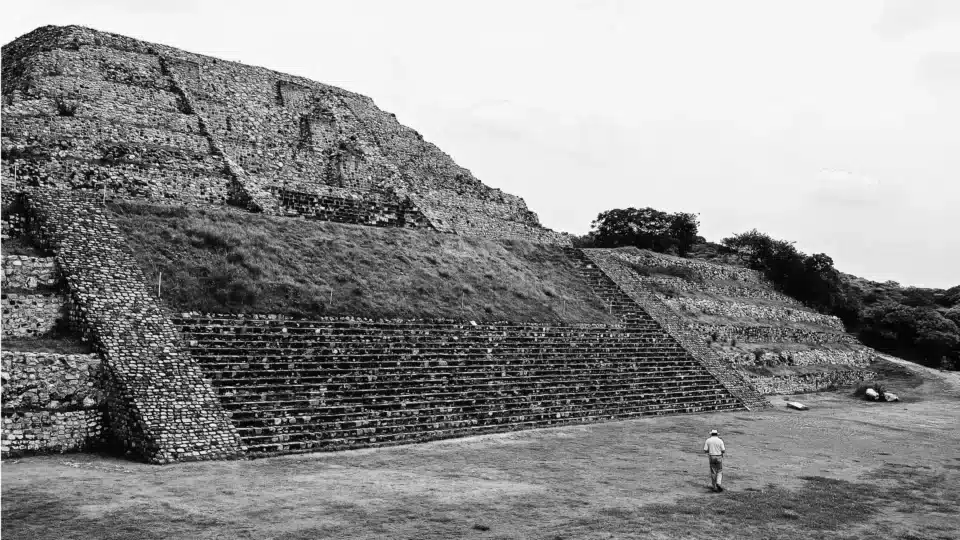
Xochicalco as a cultural crossroads
The fascinating thing about Xochicalco is its diversity. In its architecture, reliefs and even ceramics, there are characteristics that reflect a mixture of cultures: Teotihuacan, Zapotec, Maya, Mezcala, Nahua and El Tajin. This cultural fusion is manifested even in a single object, forming a kind of artistic and symbolic mosaic.
A notable example is the offering found in the Los Linares shrine, which included about 20 complete pieces of typical Teotihuacan pottery from periods II-III (250 to 650 A.D.). This finding confirms the presence of Teotihuacan influence long before the ceremonial peak of Xochicalco, since even older fragments from the Preclassic period were found under that offering.
A ceremonial, scientific and astronomical center
The development of Xochicalco took place between the Preclassic and early Postclassic periods, but its peak occurred between 600 and 900 A.D., in a transition period between Teotihuacan and the future Tula. Everything indicates that Xochicalco was not only a ceremonial center, but also a site of astronomical observation, artistic experimentation and possibly calendar adjustment.
It has been pointed out that the presence of the date of the first New Fire, or indigenous century of 52 years, reflects this scientific vocation. Xochicalco was a true Mesoamerican cultural node, a sort of Mecca of science and art, where the knowledge of different peoples converged.
Although Nahuatl was the predominant language (as it still is in many nearby communities), Xochicalco was not only inhabited by Nahua, but also by people of different origins. This reinforces the idea that the site served as a meeting point between peoples, cultures, knowledge and traditions.
Some researchers even propose that, after the decline of the site, many of its inhabitants migrated to the Valley of Mexico, which could have influenced the subsequent development of other Mesoamerican centers such as Tula or even Tenochtitlán.
–