
The arrival of the Tribunal of the Holy Office to New Spain marked a before and after in the religious and social life of the viceroyalty. Its creation responded to the need to centralize control over orthodoxy and customs, at a time when the so-called Episcopal Inquisition generated tensions and conflicts, especially in the investigations against the friars.
The Crown of Castile sought, then, to unify this power in an autonomous organism, directly dependent on the general inquisitor and the Supreme Council of the Inquisition, with headquarters in the peninsula. Thus, Philip II created the Tribunal of the Holy Office in Mexico, together with another in Peru, by means of a royal decree of January 25, 1569, complemented with another on August 16, 1570. These provisions established the jurisdiction of the new body, which would cover not only New Spain, but also the Philippines, Guatemala and the bishopric of Nicaragua.
The arrival of the first inquisitors
The general inquisitor, Don Diego de Espinosa, appointed Pedro Moya de Contreras and the lawyer Cervantes, with Pedro de los Ríos as secretary and Alonso de Bonilla as prosecutor, to be in charge in New Spain. The voyage from Sanlúcar de Barrameda in 1570 was not without tragedy: Cervantes died in Cuba and the ship in which the others were traveling was almost shipwrecked. Finally, they arrived at San Juan de Ulúa in August 1571 and made their solemn entry into Mexico City on September 12.
Viceroy Martín Enríquez de Almanza received the new institution coldly, aware that it was an independent authority that would compete with his own power. From then on, rivalries between viceroys and inquisitors would be constant in the political life of the viceroyalty.
The tribunal was installed in a house near the convent of Santo Domingo, where hearing rooms, the chamber of secrecy, chambers for the inquisitors and, soon after, prisons for the accused were set up.
Oath Ceremony and publication of the edict of grace
One of the inaugural acts was the ceremony of the oath and the publication of the edict of grace, celebrated on November 2, 1571. For several days it was announced in streets and squares that all inhabitants over twelve years of age had to go to the cathedral under penalty of excommunication.
The event was solemn: Inquisitor Moya de Contreras paraded accompanied by the viceroy, oidores, regidores, members of the University and religious orders. In the cathedral, the prosecutor Bonilla carried the crimson damask banner with a golden cross, while the royal decrees that gave life to the tribunal were read.
The oath obligated all present to denounce heretics and to collaborate with the Inquisition. The people responded in unison with a “Yes, I swear”, raising their right arms. Subsequently, the viceroy, the oidores and the representatives of the cabildo did the same.
That same day the general edict of grace was published, which offered those guilty of crimes prosecuted by the Inquisition a brief period of six days to confess voluntarily, under threat of excommunication.
With this act, the Holy Office was formally established in New Spain. Its motto, Exurge, Domine, judica causam tuam (“Arise, Lord, and judge your cause”), remained associated with the religious life of the viceroyalty until the end of the institution.
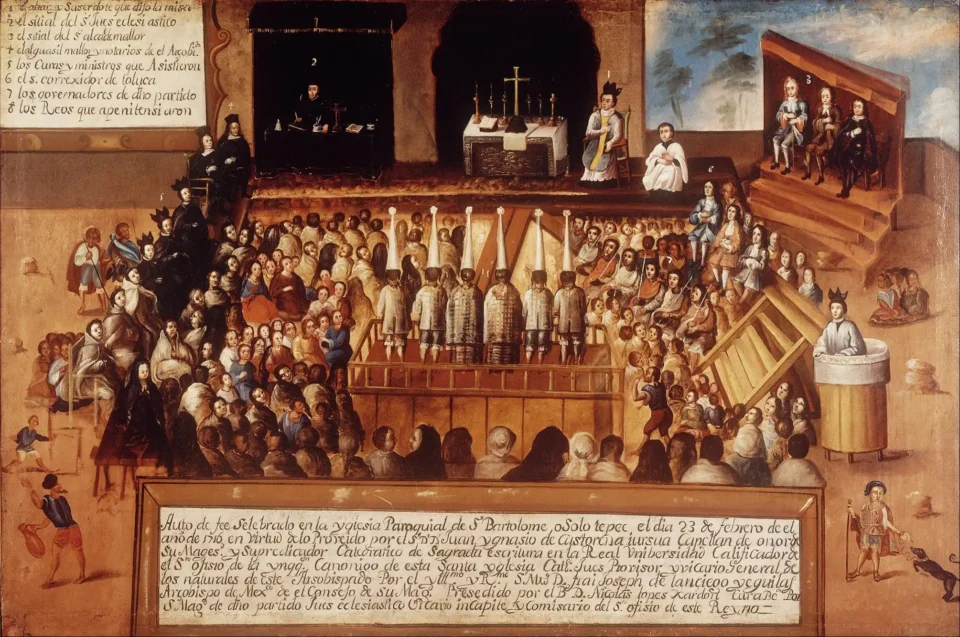
Major autos de fe and famous cases
The activity of the Tribunal of the Holy Office in New Spain was broad and complex. In general terms, it focused on four main fronts:
- Crimes against good morals and Christian morals: blasphemy, bigamy, concubinage and solicitation.
- Crimes against the faith: apostasy, heresy and, with special attention, the so-called Judaizers, that is, those who practiced the Jewish religion.
- Spread of Protestant doctrines: mainly Lutherans and Calvinists, mostly foreigners, some corsairs or accidental travelers who arrived in the viceroyalty.
- Control and censorship of books: lists of prohibited works were drawn up, shipments were checked in Veracruz and printing presses and libraries were inspected. The objective was to prevent the circulation of ideas contrary to Catholic doctrine, although numerous texts managed to enter and circulate discreetly.
The autos de fe were the public culmination of these processes: solemn acts where the sentences were read and the victory of orthodoxy over heresy was staged. In them, punishments ranged from spiritual penalties to more severe sanctions, depending on the seriousness of the case.
A court between fear and support
Although the so-called “black legend” presents the Holy Office as an apparatus of terror, the documents of the time show that a large part of the Novo-Hispanic population received it with approval. For many, it represented an instrument to ensure moral order and the purity of the Catholic faith, values considered essential both in this life and in eternal salvation.
Thus, the Tribunal of the Holy Office in New Spain was not only a judicial and religious body, but also a political and social actor that left its mark on the culture of the viceroyalty.
Some clarifications and frequent doubts about the Tribunal of the Holy Office
When was the Tribunal of the Holy Office formally established in New Spain?
The tribunal was founded in 1569 by royal decree of Philip II and was formally installed in Mexico City in 1571, with the solemn oath ceremony and the publication of the edict of grace.
What territories were under its jurisdiction?
Its jurisdiction not only included New Spain, but also the Philippines, Guatemala and the bishopric of Nicaragua, making it a court with enormous reach in the continent and the Pacific.
Who was the first inquisitor in Mexico?
The first inquisitor was Pedro Moya de Contreras, initially accompanied by the lawyer Cervantes, the prosecutor Alonso de Bonilla and the secretary Pedro de los Ríos.
What crimes did the Inquisition prosecute in New Spain?
It mainly dealt with cases of blasphemy, bigamy, concubinage and solicitation; in addition to heresy, Judaizers, Protestants and the control of forbidden books.
How were the autos de fe carried out?
They were public ceremonies in which the sentences of the accused were read. They included masses, processions and acts of great solemnity that reinforced religious authority and social order.
Did the entire population reject the court?
No. Although the Inquisition is harshly remembered by the so-called “black legend”, many inhabitants of the viceroyalty saw it as an instrument of moral and religious protection that strengthened community life.
–