
How to justify the possession of other people’s land?
During the expansion of the viceroyalty of New Spain or acts of taking possession in New Spain, towards the north, the European peninsular actors carried out various rituals of territorial possession, even in regions where indigenous peoples already lived. How was it justified to declare as their own a territory with previous population, history and political organization?
To answer this question it is necessary to understand two conflicting worldviews. On the one hand, the indigenous populations of northern Mesoamerica, many of them semi-nomadic, maintained a spiritual bond with the land. They did not conceive property as an object that could be bought or divided, but as part of their collective identity. Their forms of organization were diverse: from interethnic alliances to local leaderships with a flexible but legitimate territorial base.
On the other hand, the juridical and theological logic of the European Christian world understood territory as something that should be subject to a recognized and preferably Christian sovereignty. According to this view, a territory could be claimed if it did not belong to a Christian monarchy or if its inhabitants had not been evangelized. This principle did not apply equally to regions such as China or India, where there were recognized powers, organized armies and diplomatic agreements that limited Castilian intervention, such as the Treaty of Tordesillas that assigned these areas to Portugal. In contrast, the Novo-Hispanic north was seen as a space without sovereignty recognized by the Catholic monarchy, which facilitated the symbolic legitimization of its appropriation.
The case of Juan de Oñate in 1598 is a clear example of this practice. His act of possession was not only an administrative procedure, but a political and religious ritual charged with symbolism, which sought to inscribe the territory within the imperial order of the Catholic monarchy.
A land already inhabited: what the ritual did not recognize
Despite the official discourse, the territories where these takeovers took place were not empty lands. Various nomadic and semi-nomadic peoples inhabited these regions, with their own forms of social organization, kinship networks and spiritual ties with the environment. For many of these peoples, land was not owned, it was lived. Their relationship with the land was part of their collective identity.
The indigenous worldview did not conceive of the concept of territorial property as the Catholic monarchy did. While the peninsular actors sought to set boundaries and exercise legal control, the native peoples maintained a fluid, mobile and spiritual connection with their environment. The ritual of taking possession not only made these ways of life invisible, but also replaced them with a Christian and legalistic vision of the territory.
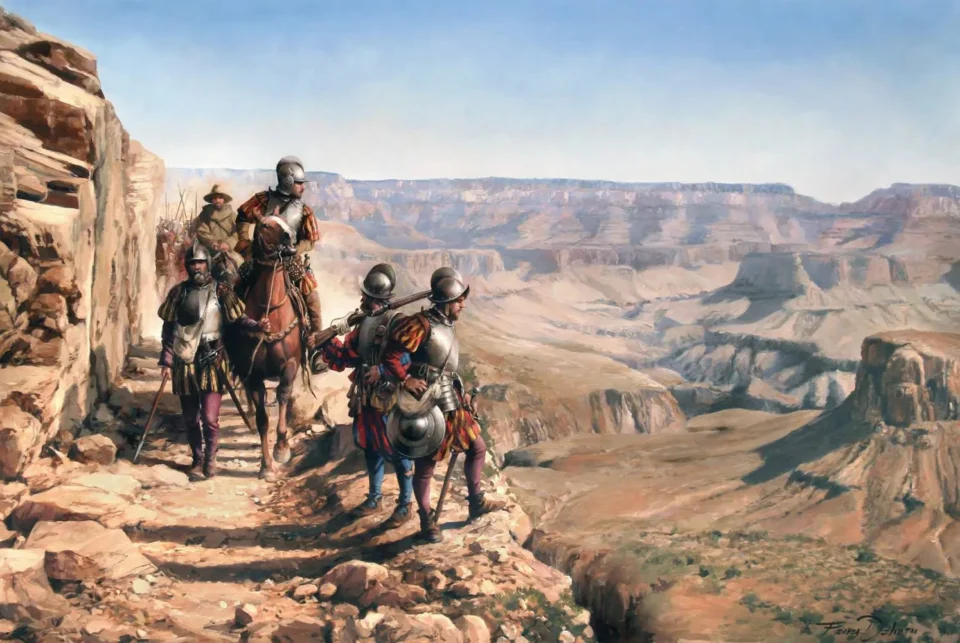
The act of possession in northern novo-Hispanic Spain
The ritual of the inauguration (1598)
On April 30, 1598, after crossing the river now known as Bravo or Grande, Juan de Oñate carried out a formal act of taking possession in the name of the Catholic monarchy. According to the testimony of witnesses recorded in official documents, the act included the reading aloud of a legal formula, the raising of a cross, the placement of mojones (symbolic markers of territory) and the oath of allegiance by those who accompanied him.
All this ritual responded to a performative logic: it was not enough to arrive at the place and occupy it; it was necessary to frame this act within a legal, visible and repeatable framework. It was a way of staging imperial power before God, before men and before any authority that might later dispute the legitimacy of the act.
The act of possession also had a strong symbolic charge. By planting the cross, Oñate was not only claiming the physical space, but also its incorporation into the Christian universe. The territory was interpreted as a space to be Christianized, therefore, “empty” in spiritual terms, although not in human terms. This type of narrative allowed denying the sovereignty of the native peoples while legitimizing military entry and evangelization.
However, not all the companions shared Oñate’s enthusiasm. Tensions within the group, climatic conditions and the resistance of some indigenous peoples soon made it evident that the venture would not be as prosperous as expected. The takeover was only the beginning of a long and conflictive settlement stage, in which violence, uprooting and disillusionment marked the experience of both the peninsular actors and the local populations.
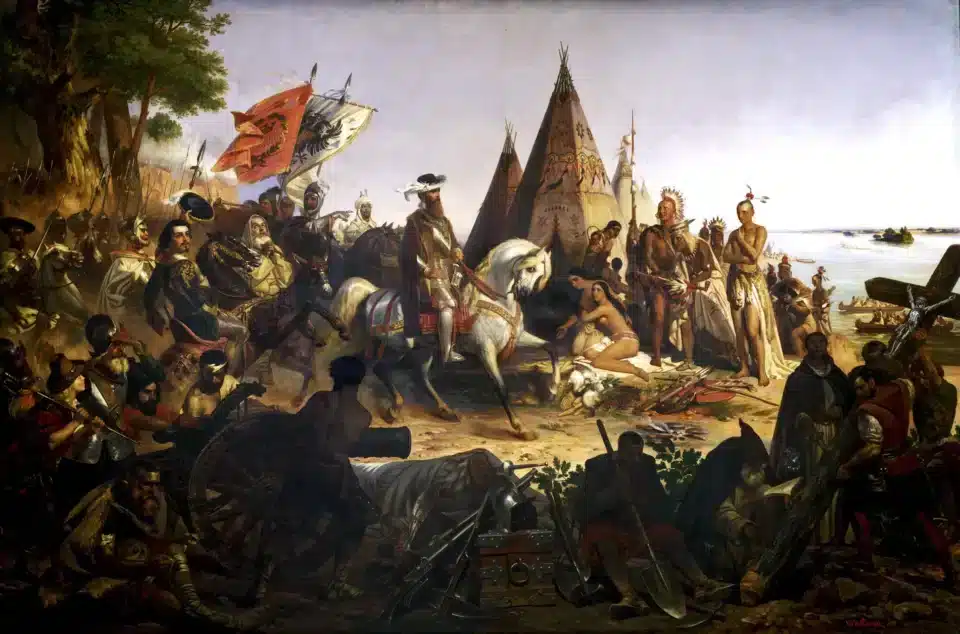
Conclusion: between imperial legality and silenced memory
The taking of possession in New Spain cannot be understood only as a legal act, but as a symbolic tool of domination. Through these rituals, the Catholic monarchy inscribed its power in territories inhabited by peoples with their own identities, deliberately ignoring their sovereignty, their culture and their spiritual ties to the land.
Although some friars, especially in regions such as the central highlands, came to document, preserve and even admire certain aspects of the indigenous world – such as languages, codices or artistic practices – this did not imply a political recognition of indigenous power over their territory. These elements were often reinterpreted from a Christian logic and used as evangelization tools.
The case of Oñate reveals the limits of viceregal expansion in regions where the logic of symbolic domination clashed with human, geographic and cultural realities. Not only because of its ritualism, but also because of what this act left aside: the deep history of the indigenous peoples of northern Mesoamerica, their forms of organization, their spirituality and their right to self-determination.
–