
Unlike the Old World, the Mexica did not use animals for agricultural work nor did they use the wheel for productive purposes. However, this did not mean an absence of technical development. On the contrary, the Mexica peoples knew how to adapt their tools and knowledge to the lake environment of the Valley of Mexico, achieving admirable results that surprised even the peninsular chroniclers. This article explores the ingenuity and agricultural technique of the Mexica, with special attention to the chinampero system, one of the most refined expressions of their productive capacity.
Non-animal-powered technology: a proprietary model of efficiency
In Mesoamerica, and particularly in Mexico-Tenochtitlan, no oxen, horses or mules were used to drag agricultural tools. Nor was the plow used as in Europe. Even so, Mesoamerican civilizations -and especially the Mexica- designed their own production model based on hand tools, among which the huictli, a hardwood planting stick, also known by its Caribbean name of coa, stood out. This instrument made it possible to turn the soil, sow and prepare the land without the need for animals.
The most widespread cultivation system was the milpa, which was based on slashing, burning and sowing in open plots in the bush. However, in the lake region of Mexico-Tenochtitlan, a highly specialized technique was developed: the chinampas.

The art of cultivating on water: the chinampas
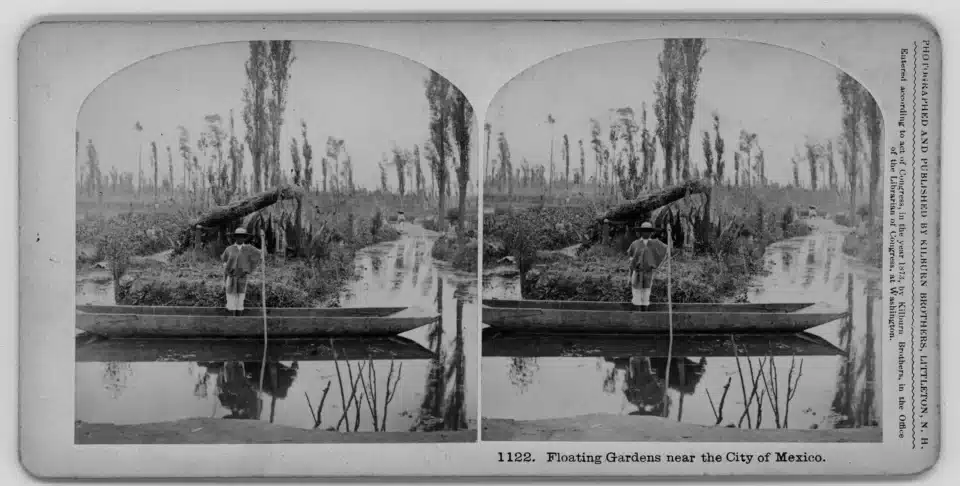
The chinampas were true floating gardens that made the most of the water resources and the limited space of the lake. According to Armillas and West’s research, their construction began with the cutting of grass strips, which were transported as rafts to a specific point in the lake. There they were stacked on top of each other and covered with mud from the bottom, creating a fertile surface.
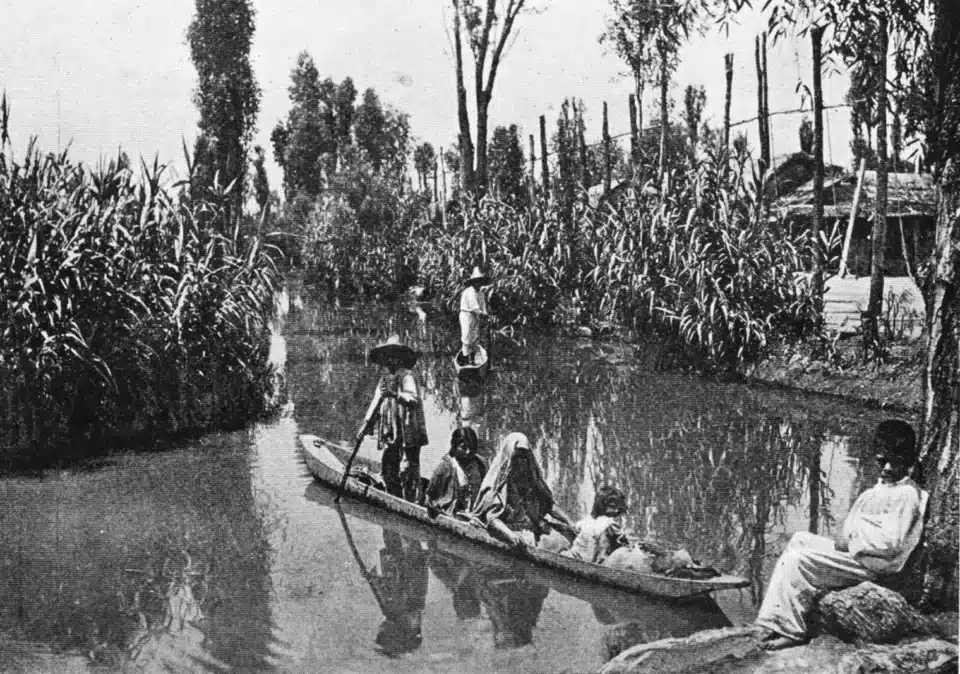
To ensure their stability, ahuejote ( Salix acumilata) stakes were placed along the edges, which eventually took root and helped hold the earth in place. These stakes not only served as living anchors, but also gave the landscape a particular physiognomy that can still be seen today in Xochimilco.
The chinampas were extremely productive. Before each planting, a new layer of fresh silt was added, guaranteeing constant fertility. Each islet was narrow to facilitate water filtration, and its length was limited only by the space available. In addition, when a chinampa became too high and hindered the penetration of moisture, it was lowered and its soil was used to restore others.
Intensive production and artisanal care
Cultivation in chinampas gave no room for rest: a continuous cycle of production was maintained throughout the year. The use of seedbeds made it possible to germinate seeds in small spaces before transplanting them, optimizing every centimeter of available soil. The climate, the humidity of the subsoil, the organic fertilizers, the irrigation system and the personalized care of each plant contributed to a remarkable agricultural yield.
Although Mexica technology did not have animal traction or metals for tools, their production system was perfectly adapted to their needs and environment. So much so that the peninsular chroniclers admired their precision, utility and beauty, especially when they saw obsidian objects, feathers and textiles that surpassed their European counterparts in quality.
Conclusion
The agricultural organization of the Mexica lordship was not the product of chance, but of a profound adaptation to their lake environment. With limited natural resources, without pack animals or metal tools, they were able to build an intensive, sustainable and efficient system that fed one of the largest cities of its time: Mexico-Tenochtitlan. Their technical legacy lives on in the chinampas that are still cultivated today in Xochimilco, proof of the ingenuity and tenacity of a civilization deeply connected to its environment.
–