
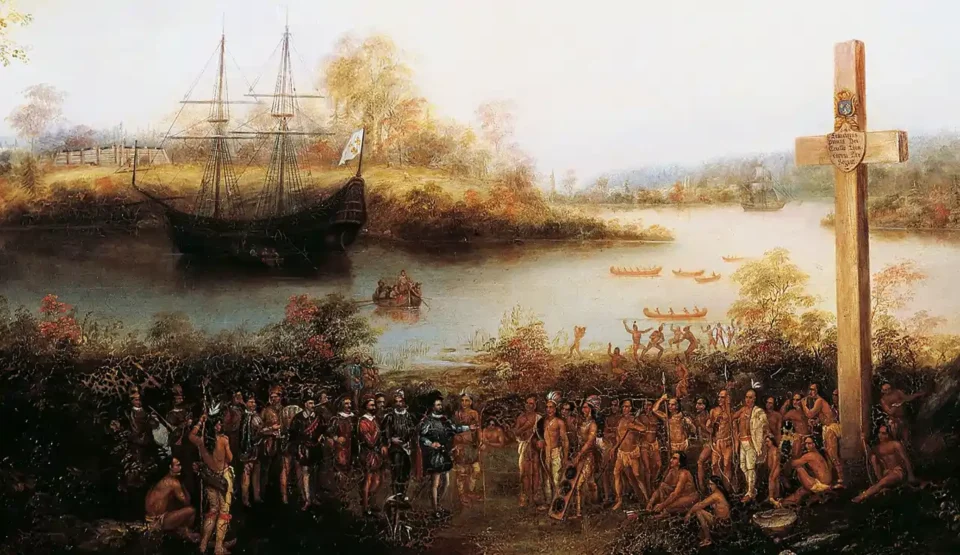
At the end of the 17th century, the north of the viceroyalty of New Spain not only represented an ill-defined frontier, but also an area vulnerable to foreign incursions. It was in this context that the French presence, led by Robert de La Salle, generated a defensive response from the viceregal capital. This episode revealed not only the fragility of the Novo-Hispanic territorial plans, but also the way in which the authorities reacted to the possibility of losing control of regions that had not yet been fully incorporated into the viceregal system.
Fort St. Louis: a French attempt to settle in the Gulf
In 1682, La Salle set out from Canada with the intention of exploring the Mississippi River. Years later, in 1684, he returned with the support of the French government to establish a permanent presence in the Gulf of Mexico. His expedition ended up founding the fort of San Luis, in what today corresponds to the bay of Espiritu Santo (present-day Texas), although he never managed to locate the mouth of the river.
The enterprise was marked by navigational errors, internal conflicts and limited knowledge of the territory. Finally, after La Salle’s death at the hands of his own men, the fort was left adrift. The indigenous peoples of the region, noticing the vulnerability of the French group, took advantage of the situation to attack, wiping out the garrison.

News in the viceregal capital and immediate reaction
The first news of the French establishment reached Mexico City through captured pirates. Although naval expeditions were organized from Cuba and Veracruz to inspect the coast, they were unable to find the fort, although they did find the remains of ships.
For their part, the northern governors began to receive more specific reports. Missionaries and Indians warned of foreign men “dressed in iron” who asked about silver mines and advised against obeying the Spaniards. This intensified the concern.
It was thanks to the collaboration of an Indian named Juan Xaviata that, in 1689, the site of the destroyed fort was finally located.
Mission and strategic response
Faced with the evidence of the French presence, the Catholic monarchy opted to reinforce its influence in the region through an evangelizing strategy. In 1690, the Franciscans of Santa Cruz de Querétaro were entrusted with the foundation of missions among the Texan peoples. The first was the Mission of San Francisco, which served as a base for other foundations, although these were short-lived due to logistical and supply problems.
This movement not only responded to the immediate threat, but was also a way of symbolically reaffirming the territorial and spiritual dominion of the Crown of Castile over a region that lacked a stable presence.
Conclusion
La Salle’s incursion into the north of the viceroyalty not only tested the defense mechanisms of the viceregal system, but also revealed the territorial vacuums that the Catholic monarchy had not yet been able to fill. The response was not a simple military action, but a long-term strategy based on the missionization of the territory, the recognition of foreign danger and the symbolic importance of each foundation on the northern frontier. Although ephemeral, the fort of San Luis forced a rethinking of the way in which power was exercised in the peripheral regions of New Spain.