
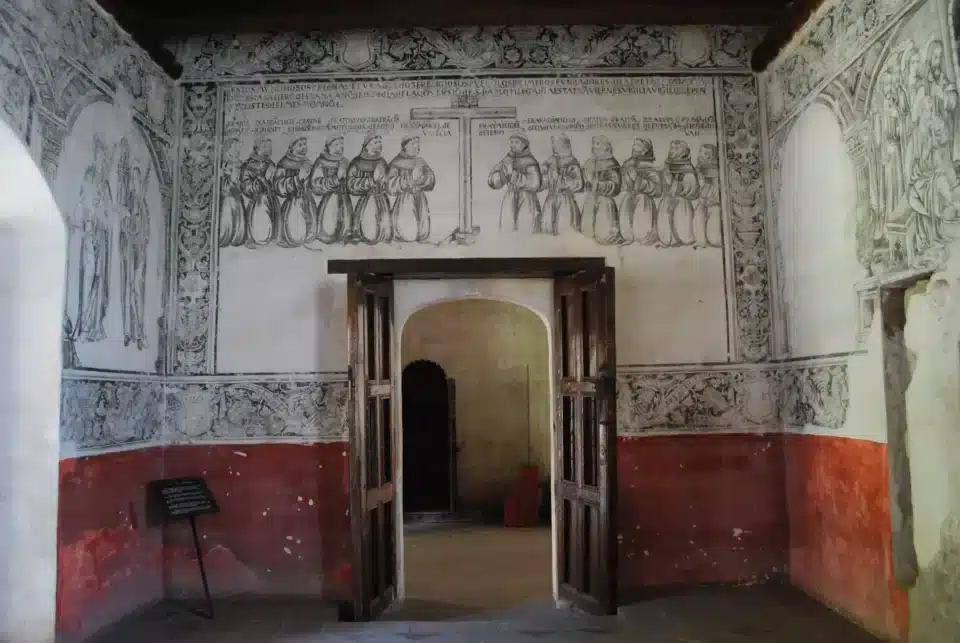
In the northern margins of the viceroyalty of New Spain, expansion was not only carried out by soldiers or civilian foundations. It was the religious orders -especially the Franciscans and Jesuits- who were the protagonists in the evangelization of extensive and little explored regions. Unlike other expansion strategies, the friars did not wait for military security or a consolidated civilian presence: they advanced with their cross, their word and their faith.
The Franciscans, influenced by ideals of poverty, obedience and simple living, sought to establish self-sufficient communities centered on prayer and collective work. The Jesuits, on the other hand, focused on education, spiritual discipline and meticulous organization, which was reflected in their structured missions and notable political influence. However, both orders shared a common mission: to integrate the indigenous peoples into Christian and sedentary life under viceregal authority.
Evangelization beyond the viceregal center
From the first decades after Cortés’ military journey, the friars set out for distant territories without waiting for a solid Castilian presence. Many of them founded missions in hostile regions, where indigenous resistance, lack of resources and rugged geography were their daily bread.
Names such as Fray Juan de San Miguel, Fray Bernardo Cosin, Fray Andrés de Olmos and Fray Agustín Rodríguez are among the many missionaries who traveled through what are today Guanajuato, San Luis Potosí, the Huasteca, Chihuahua and Coahuila. Some established towns, others simply preached, and several lost their lives in their attempt to consolidate evangelization.
Mission, resistance and destruction
Despite the effort, the reality was harsh. Often, the arrival of landowners and civil authorities profoundly altered the fragile balance achieved by the friars. The reduced indigenous peoples, who had gradually accepted to live in community under Christian norms, rebelled when forced labor was demanded or when they were deprived of what they had agreed to.
In these cases, they destroyed the missions, retreated to the mountains or fled to the sierras. What was gained was lost in days. This dynamic was repeated over and over again during the XVI and XVII centuries: the friars built, the conflicts destroyed, and they had to start from scratch.

Regions, orders and strategies
The Franciscans were primarily responsible for evangelization in Zacatecas, Nueva Vizcaya (today Durango and Chihuahua), Coahuila, the New Kingdom of Leon and parts of Texas. They worked in desert and highland regions, where the Chichimec peoples had a strong nomadic and territorial identity.
The Jesuits, on the other hand, began their work in northern Sinaloa and expanded into the Sierra Madre Occidental, Ostimuri, Sonora and the Pimerías. Their missions reached territories that today form part of Sonora and the southern United States, including Arizona and California.
Conclusion
Missionary expansion in the viceregal north was an experience of faith, effort and tensions. Although driven by the desire for conversion, evangelization also had profound effects on the territorial, economic and social configuration of New Spain.
The friars, with their cross and their doctrine, paved the way for the viceregal advance, but they also witnessed the complexity of the indigenous world. Resistance, escapes, destruction and reconstruction marked this process, revealing that the mission was not simply to teach Christianity, but to navigate in a territory where faith, power and daily life were in constant tension.