
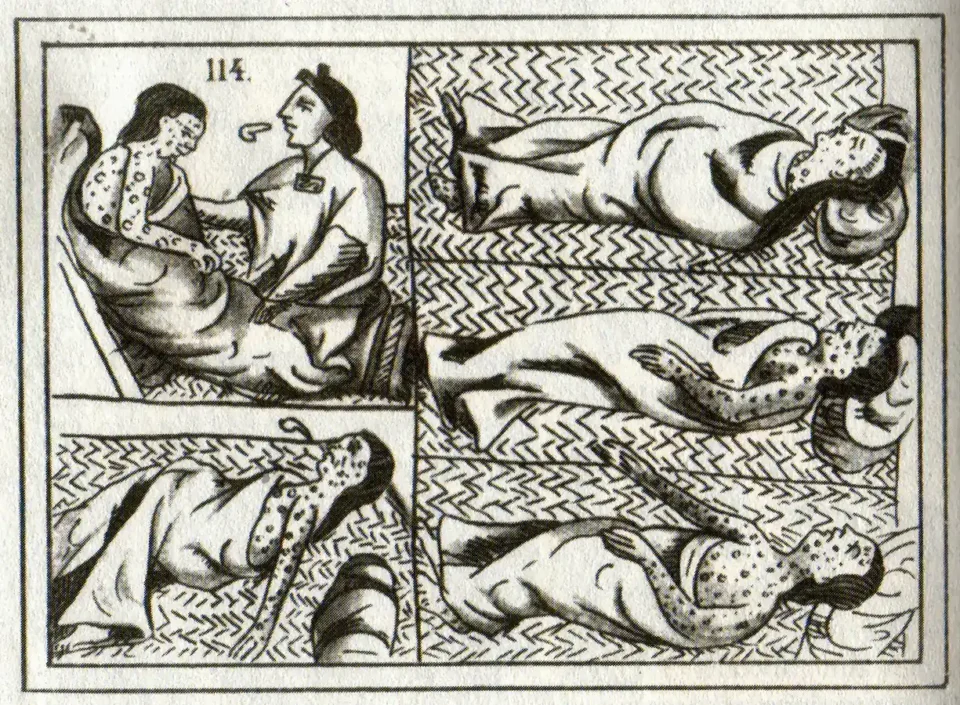
The history of 16th-century New Spain cannot be understood without considering the devastating impact of epidemics. From the early years of the viceroyalty, indigenous peoples—without biological defenses against unknown diseases—suffered unprecedented demographic collapses. Two of the most lethal outbreaks were smallpox, introduced in the early years of the occupation, and cocoliztli, a mysterious hemorrhagic fever that claimed millions of lives in the middle of the century. These diseases not only altered the demographics, but also the social, economic, and spiritual organization of all of New Spain.
The arrival of smallpox: the first demographic blow
Smallpox was the first major epidemic documented after the arrival of the Spanish. Chroniclers note that it spread rapidly between 1520 and 1521, in the midst of the military campaign led by Cortés and his indigenous allies against the Mexica empire.
Indigenous accounts, such as those compiled in the Florentine Codex, describe scenes of collective suffering: entire villages fell ill, with no one to care for the sick or bury the dead.
The disease spread rapidly along Mesoamerican trade routes, reaching distant regions in a matter of months. Its lethality was so high that it altered the political balance of the peoples, weakening government structures and facilitating the advance of the Castilian forces and their allies.
For subsequent generations, smallpox was remembered as a foundational catastrophe, a wound that marked the beginning of the viceregal order.
The century of epidemics: successive diseases
Smallpox was only the beginning. Over the following decades, the indigenous population faced a series of epidemic outbreaks: measles, typhus, bubonic plague, and other imported diseases. Each new wave found communities weakened and with fewer resources.
Records kept by friars and colonial officials—such as the letters of Fray Bernardino de Sahagún and the reports of the Royal Audience of Mexico—agree that diseases “returned with a vengeance every few years,” decimating towns and emptying the countryside.
The lack of medical knowledge, poor sanitary conditions, and mass burial practices exacerbated the impact. Hospitals founded by religious orders, such as the Franciscans and the Juaninos, were not enough to contain the death toll. In less than half a century, the indigenous population had fallen to a fraction of what it once was.
The cocoliztli of 1545 and 1576: a mysterious fever
The most devastating outbreak was cocoliztli, recorded in 1545 and again in 1576. It was a hemorrhagic disease that caused high fever, nosebleeds and bleeding from the eyes, dehydration, and death within a few days.
Unlike smallpox, cocoliztli did not originate in Europe, but was probably an endemic infection that spread due to environmental change and the social crisis resulting from the viceregal regime.
Current studies suggest that it was caused by a viral hemorrhagic fever transmitted by rodents, aggravated by droughts and malnutrition. Colonial chroniclers claimed that “thousands died every day” and that villages were left empty “as if they had never been inhabited.”
According to modern estimates, the epidemic of 1545 may have caused more than four million deaths in New Spain, reducing the indigenous population to one-tenth of its original size in just half a century.
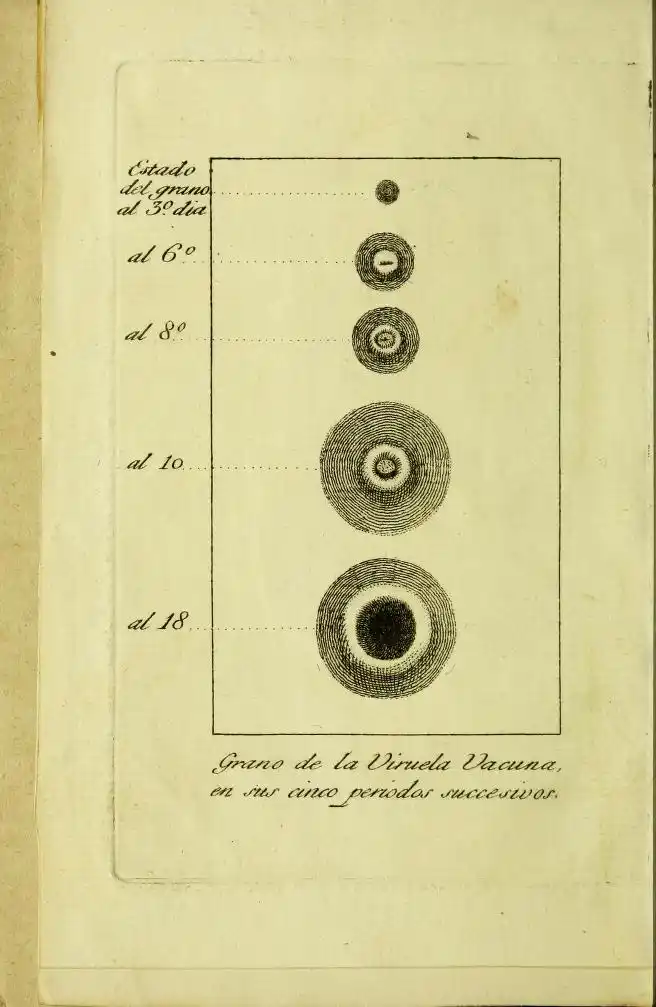
Social and economic consequences of demographic collapse
The demographic decline completely transformed the viceregal structure.
The lack of indigenous labor affected agriculture, mining, and public works. The authorities responded by importing enslaved African workers, reorganizing towns through reductions, and encouraging miscegenation as a way to repopulate depopulated areas.
The impact was not only economic: the disappearance of entire villages disrupted family networks, local cults, and agricultural traditions. Many territories were abandoned, and survivors were relocated to new communities under the supervision of civil and ecclesiastical authorities.
The friars interpreted epidemics as divine punishment, while indigenous peoples understood them as disruptions of the cosmic order. Spirituality, traditional medicine, and religious expressions adapted to this trauma, integrating new healing rituals and joint prayers between indigenous and Christian traditions.
Reactions from the colonial authorities
Faced with the magnitude of the disaster, the Crown of Castile attempted to implement health and demographic policies.
A population census (like the one in 1570) was ordered to reorganize taxes, and hospitals for natives were created in the main cities. However, these measures came too late and were not enough to recover the lost population.
The viceroyalty faced an irreversible reality: a vast territory with an ever-decreasing indigenous population. This gave rise to new forms of forced labor and internal migration, as well as the arrival of new population groups—Spaniards, Africans, and mestizos—who reshaped New Spain society.
Conclusion
The epidemics of the 16th century marked the tragic birth of New Spain. Smallpox paved the way, and cocoliztli deepened a demographic collapse unparalleled in the history of the continent.
Beyond their biological impact, these diseases transformed the economy, religion, and social relations, shaping a new viceregal order built on the memory of loss.
New Spain society was built on this collective wound: the depopulation of the indigenous population, forced reorganization, and the search for meaning in the face of mass suffering. With each epidemic, the monarchy, the Church, and the people tried to answer the same question: how to continue living in a land marked by death.
Frequently asked questions: epidemics and population in the 16th century
What were the main epidemics that affected New Spain in the 16th century?
The most devastating were smallpox, introduced around 1520 during the military campaign of Cortés and his indigenous allies, and cocoliztli, a hemorrhagic epidemic that struck the territory in 1545 and 1576, causing unprecedented mortality.
What was smallpox and why did it have such an impact on the indigenous population?
Smallpox was an unknown disease in Mesoamerica. With no immunity, indigenous peoples suffered extremely high mortality rates, with outbreaks destroying entire communities and weakening traditional political and social structures.
What does “cocoliztli” mean, and what symptoms did it present?
Cocoliztli is a Nahuatl word meaning “plague” or “pestilence.” Chronicles describe intense fevers, hemorrhages, and rapid death. Unlike smallpox, it mainly affected young adults and had a much wider geographical reach.
How significant was the population decline in the 16th century?
It is estimated that the population fell from 15–25 million in 1519 to 1–2 million by 1600. In other words, a reduction of more than 90%. It was one of the most severe demographic collapses in world history.
Did disease alone cause depopulation?
No. Epidemics acted in conjunction with other factors: forced labor, famine, malnutrition, displacement, loss of land, and local wars. The combination of all these factors weakened communities and amplified the biological effects.
What measures did the colonial authorities take?
The viceroyalty organized relocation campaigns or “congregations,” concentrating scattered villages in larger centers. Although presented as a protective measure, they also sought fiscal control and labor availability.
How did epidemics affect the economy of New Spain?
The lack of indigenous population led to a shortage of agricultural and mining labor, which drove the importation of African slaves and the development of new labor systems such as repartimiento and regulated wages.
What role did the Catholic Church play during epidemics?
The missionaries interpreted the plagues as divine punishment and promoted conversion and penance. They also organized Indian hospitals and helped document outbreaks, although many viewed the disease as part of providential destiny.
What social changes did epidemics bring about?
Indigenous communities fragmented or merged; chiefdoms lost power; and a new social hierarchy was consolidated under the viceregal order. Epidemics transformed demographics, territorial organization, and the structure of power.
What were the differences between smallpox and cocoliztli?
Smallpox was a disease of European origin, recurrent but localized; cocoliztli was an American epidemic with hemorrhagic symptoms, possibly aggravated by climate and social conditions, and caused higher mortality.
How were these epidemics remembered in indigenous memory?
In many villages, plagues were recorded in codices and oral traditions as times of destruction and rebirth. They were attributed spiritual significance: the purification of the old world and the beginning of a new order.
When did the indigenous population recover after these epidemics?
The recovery was slow. It was not until the 18th century that the population began to rebound steadily, thanks to improved agricultural conditions, a degree of political stability, and a decline in major epidemic outbreaks.