The Day of the Dead is one of Mexico’s most emblematic traditions, but its history is woven by centuries of cultural, religious and social transformations. From ancient Mesoamerican rituals to the colorful ofrendas that today illuminate homes and cemeteries, this celebration reflects the way the Mexican people have understood death: not as an end, but as a continuity.
Over time, pre-Hispanic beliefs, Catholic faith and post-revolutionary nationalism shaped what we recognize today as the Day of the Dead. These twenty curiosities bring together the key moments, symbols and characters that shaped one of the most profound expressions of Mexican identity.
I. Pre-Hispanic roots and viceregal heritage
1. The Mexica celebrated the dead twice a year in honor of Mictecacíhuatl, the “Lady of Death”.
The Mexica held two festivities dedicated to the dead: one for children (Miccaihuitontli) and another for adults (Hueymiccaihuitl). According to Fray Bernardino de Sahagún in the Florentine Codex, these celebrations were held in honor of Mictecacíhuatl, goddess of the underworld. INAH research confirms that this deity symbolized the eternal cycle of life and death, and her cult was the direct antecedent of the Day of the Dead.
2. The Catholic Church transformed the indigenous ceremonies into the “Days of Souls” during the viceroyalty.
With evangelization, the friars adapted the indigenous rituals to the Christian calendar. November 1 and 2, dedicated to All Saints and the Faithful Departed, replaced the pre-Hispanic festivities. Historian Jacques Lafaye explains that this fusion allowed the survival of symbols such as copal, flowers and food, in a mestizo religiosity where Christian souls coexisted with indigenous ancestors.
3. The first offerings included water and seeds, not bread or sugar skulls.
In the 16th and 17th centuries, the offerings were simple: water, candles, incense, seeds and flowers. These elements symbolized the spiritual nourishment of souls. Bread and sugar were later incorporated thanks to the cultural exchange between Europe and America, as documented by the Museo Nacional del Virreinato (INAH).
4. Sugar skulls were popularized in the convents of the 17th century.
The nuns made figures of alfeñique, a mixture of sugar and water, to decorate altars. Their skull shape evoked the transience of life, a concept very present in the novo-Hispanic baroque. INAH researchers have found original molds of these pieces in convents in Puebla and Oaxaca, which demonstrates their antiquity and artistic value.
5. In the viceregal era, wealthy families competed to have the largest and most ornate offering.
Domestic altars became a symbol of social status. According to the records of the Archivo General de la Nación, in the novo-Hispanic cities, wealthy families placed portraits, candelabras and fine fabrics to honor their deceased, while in the towns the altars were kept simple and communal.
II. 19th and 20th Century Transformations
6. During the 19th century, the Reform Laws reduced the processions and the celebration became domestic.
The reforms promoted by Benito Juárez limited public worship, displacing religious celebrations to the family sphere. Anthropologist Elsa Malvido (INAH) points out that it was then when the domestic altar became a private space of memory and faith, preserving tradition far from ecclesiastical control.
7. The Mexican Revolution and the Cristero War almost erased the festivity from the public space.
Between 1910 and 1929, armed conflicts interrupted the processions and masses. However, rural communities kept the custom alive. Historian Ricardo Pérez Montfort documents how, after the Cristero War, the State took up the Day of the Dead as a cultural tool to rebuild national identity.
8. During the Porfiriato, the Mexican elite preferred to celebrate All Saints’ Day in the European style.
The Frenchified taste of the time led the upper classes to celebrate with imported banquets and flowers. Indigenous traditions were seen as “rustic”. Paradoxically, it was popular art -through the skulls of José Guadalupe Posada- that satirized this hypocrisy and revalued the figure of death as part of the Mexican people.
9. Lázaro Cárdenas promoted the recovery of the Day of the Dead as a national symbol in the 1930s.
During his government (1934-1940), Cárdenas promoted a people-oriented cultural policy. The Secretariat of Public Education and the Department of Fine Arts organized fairs and exhibitions that exalted regional traditions. The Day of the Dead was adopted as a symbol of “mestizo Mexicanity”, as Pérez Montfort explains in his studies on nationalist culture.
10. Rural schools taught altar making as part of socialist education.
In the 1930s, rural teachers encouraged knowledge of local customs. Documents from the SEP Historical Archive show that ofrendas were used as exercises in community identity and artistic creativity, integrating history, art and moral education.
III. Art, symbols and living customs
11. José Guadalupe Posada’s Catrina was born as a political criticism, not as a festive icon.
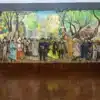
Created around 1910, Posada’s “Calavera Garbancera” ridiculed the elite who pretended to be European. Decades later, Diego Rivera reinterpreted it in his mural Sueño de una tarde dominical en la Alameda Central (1947), giving it the name by which we know it today: La Catrina, symbol of humor and equality in the face of death.
12. In Mixquic, the altars are illuminated all night on November 2 with candles that guide the deceased.
The town of Mixquic, in the Valley of Mexico, preserves one of the oldest celebrations in the country. The Night of the Souls is documented by INAH as an example of cultural continuity: candlelight symbolizes the return of the souls to their homes.
13. In Patzcuaro, Michoacan, families keep vigil on decorated canoes on the lake.
On the island of Janitzio, the Purepecha perform a vigil that combines Christianity and indigenous cosmovision. This tradition was studied by anthropologist Fernando Horcasitas, who described it as “a mirror of the collective soul of the Michoacan people”.
14. In Pomuch, Campeche, the bones of the deceased are cleaned before placing them in the offering.
This Mayan practice, called bone bath, consists of carefully cleaning the remains of the ancestors. INAH Campeche recognizes it as Intangible Cultural Heritage, because it expresses an intimate and respectful vision of death.
15. The color purple on the altars comes from the Catholic liturgy of mourning and penance.
The chromatic symbolism of the altars combines heritages: purple comes from the Catholic rite, orange represents the sun and white purity. The Museo de las Culturas Populares documents how this palette emerged from the union between religious art and the indigenous cosmovision.
16. Literary calaveritas were born in the 19th century as political satires published in newspapers.
These compositions were printed on flyers to mock public figures. Journalist Agustín F. Cuenca and other costumbrista writers popularized the genre, which continues today as a living form of Mexican social criticism and humor.
17. The papel picado has its roots in pre-Hispanic amate paper and was adopted as a festive symbol in the 20th century.
The artisans of Huixcolotla, Puebla, adapted the chinese paper technique in the 1930s, inspired by ancient ceremonial papers. INAH recognizes it as one of the essential elements of the contemporary altar.
18. In the Mexica cosmovision, the souls of children went to Chichihuacuauhco, a paradise full of trees that gave milk.
This myth, described by Sahagún and taken up by López Austin, shows that the Mexica conceived of different destinies for souls. Children waited there until they were reborn, which explains why November 1 is dedicated to the “little angels”.
19. Some Mayan communities today still celebrate Hanal Pixán, “the food of the souls”.
In Yucatán, Quintana Roo and Campeche, pibipollos are prepared and people live together in cemeteries. INAH Yucatan Peninsula emphasizes that this tradition has resisted globalization and keeps Maya spirituality alive in the 21st century.
20. The traditional altar has seven levels, representing the steps of the soul towards eternal rest.
The number seven comes from the Mesoamerican symbolism associated with the levels of the underworld. Each step has a meaning: from birth to rest. This structure was systematized by studies of the Museum of Popular Cultures as an educational and patrimonial model.
Conclusion
The Day of the Dead was not born from a single origin or a single faith: it is the sum of centuries of history, resistance and creativity. From Mexica temples to mestizo homes, from convents to rural schools, this holiday has reflected the Mexican people’s ability to transform pain into art and memory into identity.
Today, amidst the aroma of copal and the light of the cempasúchil, the Day of the Dead continues to be a conversation with the past and an affirmation of life.
We invite you to explore these articles about the Day of the Dead and discover its history in detail.
-

The Mesoamerican origin of the cult of the dead: predecessor of the Day of the Dead
Long before the Day of the Dead was celebrated, Mesoamerican cultures paid tribute to their dead on different dates of the ritual calendar. This cult of…
-
From evangelization to syncretism: the Days of the Souls in New Spain (predecessor of the modern Day of the Dead)
The Days of the Dead in New Spain were the result of the encounter between indigenous beliefs about death and the Catholic festivities instituted by Popes…
-
Day of the Dead altars and ofrendas: symbols of the reunion between the living and the dead
The Day of the Dead altars were born during the viceregal era as an adaptation of the indigenous offerings to the Catholic calendar. In them, the…
-
Lázaro Cárdenas and the transformation of the Day of the Dead: from the Days of the Dead to the Mexican national symbol.
The Days of the Souls, inherited from the Viceroyalty, survived wars and prohibitions until it was transformed into the modern Day of the Dead. Under the…
-
The Meaning of the Day of the Dead: Identity, Memory and Continuity
The Day of the Dead not only honors those who have passed away; it also affirms who we are. Among flowers, altars and memories, this tradition…
-
The Day of the Dead in post-revolutionary art and education
Post-revolutionary Mexico used art and education to build its identity. From Rivera's murals to the school offerings promoted by Cárdenas, the Day of the Dead became…
-
Top 20 curiosities and historical details of the Day of the Dead that you may not have known.
From Mictecacíhuatl to La Catrina, learn 20 historical curiosities about the Day of the Dead and discover how this celebration became a symbol of Mexican identity.
-
Regional Day of the Dead Celebrations: from Patzcuaro to Mixquic, the diversity of the tradition
From Patzcuaro to Yucatan, Day of the Dead celebrations reveal Mexico's cultural diversity. Each region preserves unique rituals - the Mixquic alumbrada, the Mayan Hanal Pixán…