
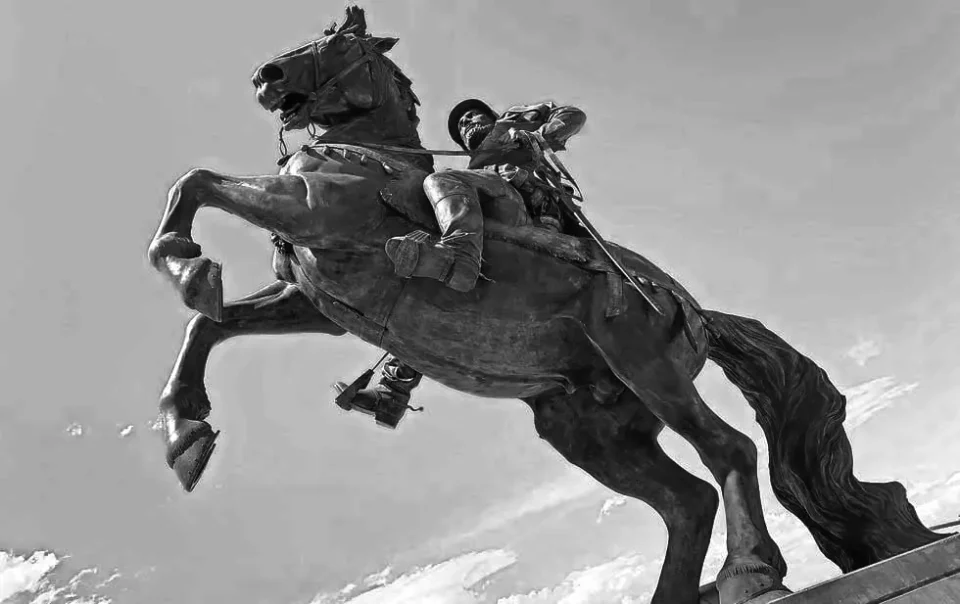
In 1598, Juan de Oñate led one of the most ambitious expeditions in the north of the viceroyalty of New Spain: the establishment of a province that would be named “New Mexico”. This name, however, did not refer to the country we know today, nor to a new version of Mexico-Tenochtitlan, but to a region to the north of the viceroyalty that the Castilians imagined to be as rich and populated as the central highlands. New Mexico” thus designated a territory not yet formally explored, but with the potential to be integrated into the imperial system, located in what today corresponds to the state of New Mexico in the United States, and which also included parts of Arizona, Texas and northern Chihuahua.
The expedition led by Oñate not only faced geographical and climatic difficulties. It also involved conflictive encounters with the native peoples of northern Mesoamerica, whose forms of political organization and spiritual ties with the territory were not recognized by the juridical rituals or by the expansionist logic of the Catholic monarchy. This episode marked the beginning of a prolonged and tense occupation, in which the promises of wealth gave way to an arid, complex and deeply disputed reality.
The promises of the north
Oñate offered land, privileges and encomiendas to those who joined his project. Many did so in the hope of replicating the triumphs achieved decades earlier by Cortés or the founders of Zacatecas. But the territory they found not only lacked fabulous mines, but was arid, dispersed and deeply hostile.
The indigenous peoples who inhabited these regions – such as the Pueblo, Zuñi and other nomadic groups – had ways of life adapted to their environment, with their own systems of political organization and a deep spiritual bond with the land. For them, Oñate’s arrival was not a “civilizing mission” but a direct threat.

The weight of ritual and the reality of rootlessness
As documented in Oñate’s takeover across the Río Bravo, the symbolic appropriation of territory was part of imperial protocol. But no ritual could ensure the success of a settlement in an unknown land, without infrastructure or effective military support. The founding of San Juan de los Caballeros, the first capital of New Mexico, was an act of will rather than of consolidation.
The Franciscans immediately began the work of evangelization, but their success was limited. The missions did not prosper, and the local population, far from integrating, passively resisted or deserted. The scarcity of food, the harsh climate and the distances between towns sapped the colonists’ morale.
The Acoma episode: violence and retaliation
One of the most violent events of this initial stage was the attack on the town of Acoma in 1599. After a conflict with the inhabitants, Oñate’s forces responded with brutal repression: hundreds of people were killed, enslaved or mutilated. This act set the tone for the Castilian presence in the region and generated controversy even within the viceroyalty.
The response in the viceregal court was not immediate, but it was significant. Oñate was subjected to a residency trial years later, where he was accused of abuse of power and excessive cruelty, among other charges.
Conclusion: a failed start
Juan de Oñate’s enterprise not only failed to consolidate a stable territory, but also left a deep wound in the indigenous memory of the north. The so-called “New Mexico” was not born of a pact or an equitable cultural encounter, but of imposition, violence and deception.
The history of this rough beginning, beyond its founding narrative, shows the limitations of imperial projects when they ignore local realities. The original peoples were not blank spaces waiting to be reclaimed; they were complex societies, with history, spirituality and the will to resist.
–