
Foundations made with allied indigenous peoples: migrations, tensions and territory.
During the viceroyalty of New Spain, the allied indigenous peoples played an active role in territorial expansion, not only as auxiliaries in military campaigns, but also as founders of new settlements in strategic regions. Their presence was essential to establish control points, promote the “pacification” of areas considered hostile and sustain the viceregal presence in northern New Spain.
Indigenous allies in territorial expansion
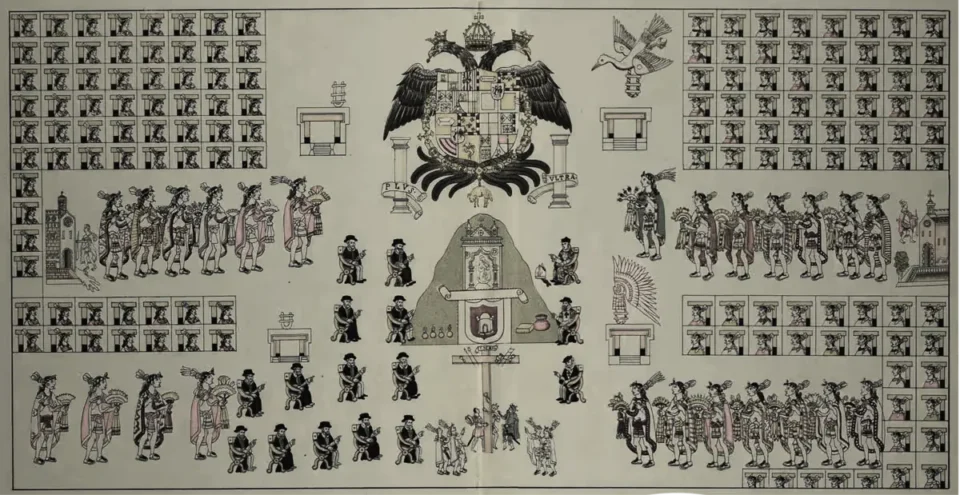
From the first moments of the military journey of Cortés and his indigenous allies, the allied sedentary peoples became a support force for new incursions. Tlaxcaltecas, Huejotzingas and Cholultecas accompanied Nuño de Guzmán in his advance through the region of Nueva Galicia, and later participated in expeditions led by Francisco de Ibarra, Luis de Carbajal and Juan de Oñate.
But their participation was not limited to the military sphere. They were also considered as examples of orderly and Christian life, so it was expected that their coexistence with nomadic peoples would facilitate their “reduction” to the viceregal order. This gave rise to foundations promoted directly by friars and civil authorities, as in the case of the town of San Miguel el Viejo, where Friar Juan de San Miguel brought together Otomí, Guamares and Tarascans.
Induced and imposed foundations
During the government of Viceroy Luis de Velasco, several settlements were established with Tlaxcalan families, such as Tlaxcalilla (near San Luis Potosí), San Miguel Mezquitic, San Andrés, Colotlán and San Esteban de la Nueva Tlaxcala (founded by Francisco de Urdiñola). These communities were endowed with land, water and certain legal privileges to favor their stability.
The transferred Indians were allowed to have cattle, land and horses. Their parishes remained under the administration of friars, and the nearby installation of Spanish ranches was prohibited. However, in practice, many encomenderos and colonists tried to seize the most fertile lands and force the Indians to work for their benefit, thus violating the viceregal dispositions.

Tensions between indigenous peoples
A little-mentioned aspect of these foundations was the conflict between the indigenous people transferred from the center and the nomadic peoples who originally inhabited the northern areas. The former, accustomed to an agricultural and sedentarized life, tended to look down on the latter, which hindered attempts at fusion or peaceful coexistence.
Thus, although viceregal policy sought to build a network of organized towns under religious and civil control, cultural differences, unequal treatment and competition for resources limited the expected results.
Spontaneous migrations to mining and cattle-raising areas
In addition to the foundations planned by the viceregal administration, there were also indigenous population movements that were not directed from the center. A considerable number of indigenous people moved voluntarily to mining areas or cattle ranches in search of work and survival opportunities, especially in the north of New Spain.
These spontaneous movements show that the indigenous peoples were not only passive subjects of viceregal politics, but actors who made their own decisions regarding the transformations of the territory.
Conclusion on the foundations made with allied indigenous peoples in New Spain.
The foundations made with allied indigenous peoples were a complex strategy, with objectives of control, evangelization and territorial reorganization. Although they were proposed as a civilizing model, in practice they were crossed by conflicts, inequalities and forms of resistance. Indigenous participation, both directed and autonomous, was crucial in the configuration of northern New Spain and reveals a history of agency, adaptation and tensions that cannot be reduced to a simple narrative of viceregal expansion.