
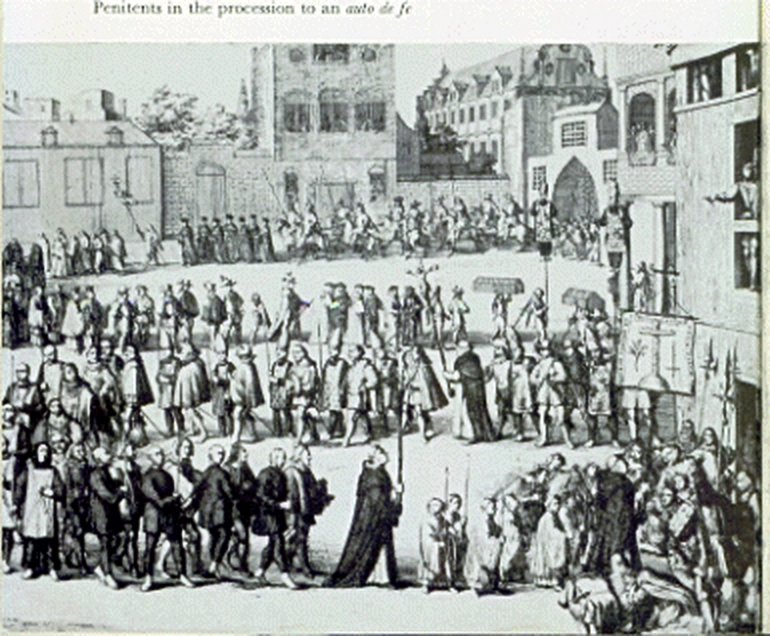
In 16th century New Spain, words had a weight that went beyond everyday communication. Blasphemy, understood as a direct offense against God, the Virgin or the saints, was considered a serious sin and a public offense that had to be punished. From the first years after the arrival of the Europeans, control mechanisms were established to punish those who expressed themselves against the Catholic faith. Hernán Cortés, friars such as Motolinía and, later, the Tribunal of the Holy Office of the Inquisition left written testimony of how penalties and excommunications were applied to the accused.
This article presents three significant examples: an ordinance issued by Cortés in 1520, Motolinía’s sentence against a convict in 1527, and a formal edict of excommunication pronounced by the Holy Office.
The ordinance of Hernán Cortés in Tlaxcala (1520)
In December 1520, when the first military campaigns were still being fought and the control of the Crown of Castile was not consolidated, Hernán Cortés promulgated an ordinance in Tlaxcala. In it he firmly condemned blasphemy, which he described as the greatest possible offense against God.
The norm prohibited expressions such as “I do not believe in God” or “I deny heaven”, and established economic sanctions. Whoever incurred in blasphemy had to pay fifteen castellanos of gold: a third part was destined to the first confraternity of the Virgin that was founded in those lands, another to the judge who dictated the sentence, and the rest to other purposes indicated by the legislation.
With this decree, Cortés sought to show that blasphemy was not only a sin, but also an act that disturbed the political-religious order he was trying to establish in the new territory.
Motolinia’s sentence against Rodrigo Rengel (1527)
Years later, in 1527, the Franciscan friar Toribio de Benavente, known as Motolinía, issued a sentence against Rodrigo Rengel, accused of blasphemy. The ruling shows a balance between the severity of the punishment and the intention to correct the sinner through penance.
The defendant should:
- Publicly listening to mass with the head uncovered and a candle in the hand.
- Spend nine months in a monastery doing penance.
- Feed five poor people every Friday for five months.
- Pay five hundred pesos of gold for pious works and the expenses of the process.
- Collaborate in the construction of the hermitage of the Eleven Thousand Martyrs in Tlaxcala or, failing that, deliver three dozen boards to the convent of San Francisco in Mexico City.
This example shows how, in the early years, the friars acted as ecclesiastical judges, imposing punishments that combined spiritual penance, communal help and material contributions.
The edict of excommunication of the Holy Office
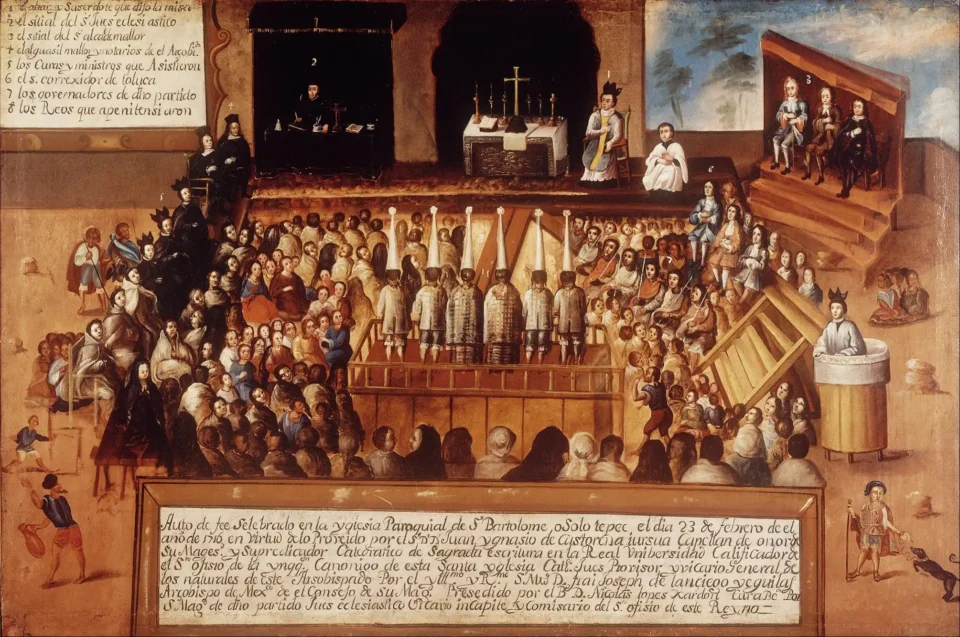
With the formal establishment of the Inquisition in New Spain in 1571, the persecution of blasphemy took on an even more solemn and ritualized tone. The edict of excommunication against those who did not denounce themselves or accuse others of heresy is a clear example of the severity of the censures.
The document cursed the accused with biblical and apocalyptic images: the plagues of Egypt, the destruction of Sodom and Gomorrah, and eternal damnation together with Lucifer and Judas. The rebels were declared enemies of the Church and were removed from any Christian community.
The liturgical act included two lighted candles placed next to a cross covered with a black veil. At the conclusion of the reading, the clergy extinguished the candles in holy water, symbolizing the extinction of the souls of the damned, while bells were rung and psalms were intoned.
Conclusion
The persecution of blasphemy in New Spain reveals the close relationship between religion, politics and social control. From the first ordinances of Cortés to the solemn edicts of the Holy Office, offensive speech against the sacred became a crime punishable by fines, penance, excommunication and threats of eternal damnation.
These documents show how the Inquisition and ecclesiastical authorities sought to regulate not only acts, but also language and thought, in an attempt to cement a social order based on Catholic faith and obedience.
Some frequent doubts about blasphemies and punishments in the Inquisition of New Spain.
What was understood by blasphemy in New Spain?
Blasphemy was any expression considered offensive against God, the Virgin Mary, the saints or the Catholic faith. Phrases such as “I do not believe in God” were grounds for punishment.
What punishments did Hernán Cortés apply against blasphemers?
In 1520, Cortés established a fine of fifteen castellanos of gold, to be distributed among religious brotherhoods and judges, in addition to the penalties already established by the laws of Castile.
How did the friars act against blasphemers?
In the early years, friars such as Motolinía dictated sentences that combined spiritual penance, help for the poor and material contributions for religious works, such as hermitages and convents.
What did the Tribunal of the Holy Office do with those accused of blasphemy?
The Holy Office applied more solemn and severe punishments, such as public excommunication, which separated the accused from the Church and condemned him symbolically with rituals charged with religious drama.
What did the candles extinguished in holy water symbolize during the excommunication?
The gesture represented the extinction of the soul of the excommunicated person, comparing his fate to the disappearance of the light of the candle, reinforcing the idea of spiritual condemnation and social marginalization.
–