

In the 16th century, when the first maps of the known world were still being drawn, any rumor about rich lands was enough to set entire expeditions in motion. It was in this context that one of the most persistent legends of New Spain emerged: the seven cities of gold. And it all began with a Franciscan friar who claimed to have seen a city larger than Mexico City itself, built of stone and adorned with turquoise. Its name was Cíbola, and its story would mark the fate of hundreds of men who dreamed of discovering riches north of the viceroyalty.
The journey of a friar and an African guide
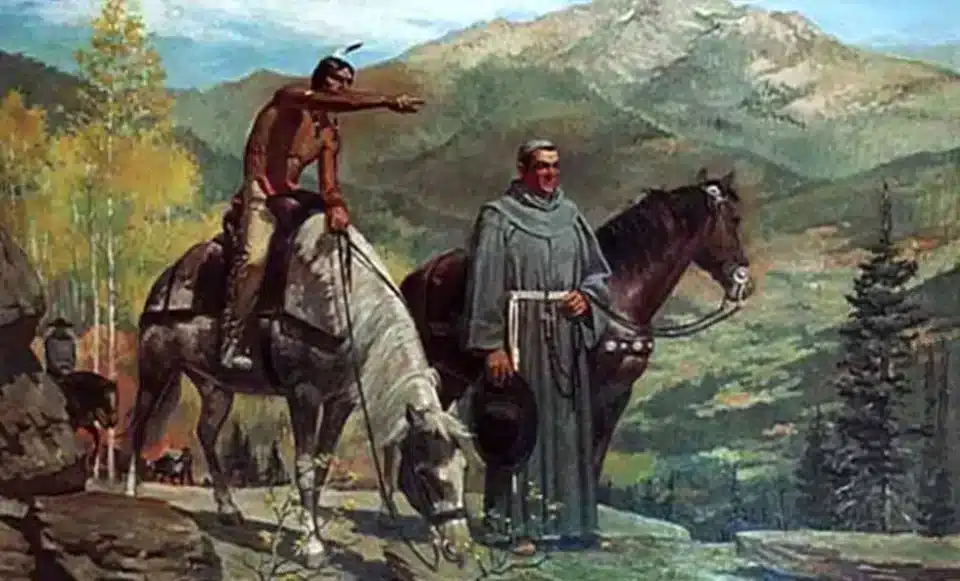
In 1539, Friar Marcos de Niza was sent to explore the northern territories, following the surprising statements made by Álvar Núñez Cabeza de Vaca, who claimed to have traveled to distant lands inhabited by organized peoples and unknown cities. His guide was Estebanico, an African man who had survived alongside Cabeza de Vaca the failed expedition of Pánfilo de Narváez.
The two set out from the northwest of New Spain with a simple plan: to advance as far as they could, and if Estebanico found something extraordinary, he would send a message… and a cross. The larger the cross, the greater the discovery.
And the cross arrived. It was the size of a man. And it was accompanied by rumors: stone houses, several stories high, facades decorated with turquoise. A rich, powerful city, hidden somewhere in the north. Its name was Cíbola.
The death of Estebanico
As Friar Marcos approached the city, a messenger brought him grim news: Estebanico had been murdered. He had gone ahead, as they had agreed, but when he reached the city gates, he was turned away. The local lord refused to receive him. Despite the warning, Estebanico insisted. He was taken prisoner, and the next day, while trying to escape, he was killed by arrows fired by the inhabitants.
Fray Marcos, however, decided to continue. He reached the top of a hill and, from there, saw what he believed to be Cíbola. A city set on a plain, with stone houses, flat roofs, and an imposing appearance. It seemed even larger than Mexico City.
He feared for his life. He did not enter. But he did something symbolic: he took possession of the land in the name of the king and decided to return. He did not want anyone to be able to report what he had seen if he died.
The Seven Cities of Gold
Fray Marcos’ account did not only mention Cíbola. He claimed that beyond that city there were six others even larger. Thus was born the myth of the seven cities of gold, also known as the Seven Cities of Cíbola.
When the friar returned to Mexico City, his testimony was received with enthusiasm. The viceregal authorities, encouraged by the possibility of wealth and glory, did not hesitate to act. Viceroy Antonio de Mendoza organized a new expedition, this time more ambitious and well equipped: it would be led by Francisco Vázquez de Coronado.
Coronado and the clash with reality
In 1540, Coronado set off northward, following in the footsteps of Fray Marcos. He was searching for Cíbola. He was searching for the other six cities. But what he found was not gold, nor lavish cities, nor precious stones. He found adobe villages, humble communities, and people who had no idea about the myth that burned in the imagination of the Castilians.
The disappointment was profound. The expedition had been costly, long, and dangerous. Fray Marcos was accused of exaggerating, of being carried away by his faith or his desire to please the Crown. He was never punished, but his name was tarnished by doubt.
Conclusion: between desire and the border
The myth of the seven cities of gold reminds us that, in the early days of New Spain, imagination was as powerful as the sword. Fray Marcos de Niza may not have lied, but he saw what he wanted to see. And his account—a mixture of rumor, hope, and fear—triggered one of the most emblematic episodes of exploration in the north of the viceroyalty.
Cíbola was never a city of gold. But its image, projected onto the desert and mountains of the north, remains a symbol of that time when the frontier was not just a geographical space, but a mirror of the dreams that drove men beyond the known world.
–