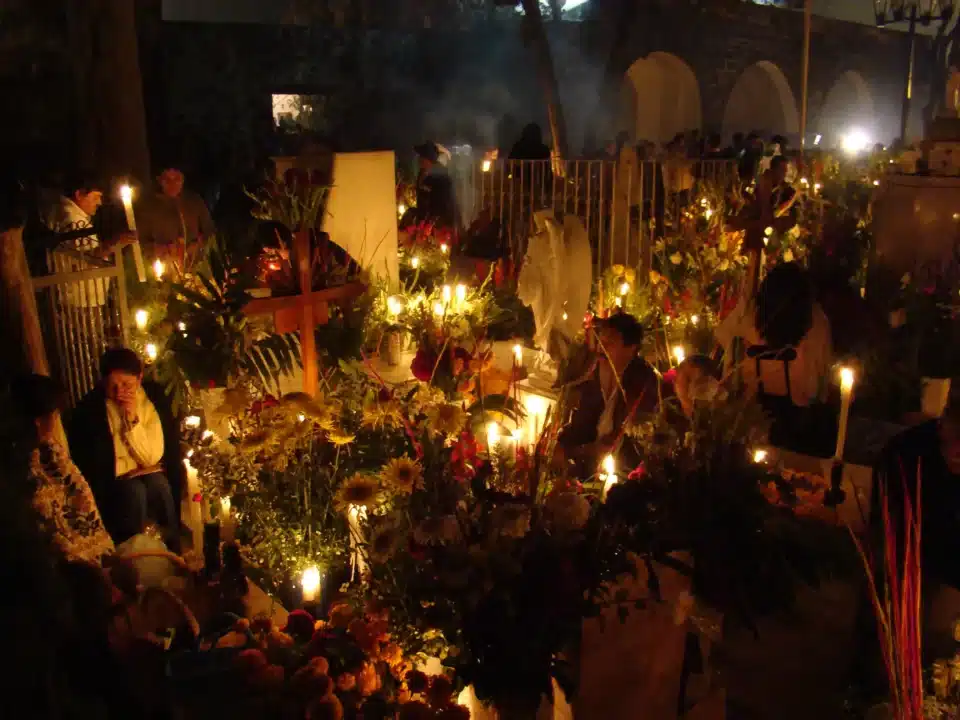
The Day of the Dead is one of the most significant celebrations in Mexico, not only because of its colorfulness or its international projection, but also because of the deep historical meaning it contains. This festivity represents the cultural continuity between the original peoples of Mesoamerica and contemporary society, where the memory of ancestors continues to occupy a central place. More than a simple commemoration, the Day of the Dead is an expression of Mexican identity, the result of centuries of religious, social and symbolic transformations.
Mesoamerican roots: death as part of the life cycle
For Mesoamerican peoples, death was not an absolute end, but a process of transformation within the cycle of life. The Nahua, Purepecha, Mixtec and Maya civilizations conceived of the underworld not as a punishment, but as a complementary stage. The dead remained linked to the community through rituals that reaffirmed the reciprocity between the living and the dead.
Offerings of food, flowers, copal and personal objects were intended to maintain this bond. In the Mexica case, the celebrations dedicated to Mictecacíhuatl and Mictlantecuhtli reflected this vision: guardian gods of Mictlán, where the souls undertook a journey back to the origin. Thus, death was conceived as a renewal of time and fertility, not as a rupture.
Syncretism in New Spain: continuity in new forms
With the introduction of Christianity in the 16th century, indigenous rituals dedicated to the dead were reinterpreted within the Catholic calendar. The festivities of All Saints and the Faithful Departed, introduced by the friars, intertwined with pre-Hispanic customs in a process of religious syncretism that did not eliminate the ancient beliefs, but rather transformed them.
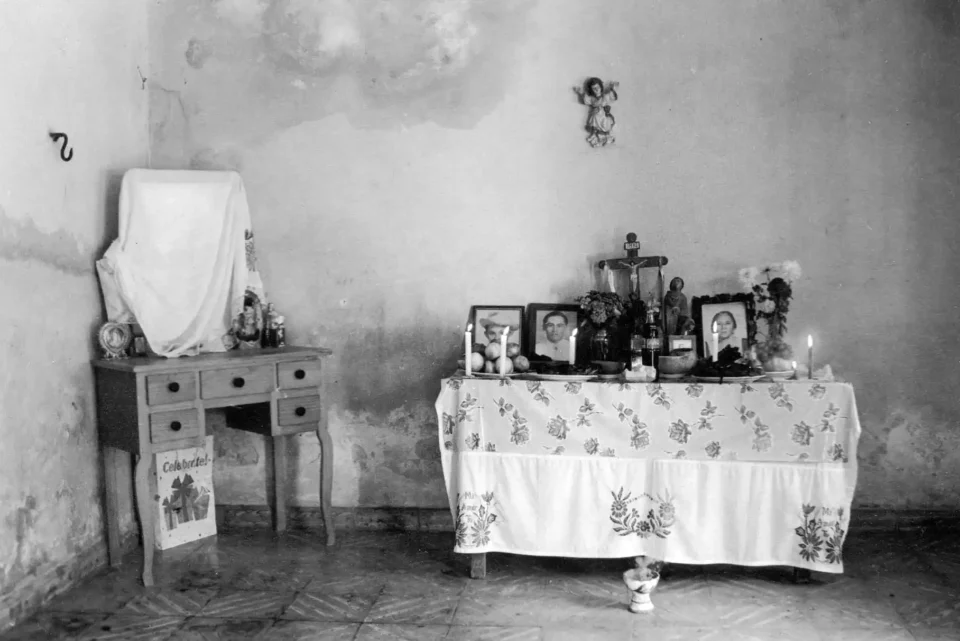
In indigenous villages, domestic altars incorporated Christian images, crosses and candles, but retained elements such as copal, corn, cempasúchil flowers and the symbolic arrangement of objects. The Day of the Dead thus became a hybrid practice: a Christian devotion covered with an indigenous cosmovision. This process allowed the collective memory to survive under a new religious and political framework.
Memory and community: the altar as a space for dialogue
The altar of the dead is the symbolic center of the celebration. Beyond its ritual function, it constitutes a memory device that articulates the past with the present. Each element has a meaning: the salt purifies, the water quenches the thirst of the soul, the candle guides the way and the flowers trace the route of return.
In rural and urban communities, the act of raising an altar is a practice that reaffirms family and community ties. Remembering the dead becomes an exercise in continuity: a way of narrating who we were and who we continue to be. Memory, transmitted from generation to generation, keeps alive a system of values where solidarity, gratitude and respect for ancestors are part of the social fabric.
From local to national symbol
During the 20th century, especially after the Mexican Revolution, the Day of the Dead acquired a political and cultural value as a symbol of Mexicanness. The artistic and educational movements of the post-revolutionary state -inspired by figures such as Diego Rivera or José Guadalupe Posada- reinterpreted the festivity as an emblem of national identity.
The figure of the festive skull, the exaltation of the people and the idea of reconciliation with death were integrated into the discourse of mestizo Mexico. This institutional appropriation, although it changed part of the original meaning, contributed to consolidate the tradition as a common reference. In 2008, UNESCO recognized it as Intangible Cultural Heritage of Humanity, validating its universal importance as a living practice of memory and cultural resistance.
Day of the Dead in the 21st century: continuity and globalization
Today, the Day of the Dead transcends borders. Mexican communities in the United States and other countries reproduce the tradition as an act of belonging and identity affirmation. Although its aesthetics have globalized -thanks to cinema, art and marketing-, its essence remains: the recognition of death as part of life.
Unlike other funeral celebrations, here death is humanized, remembered and shared. The altar is adapted, the symbols are reinterpreted, but the message remains: to remember is to exist. The continuity of the Day of the Dead demonstrates the ability of the Mexican people to preserve their memory, reinvent themselves and maintain the balance between tradition and change.
Conclusion
The Day of the Dead is a manifestation where history, spirituality and collective identity converge. Its permanence throughout the centuries shows the strength of a memory that has resisted religious, political and cultural impositions. In each altar lit and in each name pronounced there is an affirmation of continuity: the dead do not leave, they inhabit the living memory of those who remember them.
In that dialogue between past and present lies the true meaning of the Day of the Dead: a reminder that Mexican identity is not built on oblivion, but on the persistence of memory.
We invite you to explore these articles about the Day of the Dead and discover its history in detail.
-

The Mesoamerican origin of the cult of the dead: predecessor of the Day of the Dead
Long before the Day of the Dead was celebrated, Mesoamerican cultures paid tribute to their dead on different dates of the ritual calendar. This cult of…
-
From evangelization to syncretism: the Days of the Souls in New Spain (predecessor of the modern Day of the Dead)
The Days of the Dead in New Spain were the result of the encounter between indigenous beliefs about death and the Catholic festivities instituted by Popes…
-
Day of the Dead altars and ofrendas: symbols of the reunion between the living and the dead
The Day of the Dead altars were born during the viceregal era as an adaptation of the indigenous offerings to the Catholic calendar. In them, the…
-
Lázaro Cárdenas and the transformation of the Day of the Dead: from the Days of the Dead to the Mexican national symbol.
The Days of the Souls, inherited from the Viceroyalty, survived wars and prohibitions until it was transformed into the modern Day of the Dead. Under the…
-
The Meaning of the Day of the Dead: Identity, Memory and Continuity
The Day of the Dead not only honors those who have passed away; it also affirms who we are. Among flowers, altars and memories, this tradition…
-
The Day of the Dead in post-revolutionary art and education
Post-revolutionary Mexico used art and education to build its identity. From Rivera's murals to the school offerings promoted by Cárdenas, the Day of the Dead became…
-
Top 20 curiosities and historical details of the Day of the Dead that you may not have known.
From Mictecacíhuatl to La Catrina, learn 20 historical curiosities about the Day of the Dead and discover how this celebration became a symbol of Mexican identity.
-
Regional Day of the Dead Celebrations: from Patzcuaro to Mixquic, the diversity of the tradition
From Patzcuaro to Yucatan, Day of the Dead celebrations reveal Mexico's cultural diversity. Each region preserves unique rituals - the Mixquic alumbrada, the Mayan Hanal Pixán…


Resolvemos tus dudas sobre el verdadero significado del Día de Muertos
Why is the Day of the Dead so important in Mexico?
Because it represents the continuity between life and death, uniting indigenous and Christian traditions. It is a way to keep alive the memory of the ancestors and reinforce the cultural identity of the country.
¿Qué simboliza el altar de muertos?
The altar symbolizes the connection between the living and the deceased. Each element -such as candles, water or cempasúchil- has a specific meaning that helps to guide the souls and remember their presence in the family life.
What is the origin of the Day of the Dead?
Its origin goes back to Mesoamerican ceremonies dedicated to the deities of death, such as Mictlantecuhtli and Mictecacíhuatl. During the viceregal era, these practices merged with the Catholic festivities of All Saints and All Souls’ Day.
What is the difference between Day of the Dead and Halloween?
The Day of the Dead celebrates life and the memory of loved ones from a spiritual and communitarian vision. Halloween, on the other hand, has roots in Celtic traditions and focuses more on the playful and supernatural.
Why did UNESCO recognize the Day of the Dead as a World Heritage Site?
Because it reflects a unique cultural practice that combines history, art and spirituality. UNESCO valued its role in the intergenerational transmission of memory, as well as its validity as a symbol of Mexican identity.
–