
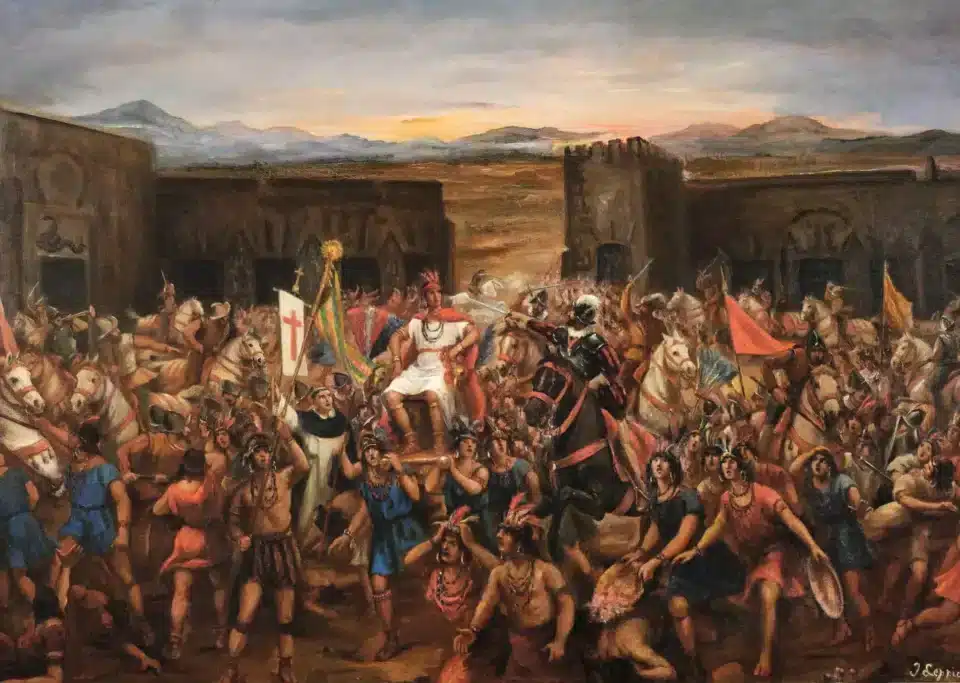
In the middle of the 16th century, when the authorities of the Catholic monarchy sought to consolidate their dominion over the vast and diverse Mesoamerican territory, a strong resistance arose from the mountainous regions of the west. The Mixtón War, between 1540 and 1542, was much more than a localized rebellion: it represented a forceful response to the violent advance, exploitation and imposition of a new politico-religious structure on the indigenous peoples who inhabited what are now parts of Jalisco, Zacatecas and Nayarit.
This episode not only revealed the deep tensions between viceregal expansion strategies and indigenous socio-political dynamics, but also the capacity for organization, leadership and resistance of the native peoples in the face of a system that sought to radically transform their lives and territory.
The origin of the conflict
The root of this conflict lies in the military entry led by Nuño de Guzmán into the region known as Nueva Galicia, where brutal campaigns were carried out against the local peoples. His government, characterized by violence and abuses, left a deep mark of resentment. Years later, despite Guzmán’s dismissal, the situation did not improve: encomenderos and officials continued with abusive practices that included the dispossession of land, the demand for tribute and the imposition of forced labor systems.
The Caxcanes, Zacatecos, Tecuexes and other affected groups began to organize. In particular, the Caxcanes played a leading role in establishing alliances between different communities and coordinating a defense that would be, in many ways, offensive.
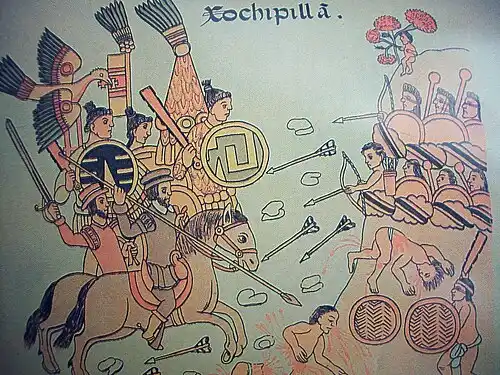
Rebellion breaks out
The uprising began in 1540. Viceregal authorities underestimated the power of the rebels, who achieved important initial victories. Several Spanish settlements and their indigenous allies were attacked and, in some cases, destroyed. Trade routes were interrupted and a real fear was generated about the loss of control in the region.
The rebellion was so significant that the viceroy himself, Antonio de Mendoza, decided to lead a campaign to put it down. This mobilization included thousands of soldiers, both peninsulars and indigenous allies from Tlaxcala and other regions already integrated into the viceregal system.
The Mixtón Hill
The symbolic and strategic heart of the resistance was the Mixtón hill, a natural fortress where the rebels took refuge and resisted attacks for weeks. From there, they repelled several offensives until, finally, the viceregal forces managed to take it in 1542.
The fall of the hill did not mean total subjugation. Many rebels managed to escape and others took refuge in more inaccessible areas. However, it marked the end of the most active stage of the conflict and consolidated the viceregal victory over the region of Nueva Galicia.
Consequences and memory
After the conflict, more complex strategies were implemented to control the region. New settlements were established, the ecclesiastical presence was reinforced and reduction mechanisms were used to reorganize the indigenous peoples into new settlements under religious and political surveillance.
In spite of this, the Mixtón war was recorded as an example of collective resistance, led by peoples who did not passively accept the advance of a power structure that denied their ways of life, beliefs and territories.
Conclusion on the Mixton War
The Mixtón war was not an isolated event or a simple revolt. It was the manifestation of a profound struggle for land, autonomy and dignity. Through it, the peoples of western Mesoamerica showed their capacity for articulation and their decision not to give in without a fight in the face of the viceroyalty’s advance. Although the final victory belonged to the Novo-Hispanic authorities, this episode continues to remind us that the history of viceregal expansion in the north was not an easy or unilateral path, but a complex web of resistance, alliances, violence and survival.