
With the arrival of Christianity in the Americas, the ancient Mesoamerican ceremonies dedicated to the dead encountered a new religious calendar. In medieval Europe, the Church had already defined specific dates to honor the saints and the souls in the afterlife, but these commemorations arose centuries earlier, in the heart of Rome.
During the 8th century, Pope Gregory III (731-741) decided to institute a special feast in honor of all the saints and martyrs, given the impossibility of commemorating each one on a different date. The celebration was set for November 1, when a chapel was consecrated in St. Peter’s Basilica dedicated “to all the saints”. The aim was to unify the cult of the Christian martyrs and to strengthen devotion in an era marked by wars, plagues and massive conversions to Christianity in Europe.
A century later, Pope Gregory IV (827-844) officially extended this feast to all of Christianity. Shortly thereafter, November 2 was added as the Day of the Faithful Departed, to pray not only for the already glorified saints, but also for the souls who were still purging their sins before reaching heaven. Thus, the Catholic calendar was divided between the celebration of the saints and the intercession for the common dead, creating a spiritual framework that united hope in eternal life with compassion for those who had departed.
When the missionaries brought these festivities to New Spain, they sought to replace the ancient indigenous cults of the deceased with them. However, instead of disappearing, these beliefs were transformed. The result was a new, profoundly mestizo tradition: the Days of the Dead, where indigenous memory and Catholic devotion coexisted on the same altar.
Evangelization and the feasts of the Catholic calendar
During the first years of the viceroyalty, the religious orders – Franciscans, Dominicans and Augustinians – promoted a vast evangelization process. In this effort, the friars taught the Catholic liturgical calendar, in which November was dedicated to remembering the saints and the souls in purgatory.
The intention was to Christianize the old indigenous ceremonies of the dead, integrating them to the new dates: November 1 for children and November 2 for adults, a division that curiously coincided with the Mexica festivities of Miccailhuitontli (the small dead) and Huey Miccailhuitl (the great dead).
In this way, the European ritual cycle was intertwined with the indigenous cosmovision, creating a symbolic bridge between the Christian sky and the Mesoamerican Mictlan.
Indigenous adaptation and symbolic continuity
Despite efforts to eradicate ancient funeral rites, indigenous communities reinterpreted Christian teachings from their own worldview. From the early years of the viceroyalty, ecclesiastical authorities issued ordinances against “idolaters” and organized campaigns to extirpate idolatry, especially during the 16th and 17th centuries. These actions – documented by chroniclers such as Fray Toribio de Benavente “Motolinía” and Fray Juan de Torquemada – consisted of inspections of temples and houses to destroy idols, tombs and objects of pre-Hispanic worship, considered “diabolical superstitions”.
However, popular faith was stronger than the prohibition. The communities, far from abandoning their beliefs, adapted them to the new Christian framework.
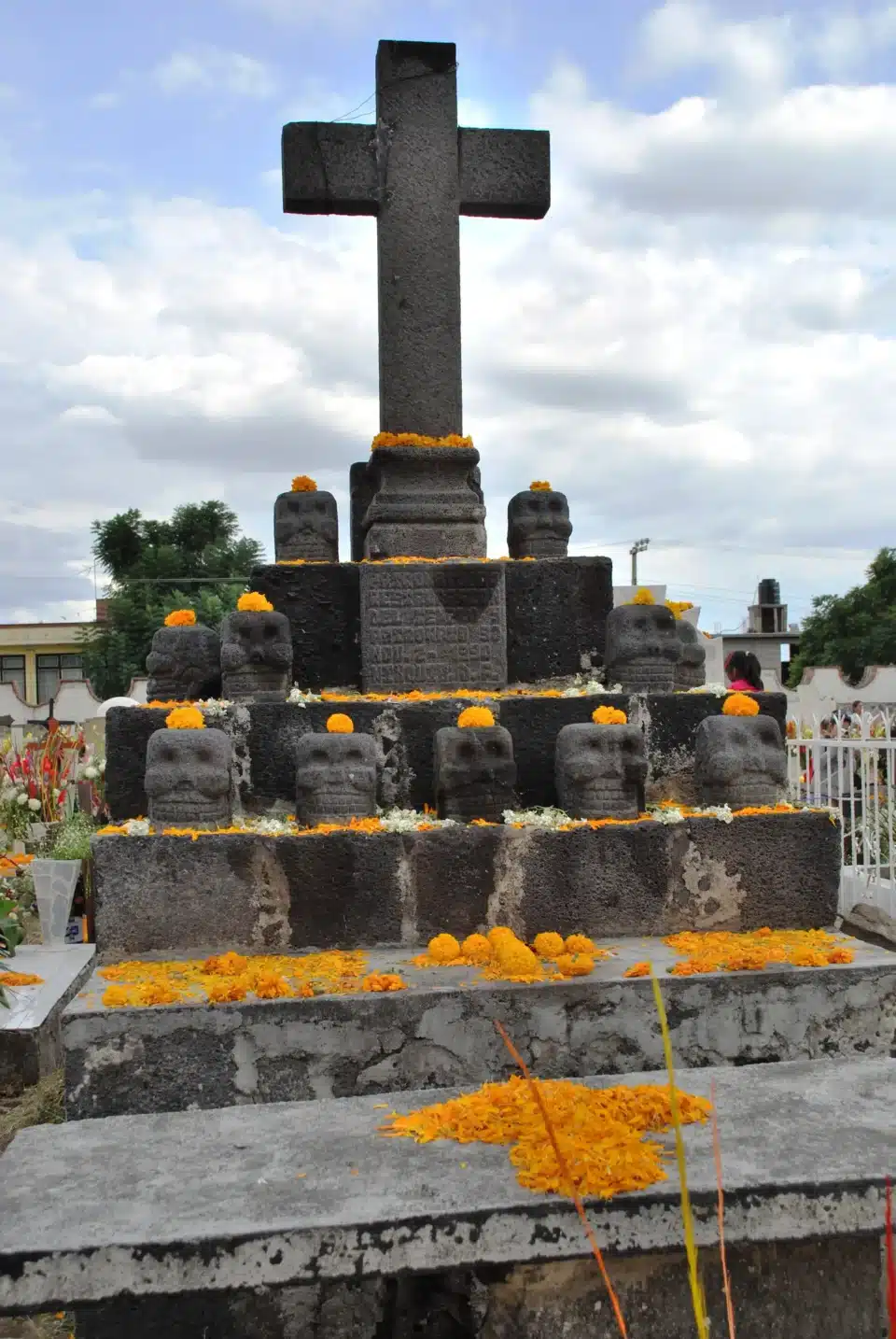
In November celebrations, masses, processions and prayers were mixed with offerings of food, flowers and copal, elements that evoked the ancient tributes to ancestors. Families went to the cemeteries to accompany the souls with food and music, and in many rural regions they placed mats, candles, flowers and bread figures in the atrium of the churches, in continuity with Mesoamerican rites.
According to studies by INAH and historian Johanna Broda, these practices show the survival of the cult of the indigenous dead within a Catholic context, reinterpreted as a prayer for the souls in purgatory.
The friars -mainly Franciscans, Dominicans and Augustinians- adopted a more pedagogical than repressive posture. They understood that prohibiting all indigenous elements would make conversion impossible, so they tolerated offerings and floral decorations, as long as they were addressed to saints or virgins. This tolerance allowed the emergence of a religious syncretism: the souls of the Christian purgatory merged with the spirits of the Mesoamerican Mictlan.
Domestic altars with images of saints and virgins began to appear in New Spain’s homes, a practice of European origin that the indigenous people transformed by incorporating their own elements. In the Iberian Peninsula, altars were centered on devotion to Christ or the Virgin, adorned with candles, rosaries and relics. On the other hand, in the indigenous houses of New Spain, corn, fruits, flowers, copal and water were added, symbols of fertility and spiritual transit. Thus, the Novo-Hispanic altars united the European Catholic format with the Mesoamerican symbolic content.
Another distinctive element was the introduction of skulls and skulls as symbolic ornaments, whose remote roots are linked to the Arab influence in the Iberian Peninsula. During centuries of Muslim presence in Spain, the Arabs spread the use of sugar and the custom of elaborating sweet figures in human or animal form, used in religious celebrations as a reminder of the transience of life. These traditions, inherited from Spanish convent pastries, were brought to New Spain by the missionaries. When they encountered indigenous representations of death – such as Mictlantecuhtli, tzompantli and stone skulls – a new mestizo aesthetic emerged: sugar skulls, a symbol of the dialogue between two visions of the afterlife that would eventually inspire the popular catrinas of modern Mexico.
In this complex cultural framework, indigenous communities preserved the essence of their ancient relationship with the dead, but under new names and meanings. Thus arose the novo-Hispanic religious syncretism, where the soul of the Christian deceased and the ancestral indigenous spirit coexisted in the same celebration, expressed both in churches and in homes.
The birth of syncretism: from Mictlán to purgatory
The Church taught that souls passed through purgatory before reaching heaven. The Indians, on the other hand, believed in a spiritual journey through different levels until reaching Mictlán.
Both visions shared the idea of a post-death transit, so they merged naturally. Prayers for the souls became a Christianized form of the ancient funeral tributes.
In convents and parishes, the friars organized “novenas de ánimas”, masses and religious representations, while in indigenous homes the custom of preparing family offerings was kept alive. This dialogue between European faith and Mesoamerican spirituality gave rise to a unique tradition: the Days of the Dead, direct predecessors of today’s Day of the Dead.
Conclusion
The Days of the Dead in New Spain were the meeting point between two worlds: European Catholicism and Mesoamerican beliefs about death.
From the devotion to purgatory and the veneration of saints was born a hybrid celebration that kept alive the memory of ancestors.
Centuries later, when the Mexican State reinterpreted it as a symbol of identity, this spiritual fusion was consolidated into what we know today as Day of the Dead: a tradition that continues to unite the sacred and the human, the ancient and the modern.
We invite you to explore these articles about the Day of the Dead and discover its history in detail.
-

The Mesoamerican origin of the cult of the dead: predecessor of the Day of the Dead
Long before the Day of the Dead was celebrated, Mesoamerican cultures paid tribute to their dead on different dates of the ritual calendar. This cult of…
-
From evangelization to syncretism: the Days of the Souls in New Spain (predecessor of the modern Day of the Dead)
The Days of the Dead in New Spain were the result of the encounter between indigenous beliefs about death and the Catholic festivities instituted by Popes…
-
Day of the Dead altars and ofrendas: symbols of the reunion between the living and the dead
The Day of the Dead altars were born during the viceregal era as an adaptation of the indigenous offerings to the Catholic calendar. In them, the…
-
Lázaro Cárdenas and the transformation of the Day of the Dead: from the Days of the Dead to the Mexican national symbol.
The Days of the Souls, inherited from the Viceroyalty, survived wars and prohibitions until it was transformed into the modern Day of the Dead. Under the…
-
The Meaning of the Day of the Dead: Identity, Memory and Continuity
The Day of the Dead not only honors those who have passed away; it also affirms who we are. Among flowers, altars and memories, this tradition…
-
The Day of the Dead in post-revolutionary art and education
Post-revolutionary Mexico used art and education to build its identity. From Rivera's murals to the school offerings promoted by Cárdenas, the Day of the Dead became…
-
Top 20 curiosities and historical details of the Day of the Dead that you may not have known.
From Mictecacíhuatl to La Catrina, learn 20 historical curiosities about the Day of the Dead and discover how this celebration became a symbol of Mexican identity.
-
Regional Day of the Dead Celebrations: from Patzcuaro to Mixquic, the diversity of the tradition
From Patzcuaro to Yucatan, Day of the Dead celebrations reveal Mexico's cultural diversity. Each region preserves unique rituals - the Mixquic alumbrada, the Mayan Hanal Pixán…

Frequently Asked Questions about the Days of the Dead in New Spain
Who instituted the feasts of All Saints and All Souls’ Day?
Pope Gregory III established the feast of All Saints in Rome on November 1, around the year 731, by consecrating a chapel in St. Peter’s Basilica dedicated “to all the saints and martyrs”. A century later, Gregory IV extended this feast to all of Christianity and added November 2 as All Souls’ Day, to pray for the souls in purgatory.
How did these celebrations arrive in New Spain?
The missionary friars brought with them the Catholic liturgical calendar and adapted the November dates to evangelize the indigenous peoples. These festivities partially replaced the ancient Mesoamerican ceremonies dedicated to the dead, giving rise to the Days of the Dead, where Christian prayers and traditional offerings coexisted.
What efforts did the Church make to eliminate indigenous rites?
During the XVI and XVII centuries, campaigns of extirpation of idolatries were carried out, directed by friars and bishops. Idols, temples and tombs considered pagan were destroyed. However, the indigenous communities preserved many of their symbols, adapting them to the new Catholic practices.
Which religious orders participated in the evangelization?
The Franciscans, Dominicans and Augustinians led the evangelization in New Spain. Although some adopted rigid postures, others understood that it was necessary to allow certain indigenous customs, such as the use of flowers, copal and food in offerings, to facilitate conversion.
Why are skulls associated with the Day of the Dead?
The use of decorative skulls has mixed roots. On the one hand, Mesoamerican peoples already represented skulls in temples and tzompantlis; on the other hand, the Arabs introduced the use of sugar and the custom of elaborating sweet figures in human form to the Iberian Peninsula (now Spain) as a symbol of the transience of life. The missionaries took this practice to America, where it merged with indigenous traditions, giving rise to the sugar skulls.
Why are the Days of Souls considered the predecessor of the Day of the Dead?
Because it was the first time that Catholic dates and indigenous customs coincided in the same commemoration. On the Days of the Dead, families prayed for the souls in purgatory, but also offered food, copal and flowers to their deceased. This spiritual fusion gave rise to the mestizo celebration that, centuries later, would be known as Day of the Dead.
–