Long before the Day of the Dead as we know it today, the peoples of Mesoamerica already held ceremonies dedicated to honoring their dead. This cult of the dead was not celebrated on a single date nor did it have a national meaning, but was part of a profound vision of the universe, where life and death were two inseparable planes of the same cycle.
The Mexica, Zapotec, Maya and Purepecha shared the idea that death was not an end, but a transformation. For this reason, funeral rituals, offerings and burials with personal objects sought to accompany the deceased on their journey to the afterlife.
The spiritual meaning of death in Mesoamerica
In the Mesoamerican cosmovision, death did not represent punishment or loss, but a transit to another plane of existence. Each person, according to his or her way of dying, went to different sacred places.
Among the Mexica, the most common destination after death was Mictlán, the vast underworld ruled by Mictlantecuhtli and Mictecacíhuatl, where the soul had to pass through nine levels to reach final rest. This journey could last four years and required the help of a xoloitzcuintle dog, a spiritual guide that led the deceased through the obstacles along the way.
The nine levels, described in sources such as the Florentine Codex and corroborated by research by the National Institute of Anthropology and History (INAH), represented physical and spiritual tests that the soul had to overcome:
- Apanohuacalhuia – the river to be crossed with the help of the xoloitzcuintle.
- Tepetl Monamictlan – the mountains that collide with each other.
- Itztépetl – the obsidian hill that cut as it passed.
- Cehuecayan – the place of the icy winds that lift knives.
- Pancuetlacaloyan – where souls were flipped through the air.
- Temiminaloyan – the field where invisible arrows attacked.
- Teyollocualoyan – the place where the beasts devoured the heart of the deceased.
- Apanohualoyan – the black waters where the soul had to float between currents.
- Chicunamictlán – the place of rest, where the soul finally found eternal peace.
In contrast, warriors fallen in battle, women who died in childbirth and people sacrificed in honor of the gods reached luminous destinations, such as Tonatiuhichan, the house of the Sun. This diversity of paths reveals that death, for Mesoamerican peoples, was a journey of transformation, intimately linked to cosmic balance and the continuity of life.
Ceremonies and times of the cult of the dead
Mesoamerican peoples celebrated feasts dedicated to the dead at different times of the year, depending on their agricultural and ritual calendar.
During these festivities, the communities prepared ritual spaces for offerings, equivalent to what we would call altars today, although their form and meaning were different from those of today. Flowers, food, copal and symbolic figures made of amate paper, made from tree bark, were placed on them. These figures represented gods or the deceased and were offered to the fire or the earth as a means of communication with the spiritual world.
Sources such as the Florentine Codex and the chronicles of Fray Bernardino de Sahagún and Fray Diego Durán describe these rituals in detail, while research by the National Institute of Anthropology and History (INAH), especially those of Eduardo Matos Moctezuma and Johanna Broda, confirm the presence of offerings deposited in altars and ceremonial boxes in archaeological contexts such as the Templo Mayor. These ceremonies, dedicated to the small dead (Miccailhuitontli) and to adults (Huey Miccailhuitl), were the true predecessors of the Day of the Dead, although they were performed on different dates and with a deep religious meaning linked to the cycle of life and fertility.
The funerary cult in everyday life
Respect for the dead was also reflected in daily life. Houses contained family heirlooms and the remains of ancestors, and cemeteries were considered sacred places where the forces of the earth dwelled. In many villages, graves were aligned with the cycles of the sun and harvests, reinforcing the idea that death nourished life.
In Mesoamerican iconography, the duality between day and night, the corn that dies and is reborn, or the skulls that sprout from flowers, were constant symbols of the balance between destruction and regeneration.
The use of cempasúchil in the pre-Hispanic world
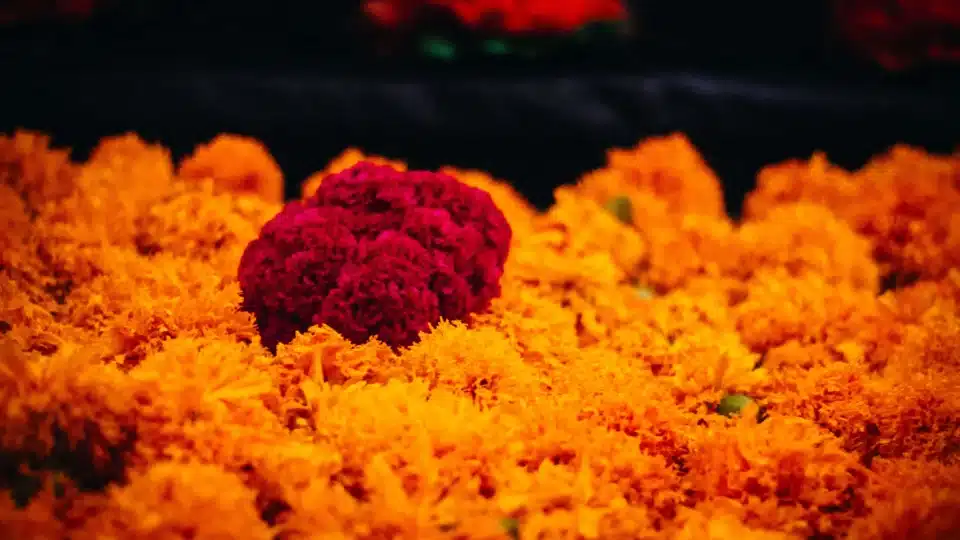
The cempasúchil, whose name comes from the Nahuatl cempōhualxōchitl (“flower of twenty petals”), is mentioned in sources such as the Florentine Codex and in the botanical studies of Fray Bernardino de Sahagún. He describes that it was a flower dedicated to the Sun and used in rituals related to death and fertility.
The Mexica and other peoples of the Central Highlands used it for:
- Decorate funerary offerings and temples.
- Honor the dead children and adults during the festivities of Miccailhuitontli and Huey Miccailhuitl.
- To spiritually guide the souls, since its golden color symbolized the sunlight that helped the deceased to find their way to the Mictlan.
There is no evidence of petal trails like today’s, but there is evidence of bouquets, garlands and floral arrangements used in altars, tombs and processions.
INAH researchers, such as Johanna Broda and Eduardo Matos Moctezuma, confirm that the cempasúchil was part of the agricultural and funerary offerings in Mexica contexts, due to its association with the Sun, corn and the life cycle.
An antecedent, not a modern holiday
Although these practices are similar to the current celebration, we cannot speak of a Day of the Dead in the modern sense. Mesoamerican communities did not mark a single day to remember the dead, but maintained a continuous relationship with the world of the dead through agricultural rituals, family offerings and community festivals.
With the arrival of the Europeans and the introduction of the Catholic calendar, many of these customs were integrated into the dates of All Saints and All Souls, giving rise centuries later to the tradition known today as Day of the Dead.
Conclusion
Today’s Day of the Dead is the living legacy of those ancient Mesoamerican cults to the dead, as well as of the religious practices developed during the viceroyalty. Although its name and modern form emerged much later, the original spirit – to remember, thank and keep in mind those who have passed away – remains the same. Each altar erected in November is, at heart, a continuity of the ancestral rites that celebrated life through death.
We invite you to explore these articles about the Day of the Dead and discover its history in detail.
-

The Mesoamerican origin of the cult of the dead: predecessor of the Day of the Dead
Long before the Day of the Dead was celebrated, Mesoamerican cultures paid tribute to their dead on different dates of the ritual calendar. This cult of…
-
From evangelization to syncretism: the Days of the Souls in New Spain (predecessor of the modern Day of the Dead)
The Days of the Dead in New Spain were the result of the encounter between indigenous beliefs about death and the Catholic festivities instituted by Popes…
-
Day of the Dead altars and ofrendas: symbols of the reunion between the living and the dead
The Day of the Dead altars were born during the viceregal era as an adaptation of the indigenous offerings to the Catholic calendar. In them, the…
-
Lázaro Cárdenas and the transformation of the Day of the Dead: from the Days of the Dead to the Mexican national symbol.
The Days of the Souls, inherited from the Viceroyalty, survived wars and prohibitions until it was transformed into the modern Day of the Dead. Under the…
-
The Meaning of the Day of the Dead: Identity, Memory and Continuity
The Day of the Dead not only honors those who have passed away; it also affirms who we are. Among flowers, altars and memories, this tradition…
-
The Day of the Dead in post-revolutionary art and education
Post-revolutionary Mexico used art and education to build its identity. From Rivera's murals to the school offerings promoted by Cárdenas, the Day of the Dead became…
-
Top 20 curiosities and historical details of the Day of the Dead that you may not have known.
From Mictecacíhuatl to La Catrina, learn 20 historical curiosities about the Day of the Dead and discover how this celebration became a symbol of Mexican identity.
-
Regional Day of the Dead Celebrations: from Patzcuaro to Mixquic, the diversity of the tradition
From Patzcuaro to Yucatan, Day of the Dead celebrations reveal Mexico's cultural diversity. Each region preserves unique rituals - the Mixquic alumbrada, the Mayan Hanal Pixán…

Frequently Asked Questions about the Mesoamerican origin of the Day of the Dead
Which peoples celebrated the dead in pre-Hispanic times?
Mainly the Mexica, Maya, Zapotec and Purepecha, although each culture had its own way of paying homage to the deceased. In all of them, death was conceived as a process of spiritual transformation and not as an end.
What were the nine levels of Mictlán?
Mictlán was the Mexica underworld, ruled by Mictlantecuhtli and Mictecacíhuatl. The soul had to pass through nine levels full of trials – rivers, mountains, winds, arrows and beasts – before reaching eternal rest. This journey represented the purification of the spirit.
Were there altars in the pre-Hispanic world?
Yes, although they were not the same as the altars of the Day of the Dead today. They were ritual spaces for offerings, where flowers, food, copal and figures made of amate paper were placed. These represented the gods or the deceased and were offered to the fire or to the earth.
Where does all this come from?
The main sources are the Florentine Codex, the chronicles of Fray Bernardino de Sahagún and Fray Diego Durán, and the archaeological findings documented by the National Institute of Anthropology and History (INAH). Researchers such as Eduardo Matos Moctezuma and Johanna Broda have confirmed the existence of offerings and ritual figures in funerary contexts.
What is the relationship between these rituals and today’s Day of the Dead?
The ancient Mesoamerican ceremonies were the symbolic basis of the modern tradition. Over time, they were mixed with the Catholic celebrations of All Saints and All Souls during the viceroyalty, giving rise to the mestizo Day of the Dead that we know today.
–