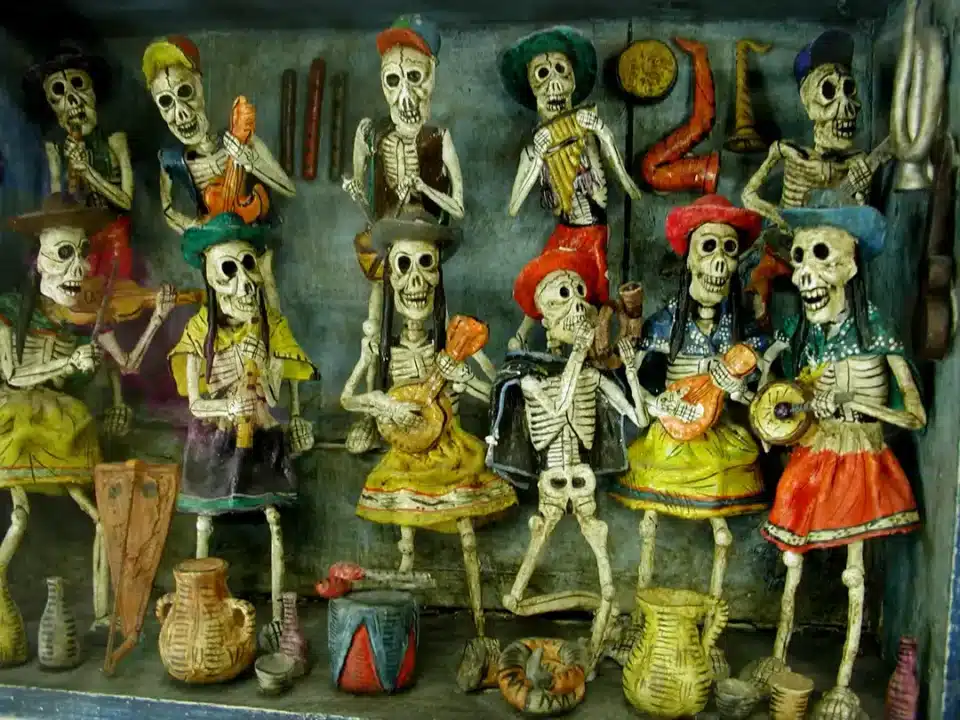
The history of the Day of the Dead cannot be understood without its passage through the 20th century. What for centuries was a religious commemoration -the Days of the Souls inherited from the viceroyalty- was transformed into a national festivity that today identifies Mexico throughout the world. This metamorphosis did not occur spontaneously: it was the result of a cultural and political process that culminated during the government of Lázaro Cárdenas del Río, when the Mexican State promoted the recovery of popular traditions to build a mestizo national identity.
From the novo-Hispanic cult to the popular tradition
During the 18th and 19th centuries, All Souls’ Days continued to be celebrated both in temples and homes. Families placed offerings, went to cemeteries and prayed for the souls in purgatory. In the countryside, indigenous communities preserved the symbolic elements of the Mesoamerican past – flowers, food and copal – while in the cities the festivity took on a more discreet and domestic tone.
However, the wars of the 19th century – Independence, French intervention and the Reformation – weakened public celebrations. The political changes and liberal policies of the century of the Reform Laws reduced the influence of the Church, which caused many religious festivities to move to the family sphere.
The Impact of the Revolution and the Cristero War
At the beginning of the 20th century, the Mexican Revolution and, later, the Cristero War (1926-1929) interrupted religious celebrations once again. In many regions, processions were prohibited and masses restricted. Offerings survived in rural homes and among indigenous communities, where family memory remained the center of the celebration.
After the conflict, the country needed to rebuild not only its economy, but also its cultural identity. It was in this context that Lázaro Cárdenas understood the unifying potential of popular traditions, including the Day of the Dead.
Lázaro Cárdenas and the nationalization of popular traditions
During his government (1934-1940), Cárdenas promoted a people-oriented cultural policy, inspired by the ideals of the Revolution. Through the Secretariat of Public Education (SEP) and the Department of Fine Arts, fairs, exhibitions and contests were organized to recover regional customs considered “authentically Mexican”.
The Day of the Dead was one of the most promoted celebrations. In rural schools, teachers instructed students to prepare ofrendas with local materials: papel picado, flowers, bread, fruit and portraits of family members. In the cities, exhibitions and festivals were organized where altars became artistic expressions.
Cárdenas’ project sought to strengthen the mestizo identity: to unite indigenous roots with the popular values of modern Mexico. In this way, a religious tradition was transformed into a cultural and educational symbol. The altar ceased to be a purely devotional act and became a representation of the country’s history and diversity.
In the words of historian Ricardo Pérez Montfort, the Cardenista State “vindicated the customs of the people as the foundation of the modern nation”, and the Day of the Dead became the perfect example of this synthesis between past and present.
From the classroom to the mural: art and national identity
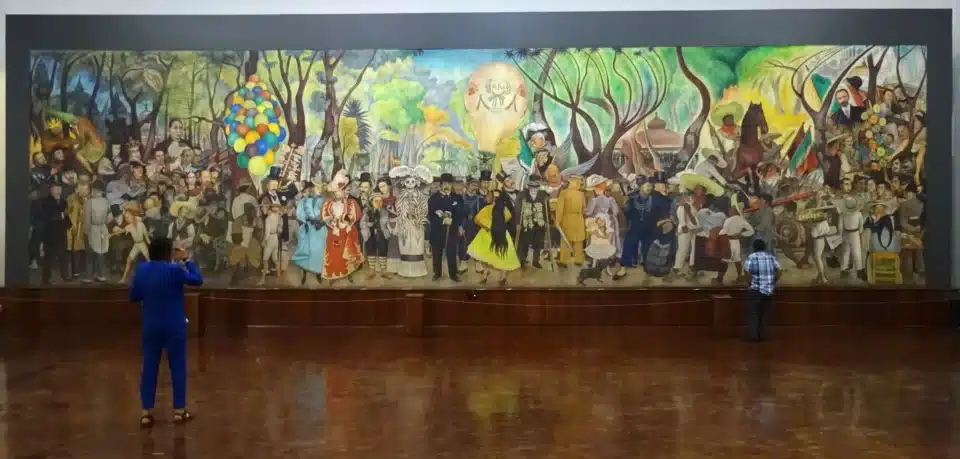
The 1930s were also the era of Mexican muralism, a movement that, under the support of the government, exalted popular culture. Artists such as Diego Rivera, Frida Kahlo, Jean Charlot and Dr. Atl incorporated skulls, catrinas, flowers and symbols of death in their work, reinterpreting the traditional elements of the altar within a nationalist narrative.
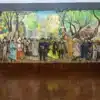
Rivera, in his mural “Sueño de una tarde dominical en la Alameda Central” (1947), placed La Catrina in the center, taken from José Guadalupe Posada’s engraving, as a figure that synthesized humor, art and identity. Death no longer represented the end, but the permanence of the Mexican people.
From tradition to national identity
Over the decades, cultural institutions continued Carden’s project. In the 1950s and 1960s, the Casa del Lago, the National Museum of Popular Cultures and rural teacher training schools promoted exhibitions and altar contests. In 2003, UNESCO declared the Day of the Dead as Intangible Cultural Heritage of Humanity, formally recognizing a tradition that was born in homes and transformed by the action of the State.
Today, the Day of the Dead combines the intimate and the public, the religious and the artistic. Its history shows how a local celebration, forged among prayers, flowers and copal, became a symbol of Mexican unity and identity.
Conclusion
From the devout remembrance of the Days of the Dead to the national pride of the Day of the Dead, the history of this festivity summarizes the cultural evolution of Mexico. What began as a religious rite ended up as a patriotic emblem.
Thanks to the vision of Lázaro Cárdenas and the strength of the communities that kept the tradition alive, the country found in death not a threat, but a way to recognize itself.
We invite you to explore these articles about the Day of the Dead and discover its history in detail.
-

The Mesoamerican origin of the cult of the dead: predecessor of the Day of the Dead
Long before the Day of the Dead was celebrated, Mesoamerican cultures paid tribute to their dead on different dates of the ritual calendar. This cult of…
-
From evangelization to syncretism: the Days of the Souls in New Spain (predecessor of the modern Day of the Dead)
The Days of the Dead in New Spain were the result of the encounter between indigenous beliefs about death and the Catholic festivities instituted by Popes…
-
Day of the Dead altars and ofrendas: symbols of the reunion between the living and the dead
The Day of the Dead altars were born during the viceregal era as an adaptation of the indigenous offerings to the Catholic calendar. In them, the…
-
Lázaro Cárdenas and the transformation of the Day of the Dead: from the Days of the Dead to the Mexican national symbol.
The Days of the Souls, inherited from the Viceroyalty, survived wars and prohibitions until it was transformed into the modern Day of the Dead. Under the…
-
The Meaning of the Day of the Dead: Identity, Memory and Continuity
The Day of the Dead not only honors those who have passed away; it also affirms who we are. Among flowers, altars and memories, this tradition…
-
The Day of the Dead in post-revolutionary art and education
Post-revolutionary Mexico used art and education to build its identity. From Rivera's murals to the school offerings promoted by Cárdenas, the Day of the Dead became…
-
Top 20 curiosities and historical details of the Day of the Dead that you may not have known.
From Mictecacíhuatl to La Catrina, learn 20 historical curiosities about the Day of the Dead and discover how this celebration became a symbol of Mexican identity.
-
Regional Day of the Dead Celebrations: from Patzcuaro to Mixquic, the diversity of the tradition
From Patzcuaro to Yucatan, Day of the Dead celebrations reveal Mexico's cultural diversity. Each region preserves unique rituals - the Mixquic alumbrada, the Mayan Hanal Pixán…


Frequently Asked Questions about the Days of Souls and its transformation into the Day of the Dead
What were the Days of Souls?
These were religious celebrations dedicated to the souls in purgatory, inherited from the Catholic tradition of the viceroyalty. Families prayed and placed domestic offerings for their deceased.
Why did its practice decline during the 20th century?
Civil wars, especially the Revolution and the Cristero War, weakened religious festivities. In many regions, processions were prohibited and celebrations were kept only in the family sphere.
What role did Lázaro Cárdenas play in the Day of the Dead?
He promoted the recovery of popular traditions through the SEP and the Department of Fine Arts. He promoted altars in schools, fairs and public spaces, transforming the celebration into a national symbol.
Why was the government interested in promoting these traditions?
Carden’s project sought to build a mestizo national identity, integrating indigenous roots and popular spirit. The Day of the Dead became an example of union between people, art and nation.
When was the Day of the Dead officially recognized as cultural heritage?
In 2003, UNESCO declared it Intangible Cultural Heritage of Humanity, highlighting its value as a living expression of Mexico’s collective memory.
–